Hundreds of inmates flee after armed gangs storm Haiti’s main prison, leaving bodies behind

1 / 5
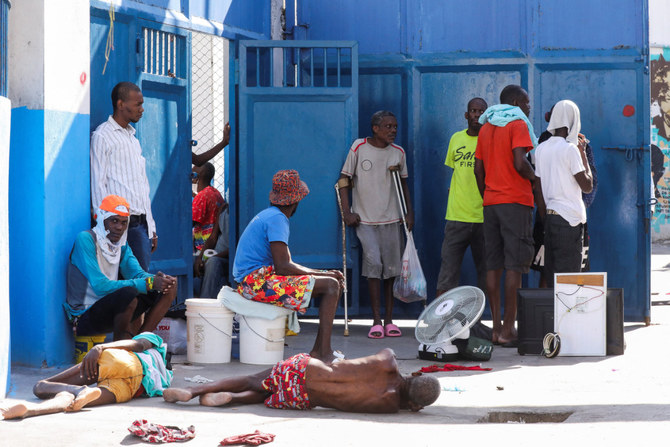
An inmate helps another prisoner inside the National Penitentiary in Port-au-Prince, Haiti, on March 3, 2024, after an overnight attack by armed gangs. (AP)
2 / 5
3 / 5
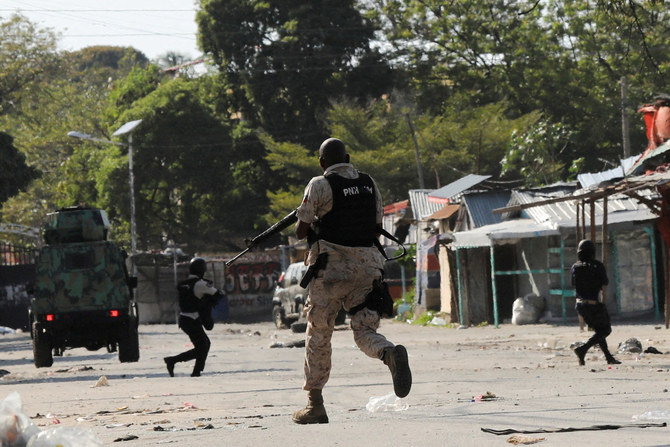
Police officers battle gangsters trying to take control of Haiti on March 1, 2024. (REUTERS)
4 / 5
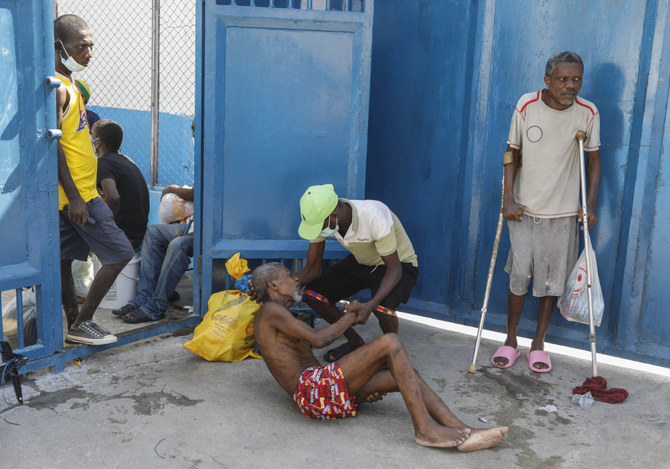
An inmate helps another prisoner inside the National Penitentiary in Port-au-Prince, Haiti, on March 3, 2024, after an overnight attack by armed gangs. (AP)
5 / 5
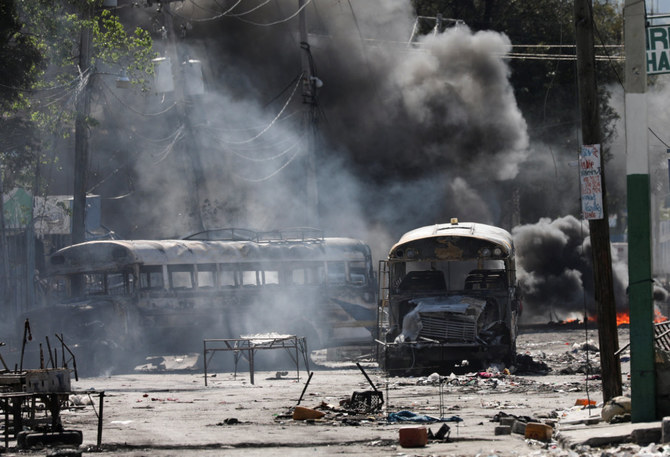
A view shows vehicles damaged by fire during a protest in Port-au-Prince, Haiti, on March 1, 2024, against Prime Minister Ariel Henry's government and insecurity. (REUTERS)
Short Url
Updated 04 March 2024
Follow

Hundreds of inmates flee after armed gangs storm Haiti’s main prison, leaving bodies behind

  • Armed gangs attacked the prison facility on Saturday while Haiti's PM is abroad trying to salvage support for a United Nations-backed security force to stabilize the troubled Carribean country

PORT-AU-PRINCE, Haiti: Hundreds of inmates fled Haiti’s main prison after armed gangs stormed the facility in an overnight explosion of violence that engulfed much of the capital. At least five people were dead Sunday.

The jailbreak marked a new low in Haiti’s downward spiral of violence and came as gangs step up coordinated attacks in Port-au-Prince, while embattled Prime Minister Ariel Henry is abroad trying to salvage support for a United Nations-backed security force to stabilize the country.


Haiti's Prime Minister Ariel Henry gives a public lecture at the United States International University (USIU) in Nairobi, Kenya, on March. 1, 2024, amid gang violence in his troubled Caribbean country. (AP)

Three bodies with gunshot wounds lay at the prison entrance, which was wide open, with no guards in sight. Plastic sandals, clothing and electric fans were strewn across normally overcrowded concrete patios that were eerily empty on Sunday. In another neighborhood, the bloodied corpses of two men with their hands tied behind their backs laid face down as residents walked past roadblocks set up with burning tires.
Haiti’s government urged calm as it sought to find the killers, kidnappers and perpetrators of other violent crimes that it said escaped during the outbreak of violence.
“The National Police is taking all measures to find the escaped prisoners and arrest those responsible for these criminal acts as well as all their accomplices so that public order can be restored,” the Communications Ministry said in a post on X, formerly Twitter.
Arnel Remy, a human rights attorney whose nonprofit works inside the prison, said on X that fewer than 100 of the nearly 4,000 inmates remained behind bars. Those choosing to stay included 18 former Colombian soldiers accused of working as mercenaries in the July 2021 assassination of Haitian President Jovenel Moïse. On Saturday night, several of the Colombians shared a video pleading for their lives.
“Please, please help us,” one of the men, Francisco Uribe, said in the message widely shared on social media. “They are massacring people indiscriminately inside the cells.”
On Sunday, Uribe told journalists who walked breezily into the normally highly guarded facility “I didn’t flee because I’m innocent.”


Colombian inmates accused in the assassination of Haitian President Jovenel Moise talk to journalists inside the National Penitentiary in Port-au-Prince, Haiti, on March 3, 2024. (AP)

In the absence of official information, inmates’ family members rushed to the prison to check on loved ones.
“I don’t know whether my son is alive or not,” said Alexandre Jean as she roamed around the cells looking for any sign of him. “I don’t know what to do.”
The violence Saturday night appeared to be widespread, with several neighborhoods reporting gunfire.
There were reports of a jailbreak at a second Port-au-Prince prison containing around 1,400 inmates. Armed gangs also occupied and vandalized the nation’s top soccer stadium, taking one employee hostage for hours, the nation’s soccer federation said in a statement. Internet service for many residents was down as Haiti’s top mobile network said a fiber optic cable connection was slashed during the rampage.
In the space of less than two weeks, several state institutions have been attacked by the gangs, who are increasingly coordinating their actions and choosing once unthinkable targets like the Central Bank. After gangs opened fire at Haiti’s international airport last week, the US Embassy said it was temporarily halting all official travel to the country. As part of coordinated attacks by gangs, four police officers were killed Thursday.
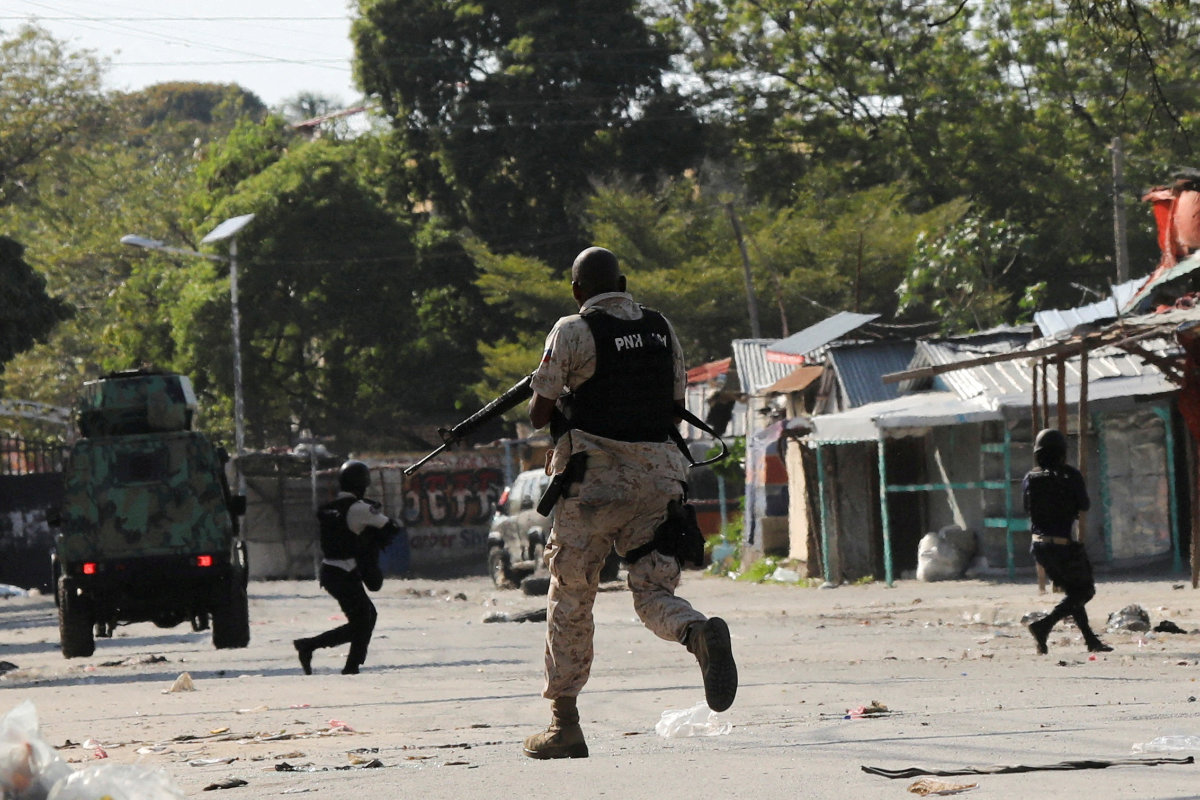


Police officers battle gangsters trying to take control of Haiti on March 1, 2024. (REUTERS)

The epicenter of the latest violence Saturday night was Haiti’s National Penitentiary, which is holding several gang leaders. Amid the exchange of gunfire, police appealed for assistance.
“They need help,” a union representing police said in a message on social media bearing an “SOS” emoji repeated eight times. “Let’s mobilize the army and the police to prevent the bandits from breaking into the prison.”
The clashes follow violent protests that turned deadlier in recent days as the prime minister went to Kenya to try and salvage a proposed UN-backed security mission in Haiti to be led by the East African country. Henry took over as prime minister following Moise’s assassination and has repeatedly postponed plans to hold parliamentary and presidential elections, which haven’t happened in almost a decade.
Haiti’s National Police has roughly 9,000 officers to provide security for more than 11 million people, according to the UN. They are routinely overwhelmed and outgunned by gangs, which are estimated to control up to 80 percent of Port-au-Prince.
Jimmy Chérizier, a former elite police officer known as Barbecue who now runs a gang federation, has claimed responsibility for the surge in attacks. He said the goal was to capture Haiti’s police chief and government ministers and prevent Henry’s return.
The prime minister, a neurosurgeon, has shrugged off calls for his resignation and didn’t comment when asked if he felt it was safe to come home.


Ahead of strikes, Trump was told Iran attack is high risk, high reward

Updated 6 sec ago
Follow

Ahead of strikes, Trump was told Iran attack is high risk, high reward

  • Experts caution that the unfolding conflict could take dangerous turns and the first official said ‌the Pentagon’s planning did not appear to guarantee the outcome of any conflict

WASHINGTON: Ahead of the US attack on Iran, President Donald Trump received briefings that not only delivered blunt assessments about the risk of major US casualties but also touted the prospect of a geopolitical shift in the Middle East in favor of US interests, ​a US official told Reuters. The launch of what the Pentagon called Operation Epic Fury on Saturday plunged the Middle East into a new and unpredictable conflict. The US and Israeli militaries struck sites across Iran, triggering retaliatory Iranian attacks against Israel and nearby Gulf Arab countries.
The official, who spoke on condition of anonymity, said the briefers described the operation to the president as a high-risk, high-reward scenario that could present a once-in-a-generation opportunity for change in the region.

HIGHLIGHTS

• Trump briefings included risks, opportunities in Middle East 

• Diplomatic efforts with Iran fail to avert ‌military confrontation 

• Iran vows retaliation, targets US and Israeli interests

Trump himself appeared to echo that sentiment when he acknowledged the stakes at the onset of the operation, saying “the lives of courageous American heroes may be lost.”
“But we’re doing this not for now, we’re doing this for the future, and it is a noble mission,” Trump said in a video address announcing the start of major combat operations.
“For 47 years, the Iranian regime has chanted death to America and waged an unending campaign of ‌bloodshed and mass murder ... We’re ‌not gonna put up with it any longer.”
The briefings from Trump’s national security team help explain ​how ‌the ⁠president decided ​to ⁠pursue arguably the riskiest US military operation since the invasion of Iraq in 2003.
Ahead of the strikes, Trump received multiple briefings from officials, including CIA Director John Ratcliffe, US General Dan Caine, the chairman of the Joint Chiefs of Staff, US Secretary of State Marco Rubio and Defense Secretary Pete Hegseth.
On Thursday, Admiral Brad Cooper, who leads US forces in the Middle East as the head of Central Command, flew to Washington to join discussions in the White House Situation Room.
A second US official said that before the strikes, the White House had been briefed on risks associated with operations against Iran, including retaliatory strikes on multiple US bases in the region by Iranian missiles that could overwhelm defenses, as well as Iranian proxies attacking US troops in Iraq and Syria.
The official said that despite the massive military ⁠buildup by the United States, there were limits to the air defense systems that had been rushed into ‌the region.
Experts caution that the unfolding conflict could take dangerous turns and the first official said ‌the Pentagon’s planning did not appear to guarantee the outcome of any conflict.
Trump called on Iranians ​to topple the government but that is easier said than done, said ‌Nicole Grajewski with the Carnegie Endowment for International Peace.
“The Iranian opposition is pretty fragmented. It’s unclear what the population is willing to do in ‌terms of rising up,” Grajewski said.
Both US officials requested anonymity due to the sensitivity of the internal discussions.
The White House did not immediately respond to requests for comment. The Pentagon declined to comment.

TRUMP’S SWEEPING GOALS

In the weeks leading up to the attack, Trump ordered a major military buildup in the Middle East. Reuters reported military planning to carry out a sustained campaign against Iran, if that is what the president chose. Plans included targeting individual officials, officials said.
An Israeli official said Iran’s Supreme Leader Ayatollah ‌Ali Khamenei and President Masoud Pezeshkian were both targeted but the result of the strikes was unclear. Speaking on Saturday, Israeli Prime Minister Benjamin Netanyahu said there were many signs indicating that Khamenei “is no longer” and ⁠called on Iranians to “take to the streets ⁠to finish the job.”
Trump made clear on Saturday that his objectives in Iran were sweeping, saying he would end the threat posed by Tehran to the United States and give Iranians a chance to topple their rulers. To accomplish this, he outlined plans to lay waste to much of Iran’s military as well as deny it the ability to build a nuclear weapon. Iran denies seeking a nuclear weapon.
“We are going to destroy their missiles and raze their missile industry to the ground... We’re going to annihilate their navy,” he said. “We’re going to ensure that the region’s terrorist proxies can no longer destabilize the region or the world and attack our forces.”
Trump’s decision demonstrates an increasing risk appetite, far greater than when he ordered US special operations forces into Venezuela last month to seize that country’s president in an audacious raid.
The unfolding campaign against Iran is also riskier than when Trump ordered US forces to bomb Iran’s nuclear sites in June.
Iran’s Revolutionary Guards threatened all US bases and interests in the region and said Iran’s retaliation would continue until “the enemy is decisively defeated.”
Experts warn that Iran has many options for retaliation, including missile strikes but also drones and cyber warfare.
Daniel Shapiro, a former senior ​Pentagon official for Middle East issues, said that despite the US ​and Israeli strikes, Tehran would still be capable of causing some pain.
“Iran has many more ballistic missiles that can reach US bases than the US has interceptors ... some Iranian weapons will get through,” said Shapiro, also a former US ambassador to Israel. “(The strikes are) a major gamble.”