

Saudi embassy, Pakistan join hands to provide Ramadan rations for the needy

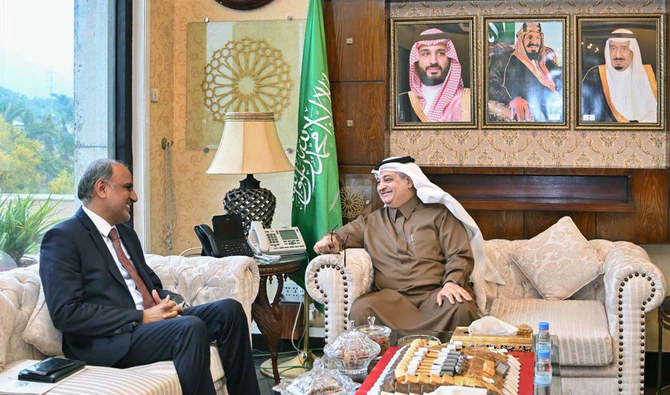
Managing Director of Pakistan Bait-ul-Mal, Syed Tariq Mahmood Al-Hassan (left), meeting with the Saudi Ambassador, Nawaf Al-Maliki at the Saudi Embassy in Islamabad, Pakistan on March 2, 2024. (APP)
Short Url
Updated 03 March 2024
Follow

Saudi embassy, Pakistan join hands to provide Ramadan rations for the needy

  • Saudi embassy to take responsibility for the care of 100 orphans from Pakistan Sweet Homes, says state media 
  • Saudi relief agencies have previously collaborated with Pakistan Bait-ul-Maal to provide help the needy

ISLAMABAD: The Saudi embassy and Pakistan Bait-ul-Maal (PBM) this week agreed to join hands to distribute ration bags among the needy during Ramadan and to care for 100 orphans across the country, state-run media reported. 

The agreement took place on Friday when PBM Managing Director Syed Tariq Mahmood Al-Hassan visited the Saudi embassy in Islamabad at the invitation of Saudi Arabia’s Ambassador to Pakistan, Nawaf bin Said Al-Malki. 

Saudi relief agencies and other social organizations from the Kingdom have previously collaborated with the PBM on numerous projects aimed at helping the needy and vulnerable individuals. 

“The Saudi Embassy on Friday agreed to collaborate with Pakistan Bait-ul-Mal (PBM) to distribute ration bags during Ramadan ul Mubarak and take responsibility for the care of 100 orphans supported by Pakistan Sweet Home,” the Associated Press of Pakistan (APP) said in a report. 

It added that Malki assured Hassan of further cooperation from the embassy in additional social projects in Pakistan. 

Hassan thanked Malki and recognized Saudi Arabia’s focus on global social sectors. 

“He highlighted the enduring support between the two brotherly nations during challenging periods, emphasizing Saudi Arabia’s continual prioritization of Pakistan’s economy and social well-being,” the APP said. 

Pakistan, ADB reaffirm commitment to ML-1 rail project amid economic reforms

Updated 6 sec ago
Follow

Pakistan, ADB reaffirm commitment to ML-1 rail project amid economic reforms

  • Flagship railway upgrade tied to IMF-backed stabilization, multilateral financing
  • ADB, World Bank working with Pakistan to address project delays, readiness gaps

ISLAMABAD: Pakistan and the Asian Development Bank (ADB) have reaffirmed their commitment to advancing the long-delayed Main Line-1 (ML-1) railway modernization project, a flagship infrastructure upgrade central to the country’s economic reform and connectivity agenda, the information ministry said on Thursday. 

The renewed focus on ML-1 follows meetings this week between senior Pakistani ministers and ADB officials in Islamabad, as the government seeks to revive large-scale infrastructure investment while maintaining fiscal discipline under an International Monetary Fund (IMF) program.

ML-1 is Pakistan Railways’ busiest north–south corridor, linking the southern port city of Karachi with major population and industrial centers in Punjab and Khyber Pakhtunkhwa. The project aims to modernize tracks, signaling and rolling stock to improve safety, cut travel times and lower transport costs. 

Originally envisioned as a flagship transport upgrade under the China-Pakistan Economic Corridor (CPEC), ML-1 has struggled to reach financial close amid cost concerns, debt sustainability debates and implementation challenges. Pakistan has since sought broader multilateral engagement, with institutions including the Asian Development Bank now playing a central role in project structuring, financing discussions and efforts to address execution bottlenecks.

During a meeting with Leah Gutierrez, Director General for Central and West Asia at the ADB, Federal Minister for Economic Affairs Ahad Cheema underscored the government’s reform priorities and the importance of the project’s timely execution.

“The Minister underscored the Government’s strong commitment to the timely implementation of the Main Line–1 (ML-1) railways project and emphasized that ADB’s continued support would be critical to achieving this milestone,” the information ministry said in a statement.

The ministry said Cheema also highlighted coordination with provincial governments and welcomed joint efforts by the ADB and the World Bank to identify implementation bottlenecks and improve project readiness to ensure timely disbursements.

Gutierrez commended Pakistan’s reform agenda and acknowledged the government’s focus on macroeconomic recovery and fiscal consolidation, reaffirming that ADB teams were working closely with Pakistani authorities on ML-1, according to the statement.

Separately, Federal Minister for Railways Muhammad Hanif Abbasi told Defense Secretary Lt. Gen. Muhammad Ali in a meeting that an agreement for the ML-1 project had been finalized with the ADB and that steps were being taken to move the project forward.

“Concrete steps are being taken to complete the project at the earliest,” the statement quoted Abbasi as telling Ali. “The ML-1 project will serve as a milestone in modernizing Pakistan Railways.”

Abbasi also briefed participants on parallel reform measures at Pakistan Railways, including the launch of an artificial intelligence-based monitoring system at Rawalpindi Railway Station, real-time tracking of trains and rolling stock through digital tagging, and the installation of a weigh bridge in Karachi to address overloading and improve safety.

Pakistan Railways has long struggled with aging infrastructure, safety challenges and financial losses, even as rail transport remains vital for passenger movement and freight. Multilateral lenders have repeatedly stressed the need for stronger execution capacity and governance reforms to translate infrastructure commitments into economic gains.