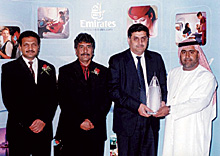
During this time of uncertainty in the Kingdom’s travel trade, Emirates held a gala awards night at Sunset Beach Resort to honor those who have supported the Saudi travel business and to give Eastern Province travel industry executives an opportunity to network in a conducive atmosphere. The highlight of the evening came when Saad Ullah Khan was presented with the Emirates Lifetime Achievement Award for his contributions to the development of the travel trade in the Eastern Province over the last 25 years.
This year the award gala was especially meaningful for Emirates because the airline was celebrating a decade of successful services between Dammam and Dubai.
“Commercial airlines have faced tough times for more than two years now,” said Afzal Azam Baig, Emirates’ sales manager, Eastern Province. “Although Emirates was affected along with other major airlines by adverse economic and political developments, we were able to meet the challenges and adapt to those changes. Our bold approach helped to overcome the negative effects of events such as SARS and the Iraq War on several of our destinations. As a result, in 2003 we were able again to reach our goals, and were one of the top five most profitable airlines in the world.”
Baig was very pleased that Khan had been selected for the Emirates Lifetime Achievement Award.
“Saad Ullah Khan has helped the Eastern Province travel industry grow and mature,” he said. “His contribution during the Gulf War was particularly impressive. Now he is using his talents to create training opportunities for young Saudis and to provide direction as the local travel trade makes the transition to an electronic business environment. He must be congratulated for his unstinting efforts over so many years.”
Khan himself was quite humble about winning the award. He felt that he had simply been part of excellent corporate teams over the years. He emphasized that in the travel trade information, relationships and resources must be combined with a focused work ethic and commitment for any travel company to succeed.
Khan came to the Kingdom in 1979, when he was hired to manage the travel requirements for a large Saudi company. Within six months, people from outside the company were clamoring to make use of the travel services Khan and his team had created. The reliance on in-house business began to decline considerably as Khan and his group looked outward. In about a year, the team’s in-house business made up less than five percent of their total business.
There were serious difficulties. The lack of infrastructure, training and automation all had to be overcome. Team members traveled up to 500 km daily to maintain customer contacts. The leisure travel business being handled by local travel firms was minimal. There were only a few desirable nearby destinations such as Egypt, Turkey and Greece.
“Our team at Najran Travel was breaking ground in a new business territory locally. The travel business in Saudi Arabia was quite behind the rest of the world at that time,” said Khan. “We quickly made a serious attempt to address customer needs and then attract potential travelers to our agency. We offered them reasonable choices and they were excited. From then on there was no looking back and the leisure travel sector began booming.”
The true test of the team’s abilities came during the Gulf War. While many travel companies pulled down their shutters and disappeared during this time of crisis, Khan’s team settled in for the duration.
“I learned a lot about human behavior during that difficult time,” Khan said. “Our team remained fully operational to support the community. Saudi airspace was closed for weeks. We made special arrangements with Gulf Air out of Bahrain to charter planes. We had flights every other night, sending passengers by bus across the King Fahd Causeway to catch the flights. We barely broke even cost wise, but that was fine. The community needed us and I am proud to say we did our part. The impact later was phenomenal. We got so much goodwill and so much business based on our wartime performance.”
In the 1990s the process of automation at the travel agency level, the bank settlement of airline payments and stronger regulations led to major changes in the Saudi travel trade. Business and cash management became a priority. Customer service was enhanced and customer requirements increased. Currently the Kingdom’s travel business is facing new challenges.
Khan is of the opinion that the Saudi travel industry must have a trade association to look at issues specific to the travel business. Such an association would help to effectively move the travel industry in new directions and would herald a new maturity in the local market. He also feels that the Saudization of the travel business must be approached rationally.
“Saudization is part of a natural process,” Khan said. “If you think of Saudization as something that can be solved with numbers and quotas it will not succeed. We need an effective Saudi work force. There is no denial of that. Most important is getting the right type of people with the right attitudes to take up responsibilities in the business world.
“Many travel agencies are facing difficulties in hiring Saudis due to the lack of viable candidates being developed. When I say this I am not coming to their defense. I am being realistic. Kanoo has invested a huge amount of time and resources in developing our Saudization program and we take pride in its success. Other companies don’t have such a resource. So proper training must become either a collective responsibility of the industry or government or both.”
Khan pointed out that right now a comprehensive training program targeting the local travel industry is unavailable. Kanoo Travel hopes to step forward with a solution.
“Right now at Kanoo we are making a push to set up something called the Travel Academy,” Khan said. “We think we will be able to develop a program to cover the travel industry’s needs. The Travel Academy would be able to take a class of 70-80 students per year. It would be a three-year degree program. We envision that students would pay for the training, as this would attract those who are serious and committed to working in the hospitality and travel trade. We think that the scope for such training is enormous as the Saudi travel industry already has the need for a lot of trained people. At Kanoo, as the largest travel company in the Middle East, I believe we have the responsibility to be a leader in this area.”