

Saudi academy signs deal with Thai university to promote language cooperation

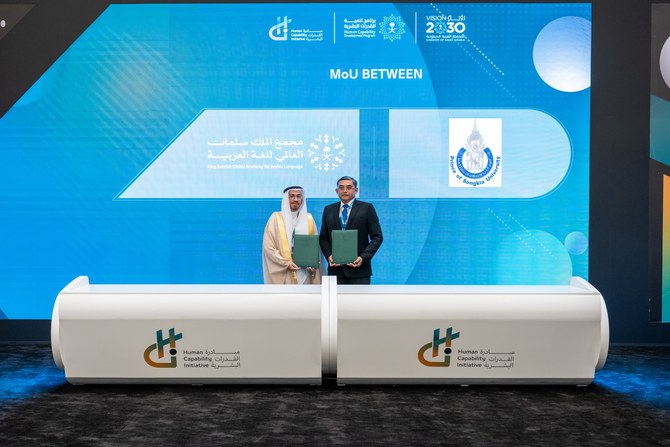
Dr. Abdullah Al-Washmi, the Secretary-General of the King Salman global academy for Arabic Language, and Dr. Niwat Keawpradub, Prince of Songkla University after signing the memorandum of understanding (MoU) in Riyadh (Supplied)
Short Url
Updated 02 March 2024
Follow

Saudi academy signs deal with Thai university to promote language cooperation

  • Agreement was signed as part of the Human Capability Initiative Conferenc

Riyadh: The King Salman Global Academy for the Arabic Language signed a memorandum of understanding in Riyadh with Prince of Songkla University, Thailand, “to enhance mutual cooperation in dissemination of the Arabic language.”

The agreement was signed as part of the Human Capability Initiative Conference, which began on Wednesday under the patronage of Saudi Crown Prince Mohammed bin Salman.

KSGAAL was represented by its Secretary-General, Abdullah Al-Washmi, while Prince Songkla University was represented by its President, Niwat Keawpradub.

The MoU is also aimed at strengthening “teaching, preservation, and fostering scientific and practical relations to mutually benefit and achieve strategic objectives.”

Collaboration will also take place in: Arabic language and its sciences, Arabic language computing, building digital dictionaries, linguistic blogs, developing assistive digital solutions, cooperation in curricula and tools related to teaching Arabic to non-native speakers, administering proficiency tests in Arabic for non-native speakers, and sharing linguistic services and consultations in areas of mutual interest.

The agreement comes within the strategic objectives of the KSGAAL in spreading the Arabic language at the local and international levels, said Al-Washmi.

He told Arab News that Thailand is one of the targeted countries to open Arabic language education centers in coming years as part of KSGAAL’s strategy, which includes establishing a number of centers in countries around the world.

A high-level delegation from the KSGAAL recently visited Thailand and conducted a program that included seminars and discussion sessions to study the status of the Arabic language in the country, he added.

The MoU falls within the initiatives of the KSGAAL, its strategic partnerships with entities concerned with local and international Arabic linguistic development.

These initiatives aim to enhance the level of usage of the Arabic language, strengthen its presence, and preserve it in line with the Human Capability Development Program, one of the programs realizing Saudi Vision 2030.

KSGAAL was established by a decision of the Council of Ministers and is one of the initiatives of the Ministry of Culture aimed at enhancing the role of the Arabic language regionally and globally.

It was established in September 2020 to highlight the status of the Arabic language and activate its role regionally and globally, as well as to enhance its value as an expression of the linguistic depth of Arab and Islamic culture.

KSGAAL works on spreading the Arabic language and ensuring the integrity of its usage in various fields, revitalizing its heritage through study, research, and dissemination, in addition to unifying scientific reference internally regarding the Arabic language and its sciences, and working to achieve this externally.


SDAIA Academy opens registration for quantum computing boot camp

Updated 05 January 2026
Follow

SDAIA Academy opens registration for quantum computing boot camp

  • 5 hours of daily training offered, from Jan. 11-15

RIYADH: The SDAIA Academy has opened registration for a five-day quantum computing boot camp aimed at building national capabilities in one of the world’s most advanced and complex computing fields.

The boot camp will run from Jan. 11 to 15, offering five hours of daily training, according to the Saudi Press Agency.

It is organized by the Saudi Data and AI Authority, in collaboration with the King Fahd University of Petroleum and Minerals, and targets professionals and specialists in computer science and related disciplines.

According to the SDAIA, the program is designed to equip participants with a foundational understanding of quantum computing and its potential applications, as Saudi Arabia steps up investments in advanced and emerging technologies, aligned with Vision 2030.

Quantum computing differs fundamentally from classical computing by relying on quantum mechanics rather than binary logic.

While still an emerging field, it is widely expected to reshape areas such as cybersecurity, optimization, advanced simulation and data-intensive research.

The boot camp will introduce participants to the physical and mathematical principles that underpin quantum computing, including the behavior of qubits, quantum superposition and entanglement.

It will also examine how quantum systems differ from traditional computing architectures and where quantum approaches may offer advantages.

In addition to theory, the program places a strong emphasis on applied training.

Participants will receive hands-on exposure to designing and running quantum algorithms using industry-recognized tools and platforms, including Qiskit and CUDA-Q.

These tools are currently used in research and early-stage development environments worldwide.

Organizers say the practical component aims to prepare participants to engage with real-world quantum computing workflows rather than limiting training to conceptual knowledge.

The goal is to build early-stage technical readiness among Saudi professionals, as global interest in quantum technologies accelerates.

The collaboration with King Fahd University of Petroleum and Minerals reflects a broader push to link national digital initiatives with academic and research expertise.

KFUPM has played a central role in developing technical talent in engineering, computing and applied sciences, fields closely connected to quantum research.

The SDAIA has increasingly focused on capability-building programs that support Saudi Arabia’s long-term digital and data strategy.

Training initiatives in artificial intelligence, advanced analytics and emerging technologies are viewed as essential in reducing reliance on external expertise and strengthening local innovation ecosystems.

Officials say the quantum computing boot camp forms part of this wider effort to develop specialized skills that may not yet be widespread in the local labor market but are expected to become strategically important in the coming decade.

The program also aligns with the objectives of Vision 2030 related to human capital development and the transition toward a knowledge-based economy, particularly in high-value technology sectors.

Registration for the boot camp is open until Jan. 6. Applicants can register through the SDAIA’s official training platform.