Pakistan polls regulator announces schedule for presidential election on Mar. 9

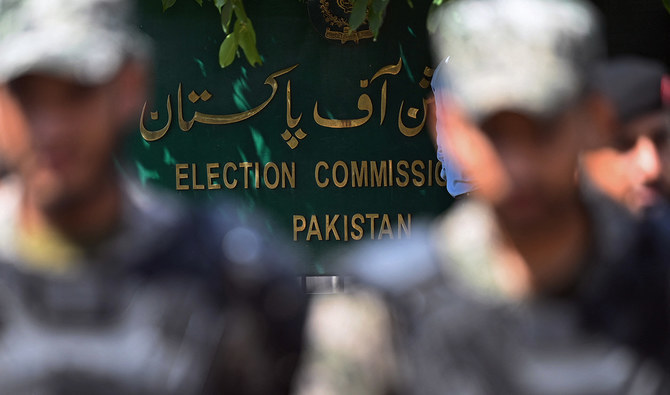
Paramilitary soldiers stand guard outside the Pakistan’s election commission building in Islamabad on August 2, 2022. (AFP/File)
Short Url
Updated 01 March 2024
Follow

Pakistan polls regulator announces schedule for presidential election on Mar. 9

  • Nominations for the post can be filed until Saturday with presiding officers in Islamabad and four provincial capitals
  • A returning officer will scrutinize nomination papers by March 4 and candidates can withdraw nominations by March 5

ISLAMABAD: The Election Commission of Pakistan (ECP) on Friday announced a schedule for the presidential election on March 9, months after the end of Arif Alvi’s term as the 13th president of Pakistan.

Nominations for the post can be filed until Saturday with presiding officers in Islamabad and provincial capitals of Karachi, Lahore, Peshawar and Quetta, according to the ECP.

A returning officer, appointed by the ECP, will scrutinize the nomination papers by March 4 and candidates can withdraw their nominations by March 5.

“In pursuance of the provisions... public notification for election to the office of the President of the Islamic Republic of Pakistan is hereby issued,” read an ECP notification issued on Friday.

In Pakistan, a president is elected by members of an electoral college, which comprises both upper and lower houses of parliament as well as provincial assemblies. Polling to elect the new president will be held on March 9.

An alliance of major political parties, including three-time former prime minister Nawaz Sharif-led Pakistan Muslim League-Nawaz (PML-N) and ex-foreign minister Bilawal Bhutto-Zardari’s Pakistan Peoples Party (PPP), has nominated Asif Ali Zardari as its candidate for presidency. Zardari has previously served as the president of Pakistan from 2008 till 2013.

President Alvi’s five-year term ended in September last year, but in Pakistan, a president may continue to stay in office constitutionally until his successor is elected to the presidency.

The tenure of Alvi, who took oath on Sept. 9, 2018 after former PM Imran Khan’s Pakistan Tehreek-e-Insaf (PTI) party came to power in election held the same year, was marked by political instability and civil-military tensions, and saw the ouster of Khan in a parliamentary no-trust vote in April 2022, followed by the departure of PM Shehbaz Sharif’s coalition government in August.

Besides political instability, an economic crisis gripped Pakistan during this period, with the South Asian country barely averting a default in June last year by securing a $3 billion bailout deal from the International Monetary Fund (IMF).


Bangladesh leader pushes for SAARC revival after meeting Indian, Pakistani dignitaries

Updated 02 January 2026
Follow

Bangladesh leader pushes for SAARC revival after meeting Indian, Pakistani dignitaries

  • Muhammad Yunus met Pakistan’s parliamentary speaker, Indian FM at Khaleda Zia’s funeral on Wednesday
  • SAARC has been dysfunctional since 2016, after India withdrew following a militant attack it blamed on Islamabad

ISLAMABAD: Bangladesh Chief Adviser Muhammad Younus this week pushed for reviving the South Asian Association for Regional Cooperation (SAARC) platform after meeting dignitaries from India, Pakistan and other parts of the region. 

SAARC has been effectively dysfunctional since 2016, when its planned Islamabad summit collapsed after India withdrew following a militant attack it blamed on Pakistan. Islamabad denied involvement, but New Delhi’s decision prompted Afghanistan, Bangladesh and Bhutan to pull out, leading to the indefinite postponement of the summit.

Younus met Pakistan’s National Assembly Speaker Ayaz Sadiq and Indian External Affairs Minister Subrahmanyam Jaishankar at former Bangladesh premier Khaleda Zia’s state funeral in Dhaka on Wednesday. The funeral also saw a handshake between the Indian and Pakistani representatives, the first high-level contact between officials of the two countries since their conflict in May. 

“During the meetings, Professor Yunus repeatedly emphasized the need to revive the South Asian Association for Regional Cooperation (SAARC),” Yunus’ account on social media platform X said.

“We witnessed a true SAARC spirit at the funeral yesterday,” the account quoted Yunus as saying. “SAARC is still alive. The SAARC spirit is still alive.”

The Bangladesh leader said apart from Jaishankar and Sadiq, representatives from South Asia who attended the funeral included Nepal’s Foreign Minister Bala Nanda Sharma, Sri Lanka’s Minister of Foreign Affairs, Employment and Tourism Vijitha Herath, and Maldives Minister of Higher Education and Labor Ali Haider Ahmed. 

Yunus said he tried to convene an informal gathering of SAARC leaders on the sidelines of the UN General Assembly in New York last year.

His statement to revive SAARC follows that of Pakistan’s Prime Minister Shehbaz Sharif, who earlier this month also called for reviving the South Asian platform. 

Sharif’s message last month came as the bloc marked the 40th anniversary of its founding charter. The Pakistani premier stressed the importance of deeper economic collaboration and collective responses to shared regional challenges such as poverty, climate-induced natural disasters, food and energy insecurity, and public-health vulnerabilities.