

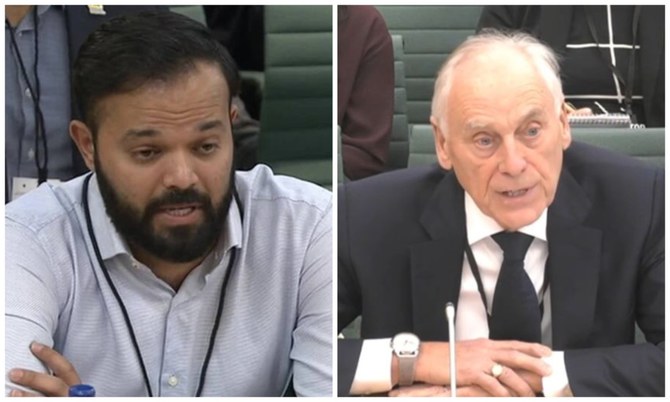

LONDON: My cricket column this week referred to a follow-up hearing on Feb. 20 by the UK House of Commons Parliamentary Select Committee for Culture, Media and Sport into racism in cricket.
It focused specifically on what measures had been put in place since its initial hearing in November 2021, and after the recommendations of the Independent Commission for Equity in Cricket were published in June 2023.
The key catalysts for this have been Yorkshire County Cricket Club and one of its former players, Azeem Rafiq, who made allegations of racist behavior at the club. A number of the allegations were upheld and formally accepted by the club, although not, it seems, by all parties involved in cricket. Another figure in the saga has emerged, or rather re-emerged, in recent weeks.
Colin Graves was executive chair of YCCC between 2012 and 2015, and then chair of the England and Wales Cricket Board from 2015 until 2020. Prior to that he was part of a consortium that rescued YCCC from insolvency in 2002. Repayment of club debt was consolidated into Graves Trust funds, to which the club currently owes almost £15 million ($19 million).
Graves said that since his stint at the ECB ended four years ago, he “has not been involved with running any form of cricket.”
Ongoing financial difficulties at YCCC, exacerbated by costs generated by payouts to previous employees, have brought it, once again, to the brink of insolvency, and so the club’s board sought a financial rescue package.
A consortium led by Graves put forward a proposal that was accepted by a majority of the 25 percent of members who chose to vote. It seemed like there was a general feeling of inevitability about the outcome, inside and outside of Yorkshire.
Nevertheless, some have voiced concerns about the potential effects of Graves’ return to the club appointment as chair of the board. He accepted an invitation to appear at the last week’s hearing of the Parliamentary Select Committee, during which its members articulated some of those concerns.
Asked whether he intends to bring back any of the previous backroom and coaching staff, his response was: “It has not been discussed by the board. We have our first board meeting on Monday (Feb. 26), and I am sure that the future, the structure, everything will be discussed. But at this point in time it has not been discussed.”
On the afternoon of Feb. 27, an article appeared in The Cricketer magazine, written by George Dobell, who has been closely associated with reporting on and supporting Rafiq’s case.
The article reported that, incredibly, the board of the YCCC was considering bringing back Mark Arthur, who was its CEO from 2014 until his resignation in November 2021. He stepped down days before the initial hearing of the Parliamentary Select Committee on Nov. 16, 2021. During that hearing, Roger Hutton, who served as chair of the YCCC board between April 2020 and November 2021, alleged that the CEO had attempted to prevent further investigation into the racism allegations.
During his tenure, Hutton commissioned a law firm to conduct a review of the allegations of racism. Only a summary of its findings has been released publicly. During his appearance at the Select Committee hearing on Feb. 20, Graves referred twice to this fact, though it was not clear why.
Seven of the 43 allegations made by Rafiq were upheld on Sept. 10, 2021, by an independent panel appointed by YCCC. It confirmed he had been the “victim of racial harassment and bullying.” Perhaps the fact that 36 allegations were not upheld provides YCCC’s new board with some hope for exoneration.
Much water has flowed under the bridge since that verdict. Part of that has been an acceptance, albeit in some cases reluctantly, that racism has been present in the game. Indeed, Graves proffered an apology during the recent Select Committee hearing to those from ethnic-minority backgrounds who had experienced discrimination or racism at the club, including Rafiq.
He said it “should never have happened, it never will be acceptable, and it certainly will not be going forward.”
Arab News asked Rafiq whether he felt the timing of the apologies ahead of the YCCC’s extraordinary general meeting to decide whether Graves would return as chair of the board, and those made during the Select Committee hearing last week, were coincidental and whether they could they be accepted as sincere. He declined to comment.
During the recent Select Committee meeting, Graves was asked whether he or his representatives had sent a legal letter to the publishers of “It’s Not Banter, it’s Racism,” a book by Rafiq that is due to be published in April. He said solicitors acting on behalf of YCCC had asked to see an advance copy. He denied that the tone of the letter was intimidatory and agreed to make public its contents. The reasons for requesting a copy of the book were not clear.
It is difficult not to feel a sense of unease about how the latest turn of events at YCCC might unfold. Graves deflected any detailed discussion during the Select Committee meeting of senior management appointments on the grounds that the club’s board had not yet met to discuss them.
This prompted one of the committee members to note that Graves “did not say that he would not bring back any of the old guard who were fired.” It was further noted that such people were those who had failed to notify the chair of problems that were subsequently shown to have existed.
Graves offered assurances that equality, diversity and inclusion measures put in place in the past two years would be guaranteed and fully supported. A new board member, Sanjeev Gandhi, will be appointed specifically to oversee the development of these EDI measures. Gandhi previously worked with Graves at the ECB on the creation of The Hundred tournament.
There was no mention or recognition of the measures to address EDI issues that were initiated by Kamlesh Patel, senior independent director of the ECB, during his time as chair of YCCC between November 2021 and March 2023. Instead, he has faced heavy criticism as the person who purged the old guard at a damaging cost to the County.
As far as can be seen, none of the British media has picked up the The Cricketer’s story. YCCC has not responded to requests for confirmation of its claims.
The ECB seems to be impotent in terms of intervention in a matter that, so far, is solely the YCCC’s business. It is difficult to avoid the feeling, however, that there is an underlying process of retrenchment at play, in which financial considerations are to the fore.
There is an old adage that suggests a strong Yorkshire (in cricket terms) means a strong England. The truth of this is about to be tested off the field. Graves has a responsibility not to undermine the progress that has been made since Rafiq’s allegations came to light, and to match his own words of apology and his commitment to equity with commensurate actions for the good not only of Yorkshire, but for English and Welsh cricket as a whole.
Trust needs to be reestablished. A good place to start might be to rebuild some trust with Rafiq, rather than reappointing a previous CEO.


