

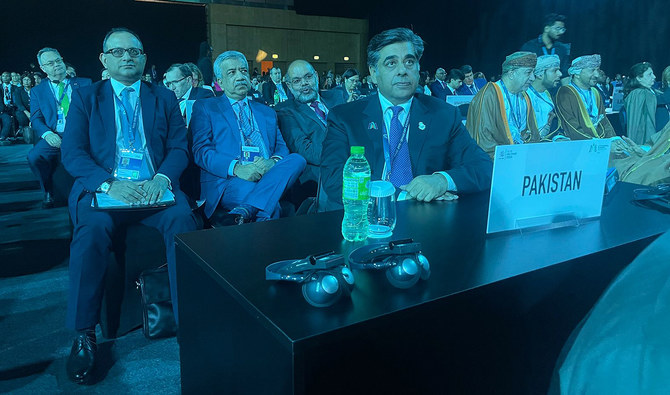
Pakistan’s commerce minister attends WTO ministerial conference in Abu Dhabi 

Pakistan’s Caretaker Commerce Minister, Dr. Gohar Ejaz, attends the 13th high-level ministerial meeting of the World Trade Organization in Abu Dhabi, UAE, on February 26, 2024. (Government of Pakistan)
Short Url
Updated 26 February 2024
Follow

Pakistan’s commerce minister attends WTO ministerial conference in Abu Dhabi 

  • Commerce Minister Dr. Gohar Ejaz meets counterparts from Saudi Arabia, UAE, Bahrain and China, says state-run media 

ISLAMABAD: Pakistan’s Caretaker Commerce Minister Dr. Gohar Ejaz is in Abu Dhabi to attend the the13th high-level ministerial meeting of the World Trade Organization, state-run media said on Monday, as representatives of various countries around the world gear up to discuss global trade in the shadow of Israel’s war on Gaza and conflicts in other parts of the globe. 

The WTO’s ministerial conference, scheduled to run until Thursday, includes discussions on various contemporary issues ranging from trade and environment to climate change, sustainability, and inclusion in its agenda. 

“Caretaker Minister for Commerce, Industry and Investment Gohar Ejaz is in Abu Dhabi to attend the 13th World Trade Organization (WTO) Ministerial Conference,” the state-run Radio Pakistan said. 

It added that Ejaz met his counterparts from other countries, including Saudi Arabia, UAE, Bahrain, Egypt, Turkiye, and China in Abu Dhabi. 

The UAE is Pakistan’s third-largest trade partner after China and the United States. It is also viewed as an ideal export destination by policymakers in the South Asian country due to its geographical proximity with Pakistan that reduces transportation and freight costs.

The Gulf country is also home to an estimated 1.8 million Pakistani expatriates and after Saudi Arabia, the second-largest source of remittances for the South Asian nation of more than 240 million. Pakistan’s principal exports to the UAE consist of textile products and various food items.

Last month, Pakistan and the UAE inked multiple agreements worth over $3 billion for cooperation in railways, economic zones, and infrastructure at the World Economic Forum in Davos. 


Pakistan rice exports slump 40% as India’s return hits pricing power

Updated 24 February 2026
Follow

Pakistan rice exports slump 40% as India’s return hits pricing power

  • Statistics show non-Basmati shipments have fallen over 50 percent in July-January period
  • Government offers 9 percent tax drawback on premium Basmati exports to support sector

ISLAMABAD: Pakistan’s rice exports fell 40.5 percent to $1.31 billion in the first seven months of the fiscal year, official data showed on Tuesday, as India’s return to the global market squeezed Islamabad’s market share and pricing power.

According to the Pakistan Bureau of Statistics (PBS), non-Basmati exports dropped 50.8 percent to $827.8 million, with volumes falling to 2.0 million tons from 3.15 million tons a year ago. Basmati exports declined 6.62 percent to $477.7 million, with volumes easing to 436,484 tons from 487,278 tons.

The Ministry of National Food Security told a parliamentary committee in two separate meetings in December and January that India’s re-entry into the global rice market was a key factor behind the decline, saying increased Indian supplies had made Pakistani rice less competitive.

Officials told lawmakers that India benefits from free trade agreements and provides substantial support to its rice sector, putting additional pressure on Pakistani exporters.

In response, the Ministry of Commerce last month issued a notification under the “Drawback of Local Taxes and Levies for Rice Order, 2026,” allowing a rebate of 9 percent of the free-on-board (FOB) value for Basmati exports priced above $750 per metric ton.

The government said the measure, announced on January 23, aims to ease liquidity pressures on exporters and improve competitiveness.

While PBS data for July-January shows a 40.5 percent decline, figures from the Federal Board of Revenue (FBR) for July-December show an even steeper 47 percent drop to $973 million from $1.82 billion in the same period last year, reflecting a deficit of over $800 million.

Industry representatives say they are now focusing on market diversification to counter the slowdown.

“Currently Basmati is mainly exported to Middle East and EU. Non-Basmati is exported to Philippines, Indonesia, Malaysia and African countries,” Malik Faisal Jahangir, chairman of the Pakistan Rice Exporters Association, told Arab News last week.

“For the new markets for our non-basmati rice exports, we are looking to increase our volumes to China, Philippines, Indonesia and Bangladesh,” he added.