

Key Karachi party says has decided to be part of upcoming Pakistani cabinet

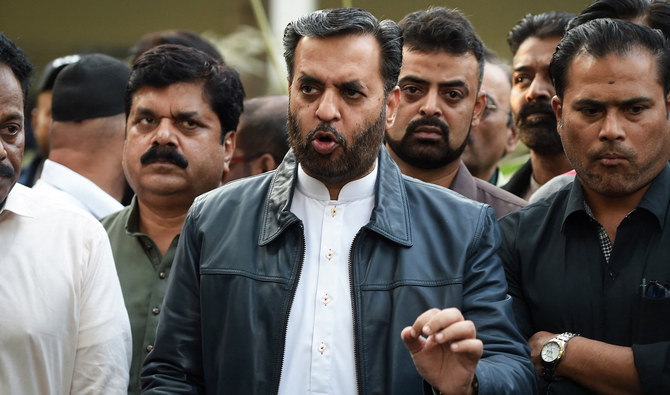
Syed Mustafa Kamal (C), Senior Deputy Convener of Muttahida Qaumi Movement-Pakistan (MQM-P) party speaks to the media in Karachi, Pakistan, on December 22, 2023. (AFP/File)
Short Url
Updated 26 February 2024
Follow

Key Karachi party says has decided to be part of upcoming Pakistani cabinet

  • Muttahida Quami Movement Pakistan bagged 17 National Assembly seats in the inconclusive February 8 polls 
  • “No deadlock” in talks with ex-PM Sharif’s party on government formation, confirms MQM-P leader Mustafa Kamal

ISLAMABAD: A senior member of the Karachi-based political party Muttahida Quami Movement Pakistan (MQM-P) this week clarified it would be part of the federal cabinet, confirming that there was no “deadlock” with former prime minister Nawaz Sharif’s party on talks related to forming the next government. 

The MQM-P emerged as the third largest political party in the country after securing 17 National Assembly seats in the inconclusive Feb. 8 elections. While independent candidates backed by former prime minister Imran Khan’s Pakistan Tehreek-e-Insaf (PTI) party form the largest group in the parliament after winning over 90 seats, they cannot form the government on their own as they contested the polls as independents and not members of the party. 

Ex-PM Sharif’s Pakistan Muslim League-Nawaz (PML-N) and the Pakistan Peoples Party (PPP) bagged 75 and 54 seats respectively. Both announced earlier this month they would join hands to form a coalition government by jointly supporting ex-PM Sharif’s younger brother, Shehbaz Sharif, as their candidate for prime minister and PPP leader Asif Ali Zardari for president. 

“We have decided to support the government and we have agreed that we will be part of the government,” Kamal told Geo News on Sunday night. “We will also take ministries and governorship.”

Kamal said the MQM-P wanted to head certain departments and ministries through which it could serve people in its constituencies and in the southern Sindh province. He rejected reports there was a deadlock between the PML-N and the MQM-P on the power-sharing formula. 

“There is no deadlock [between the MQM-P and the PML-N],” Kamal said. “Our last meeting was a great one.”

The formation of the next government is expected to end political uncertainty, which has shrouded Pakistan since April 2022 when ex-PM Khan was ousted from office via a parliamentary vote. 

Pakistan is facing an economic crisis, with dwindling foreign currency reserves that will be further strained by a $1 billion bond payment due in two months, while its $3 billion funding program with the International Monetary Fund (IMF) expires on April 12.

A new government is expected to quickly take necessary steps on various economic issues, for instance regarding the governance of state-owned enterprises to complete the last remaining review of the current $3 billion IMF Standby Arrangement — a bridge loan that helped pull the country back from the brink of default.


Pakistan deputy PM speaks with Iranian FM as Saudi Arabia intercepts missiles and drones

Updated 06 March 2026
Follow

Pakistan deputy PM speaks with Iranian FM as Saudi Arabia intercepts missiles and drones

  • Ishaq Dar expresses concern over evolving regional situation as both officials agree to remain in contact
  • Pakistan earlier reminded Tehran of its mutual defense pact with Saudi Arabia during diplomatic outreach

ISLAMABAD: Pakistan’s Deputy Prime Minister and Foreign Minister Ishaq Dar spoke with Iranian Foreign Minister Seyyed Abbas Araghchi on Friday amid escalating tensions in the Gulf, including recent missile and drone attacks targeting Saudi Arabia that were intercepted by the Kingdom’s air defenses.

The call comes as Islamabad remains in contact with both Tehran and Gulf states to prevent the widening Iran conflict from spilling further across the region, particularly after attempted strikes on Saudi territory, a sensitive development for Pakistan, which signed a mutual defense pact with the Kingdom last year.

Pakistan’s foreign ministry said Dar raised concerns about the evolving regional situation during the conversation.

“Deputy Prime Minister/Foreign Minister Senator Mohammad Ishaq Dar spoke this evening with the Foreign Minister of Iran, Seyyed Abbas Araghchi,” the ministry said in a statement.

“The DPM/FM expressed concern over the evolving regional situation. The two agreed to remain in touch on the developments,” it added.

The ministry did not share details of the conversation, though it came amid fast-moving developments in the region, with Saudi Arabia saying its air defenses intercepted multiple missiles and drones early on Friday.

Earlier this week, Prime Minister Shehbaz Sharif’s adviser on political affairs Rana Sanaullah said Pakistan was in contact with Iran to discourage attacks on Gulf countries and prevent misunderstandings.

“Such attacks should not be carried out from Iran’s side,” he told Geo TV.

Prior to that, the deputy prime minister told Pakistan’s Senate that Islamabad had engaged both Iran and Saudi Arabia at the outset of Iran’s retaliation in the region, reminding Tehran of its defense agreement with Saudi Arabia and conveying assurances from Riyadh that Saudi territory would not be used against Iran.

Pakistan says its administration is striving to end the conflict, though the United States-Israeli strikes on Iran, which triggered the war and led to its spillover, have only intensified.

Iranian President Masoud Pezeshkian said on Friday some countries had begun mediation efforts but insisted Tehran would defend its sovereignty.

Meanwhile, US President Donald Trump has called for Iran’s “unconditional surrender” on his Truth Social platform as the confrontation shows little sign of easing.