

AI will drive efficiency amid global economic slowdown, leading financiers tell FII Priority Summit

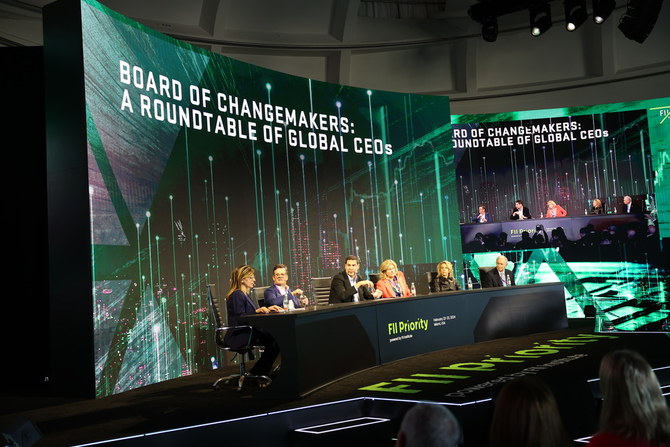
Speakers at the roundtable stressed the need to regulate AI. (AN Photo)
Short Url
Updated 24 February 2024
Follow

AI will drive efficiency amid global economic slowdown, leading financiers tell FII Priority Summit

  • 'AI is the bicycle of the minds — we are all going to have to learn how to ride it,' said the head of Claure Group
  • Johnson of Franklin Templeton noted that the supply chain was shifting

MIAMI: The chiefs of four of the world’s leading corporations stressed on Thursday, during the first day of the Future Investment Initiative Miami Summit, that while artificial intelligence has the potential to drive higher investment and economic growth across the world despite the current slowdown, it can cause significant harm if not regulated at the right pace.

Marcelo Claure, founder and CEO of Claure Group, told the “Board of Changemakers” panel that when it comes to AI, it is hard in many cases “to differentiate (between) what is hype versus what is reality,” but regardless, all businesses would have to incorporate the technology into their work if they wanted to succeed in the next few decades.

“AI is the bicycle of the minds — we are all going to have to learn how to ride it,” he said.

Claure pointed out that when the browser was invented 30 years ago, it “made the cost of information zero,” which led to the creation of global companies like Google.

He added that AI is going to “reduce the cost of three very important things to basically zero: cognition, creativity, and problem-solving.”

He said: “In our companies, we hire thousands of people, we pay them to do what? We pay them to think, we pay them to problem solve, we pay them to be creative, and AI is going to enhance that.”

As an example of how Claure’s company utilized AI for higher efficiency, he mentioned that his teams used to require about 100 hours to manage a marketing campaign. However, after employing AI, the same process took less than an hour.

“So, think about a 99 percent efficiency,” he said.

Highlighting that generative AI, such as ChatGPT, will develop an IQ level of 12,000 in the next three to four years, Stephen Schwarzman, chairman and CEO of Blackstone Group, stressed the importance of “ethics in AI.”

He told the panel of CEOs: “In terms of the downsides of the technology, that in the hands of bad actors, call them rogue states, will have the use of this very powerful technology — that is a bad thing.”

Schwarzman highlighted that AI technologies are “moving so quickly,” making it more of a challenge to “catch up” and “protect systems.”

He added that experts in the field, such as MIT (Massachusetts Institute of Technology) scientists, “are really cautious about this technology.”

He said: “In other words, they love it. It can do marvelous things, but unlike most of the business community, they are not against regulation. In fact, they are pretty enthusiastic about regulation because they see the downsides, and they want those downsides addressed.

“And one of the things I have tried to do with both AI ethics centers at MIT and at Oxford, is try and be part of that dialogue, encourage people to be thinking about this — there is a lot of stuff going on in the regulatory world.”

Echoing Claure’s observation that AI is advancing rapidly, Schwarzman emphasized the importance of responding with the appropriate regulations at a fast pace.

“This is moving so fast, whatever you come up with, it’ll be obsolete pretty quickly,” he said.

In addition to AI, Jennifer Johnson, president and CEO of Franklin Templeton, identified five broad trends that may define the next decade in investments: demographics, deglobalization, digitization, decarbonization, and debt.

Like the rest of the speakers, Johnson stressed the importance of regulating AI.

“The problem is, it is scary,” she said. “But on the other hand, if we do not create environments where the good folks are learning how to use AI, the bad guys become the experts on it.

“And, so, you have to create and allow for innovation to happen.”

Speaking about deglobalization, Johnson highlighted that the supply chain was shifting.

She said: “It’s the China plus one, the nearshoring, the French shoring. But the key is that capital is moving.”

She added that “capital goes where capital is treated well — where there is a political will to create policies like the Kingdom (of Saudi Arabia) is doing to create opportunities for investment.”

Johnson referred to the shifting of supply chains as “disinflation,” but she also noted that “the raising of interest rates to slow down the economy” means that while there is a global growth slowdown, there are also “pockets of strength … like (in) India.”

Alongside Claure, Johnson and Schwarzman, panelists partaking in the roundtable discussion also included Pierre Beaudoin, chairman of the board of Bombardier, and Pam Liebman, president and CEO of The Corcoran Group.


Startups across MENA secure fresh funding to scale chips, AI, mobility and proptech platforms

Updated 3 sec ago
Follow

Startups across MENA secure fresh funding to scale chips, AI, mobility and proptech platforms

  • The company plans to use the funding to scale operations across Dubai and the wider UAE before expanding into other GCC markets

RIYADH: Startups across the Middle East and North Africa continue to attract investor backing, with companies spanning semiconductors, artificial intelligence infrastructure, and health technology all benefitting.

Rimal Semiconductors, a Saudi chip design startup, secured a bridge funding round from Keheilan Asset Management and an undisclosed regional investor as the company works to strengthen its position within the global semiconductor supply chain. 

The funding will support Rimal’s strategy of building a fabless semiconductor business that designs chips while outsourcing manufacturing to international foundries, enabling the company to distribute production across multiple jurisdictions while retaining ownership of its intellectual property. 

Rimal currently maintains manufacturing partnerships across Taiwan, Korea, and China, and is in discussions with US-based foundries as it seeks to diversify its production network. 

The company positions its approach as a way to navigate the increasingly fragmented semiconductor industry, where geopolitical tensions between the US and China are reshaping global supply chains and restricting market access for many companies. 

By maintaining Saudi ownership of its intellectual property while distributing manufacturing across multiple partners, Rimal aims to supply its chip designs to markets worldwide regardless of manufacturing location. 

The startup is also finalizing a distribution agreement with a regional distributor operating across Turkiye, Egypt, and Morocco, as well as Tunisia and the UAE, supported by local engineering teams providing technical support in each market. 

Rimal currently has six contracts in the pipeline, including one with a major Egyptian corporation, with projects spanning defense systems, power grid infrastructure, and data center technologies. 

iQtech raises first investment round 

iQtech LLC, a Qatar-based startup specializing in advanced medical simulation and cross-reality technologies, has closed its first investment round with backing from European assessment technology company Selexi and deep-tech collaborator Yuniro. 

The funding marks a milestone for the startup, founded in 2025, as it transitions from its founding phase into a structured growth stage while accelerating development of its AI-powered medical training platform. 

The investment will support the development of EsculapioVR, iQtech’s flagship platform that combines immersive virtual reality simulations with artificial intelligence-driven performance evaluation designed to enhance medical education and professional training outcomes. 

Operating from Doha within the Qatar Science & Technology Park ecosystem, the startup positions itself at the intersection of healthtech and edutech. 

Weego operates a mobility-as-a-service application that integrates multiple transportation options into a single platform. (Supplied)

The company aims to modernize professional training through high-fidelity simulation environments for health care professionals, as well as civil and military training programs. 

With the new funding, iQtech plans to strengthen its technical infrastructure, accelerate platform development, and expand deployments across Qatar and the wider Middle East and North Africa region. 

Weego raises $1.1m

Weego, a Moroccan–Senegalese mobility startup, has raised $1.1 million in a funding round led by early-stage venture capital firm Azur Innovation Fund as the company seeks to expand its mobility-as-a-service platform across African markets. 

Founded in 2020 by Saad Jittou and Mor Niane, the company operates a mobility-as-a-service application that integrates multiple transportation options into a single platform, allowing users to access and book public transit, ride-hailing services, and other transportation modes through one interface. 

The company also provides enterprise mobility solutions through its WeegoLines service, which enables companies to organize and manage employee transportation. The service is designed to improve reliability and efficiency in staff mobility for corporate clients. 

“Transportation remains one of the primary barriers to economic activity in many cities,” said Jittou, co-founder and CEO of Weego. “We are building the technological layer that helps make existing mobility infrastructure more efficient and accessible.” 

With the new funding, Weego plans to expand into additional cities across Morocco, strengthen its enterprise mobility services, and further develop its multimodal platform. 

The company is also preparing for broader regional expansion into other African markets, with longer-term ambitions to explore opportunities in Europe and the Middle East. 

Skipr raises $2m seed round 

Skipr, a startup developing infrastructure designed to enable trusted interaction between autonomous artificial intelligence systems, has closed a $2 million seed funding round at a $10 million valuation. 

The funding will support the company’s expansion from Hub71, Abu Dhabi’s global technology ecosystem, as it works to scale sovereign artificial intelligence infrastructure for national and enterprise deployments. 

Skipr focuses on enabling secure communication, coordination, and value exchange between AI systems operating across organizations, cloud environments, and geographic jurisdictions. 

The company’s platform is designed to allow governments and enterprises to maintain sovereign control over their data and decision-making processes while deploying AI-powered services. 

We are building the trust infrastructure nations and enterprises need to deploy AI safely, confidently, and at scale.

Andreas Hartl, CEO at Skipr Technologies

Skipr said it is already working with telecommunications operators, AI and cybersecurity laboratories, and data center partners to deploy autonomous digital services at national and enterprise scale. 

“This funding accelerates our work on what we believe is a foundational layer for the AI era,” said Andreas Hartl, CEO at Skipr Technologies. 

“As AI systems become autonomous and interconnected, secure AI-to-AI interoperability under sovereign control is no longer optional. We are building the trust infrastructure nations and enterprises need to deploy AI safely, confidently, and at scale,” he added. 

Skipr operates as part of the Hub71+ Digital Assets specialist ecosystem, which brings together technology companies, regulators, and strategic partners focused on developing digital infrastructure. 

Rewa launches UAE rent payment and rewards platform

UAE-based proptech startup Rewa has launched its digital rent payment and rewards application across the country following the close of a strategic seed funding round backed by Qatar Development Bank, Plug and Play, and Neocity Invest, as well as Startup Wise Guys, Second Century Ventures, and several Gulf Cooperation Council real estate executives. 

Founded in 2024 by Ramzi Mneimneh and Najib Khanafer, Rewa enables tenants to pay rent through card or bank transfer while earning loyalty points that can be redeemed across more than 150 partners spanning travel, retail, and dining, as well as groceries and lifestyle services. 

The platform also allows users to apply rewards toward future rent payments and utility bills. In addition to tenant services, Rewa provides tools for landlords through its Rewa Alliance platform, which streamlines rent collection through automated tracking, digital receipts, and workflows designed to align with UAE rental regulations. 

The company plans to use the funding to scale operations across Dubai and the wider UAE before expanding into other GCC markets. 

Ayar Labs raises $500 million  

Ayar Labs, a US-based semiconductor startup focused on optical interconnect technology, has raised $500 million in a series E funding round led by Neuberger Berman. 

The round included participation from institutional investors AKR Invest, Insight Partners, Sequoia Global Equities, and 1789 Capital. 

Qatar Investment Authority joined the round as a Middle East-based institutional investor. 

Additional strategic investors included Alchip Technologies and MediaTek, joining existing backers such as Advent Global Opportunities, Boardman Bay Capital Management, and IAG Capital Partners, as well as Light Street Capital, Playground Global, AMD Ventures, and NVIDIA. 

Founded in 2015 by Mark Wade, Vladimir Stojanovic, Chen Sun, Rajeev Ram, and Milos Popovic, Ayar Labs develops optical interconnect technologies known as co-packaged optics, which replace traditional electrical connections used in chips and data centers. 

The company’s technology is designed to improve data transfer speeds and energy efficiency in high-performance computing environments, including artificial intelligence infrastructure and large-scale data centers.