DUBAI: A cargo ship abandoned in the Gulf of Aden after an attack by Yemeni rebels remains afloat and could be towed to Djibouti this week, its operator said on Thursday.
Rubymar, a Belize-flagged, British-registered and Lebanese-operated cargo ship carrying combustible fertilizer, was damaged in Sunday’s missile strike claimed by the Iran-backed Houthi rebels.
Its crew was evacuated to Djibouti after one missile hit the side of the ship, causing water to enter the engine room and its stern to sag, said its operator, the Blue Fleet Group.
A second missile hit the vessel’s deck without causing major damage, Blue Fleet CEO Roy Khoury said.
Yemen’s Iran-backed Houthi rebels had claimed on Monday the attack on the ship, saying it was “at risk of potential sinking in the Gulf of Aden” after receiving “extensive damage.”
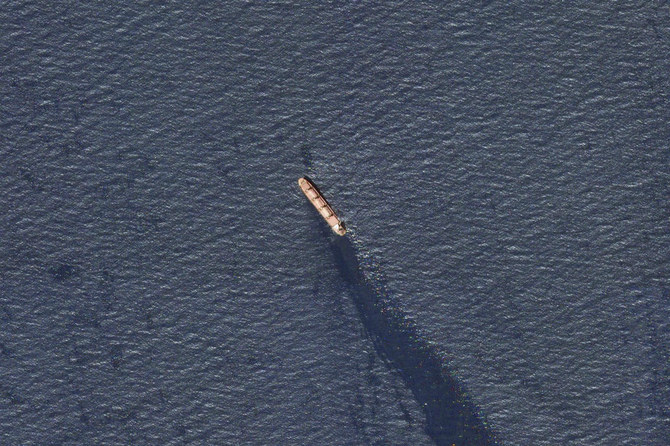
Khoury said the ship was still afloat and shared an image captured on Wednesday that showed its stern low in the water.
“She will be towed to Djibouti but the tugboat has not yet arrived,” Khoury said. “It should be there in two to three days.”
When asked about the possibility of it sinking, Khoury said there was “no risk for now but always a possibility.”
Ship-tracking site TankerTrackers.com confirmed that the Rubymar had not sunk but warned that the vessel was leaking fuel oil.
The attack on the Rubymar has inflicted the most significant damage yet to a commercial ship since the Houthis started firing on vessels in November — a campaign they say is in solidarity with Palestinians in Gaza during the Israel-Hamas war.
The Djibouti Ports and Free Zones Authority said the ship’s last port of call was the United Arab Emirates and it was destined for Belarus.
Its 24 crew members included 11 Syrians, six Egyptians, three Indians and four Filipinos, the authority said in a statement on Monday.
“The vessel has on board 21,999 MT (metric tons) of fertilizer IMDG class 5.1,” the authority said on X, formerly Twitter, describing it as “very dangerous.”
The Houthi attacks have prompted some shipping companies to detour around southern Africa to avoid the Red Sea, which normally carries about 12 percent of global maritime trade.
The UN Conference on Trade and Development warned late last month that the volume of commercial traffic passing through the Suez Canal had fallen more than 40 percent in the previous two months.


![]()

Abandoned Red Sea ship remains afloat, to be towed to Djibouti: operator
Short Url
https://arab.news/ya327
Abandoned Red Sea ship remains afloat, to be towed to Djibouti: operator
- Rubymar, a Belize-flagged, British-registered and Lebanese-operated cargo ship, was damaged in Sunday’s Houthi missile strike


Latest updates


© 2026 SAUDI RESEARCH & PUBLISHING COMPANY, All Rights Reserved And subject to Terms of Use Agreement.