


NEW YORK: The US on Monday tabled its own UN Security Council draft resolution on Gaza, ahead of Tuesday’s vote on an Algerian resolution calling for an immediate ceasefire between Israel and Hamas.
Although it is the first US draft that supports a “ceasefire,” it is referred to as a temporary one “as soon as practicable” and “based on the formula of all hostages being released.”
The US draft resolution underscores that the Israeli offensive against the Gazan town of Rafah should not proceed, citing circumstances under which such an attack “would result in further harm to civilians and their further displacement including potentially into neighboring countries, which would have serious implications for regional peace and security.”
On Sunday, the US had said it would veto the Algerian resolution as it could jeopardize Washington’s diplomatic efforts aimed at brokering an end to hostilities in Gaza.
The Algerian text rejects the forced displacement of Palestinians and demands full, rapid and unfettered flow of humanitarian aid into and throughout Gaza.
Since the start of the war, the US has twice vetoed ceasefire resolutions that were backed by an overwhelming majority of countries, and has abstained from two others, allowing the council to call for increasing aid convoys into Gaza.
UNSC resolutions need at least nine votes in favor and no negative votes by the five permanent members — the US, UK, France, China and Russia — to be adopted.
Chinese Ambassador to the UN Zhang Jun said he does not see any reason for the US to veto the Algerian resolution.
“The killings are going on, the humanitarian catastrophe is continuing to unfold, and we’ve heard the loud cries all over the world for ending this tragic situation, so I don’t know why they’ll vote against it,” he said. “They’ve always been calling for protection of human rights.”
The US draft, seen by Arab News, condemns “all acts of terrorism, including the Hamas-led attacks of October 7, 2023, as well as Hamas’ taking and killing of hostages, murder, and sexual violence including rape.”
It emphasizes “grave concern” for the well-being of the 130-plus Israeli hostages held by Hamas and other groups, as well as for the well-being of the civilian population of Gaza, including the more than 1.5 million Palestinians now taking refuge in Rafah.
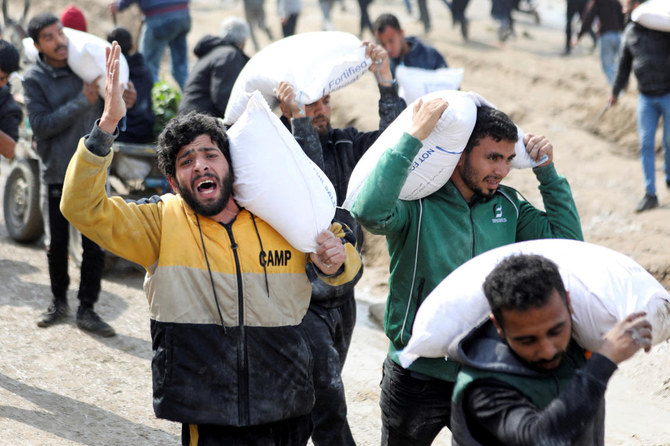
It calls for the lifting of “all barriers to the provision of humanitarian assistance at scale,” and for parties to the conflict to allow “the immediate, safe, sustained and unhindered delivery of humanitarian assistance at scale directly to the Palestinian civilian population throughout the Gaza Strip.”
The text also stresses the urgent need for “a viable plan to ensure the protection of and prevent the displacement of civilians in the event of a major ground military offensive into Rafah,” and calls on all parties to “refrain from depriving Palestinians in Gaza of assistance indispensable to their survival.”
It further stresses that Gaza constitutes “an integral part of the territory occupied in 1967,” and reiterates the vision of a two-state solution with the Gaza Strip as part of a Palestinian state.
The US text reiterates demands that Hamas and other armed groups immediately grant humanitarian access to all remaining hostages, and calls on UN member states to intensify their efforts “to suppress the financing of terrorism, including by restricting financing of Hamas.”


