

Multan Sultans and reshuffled Quetta Gladiators make winning starts in PSL cricket

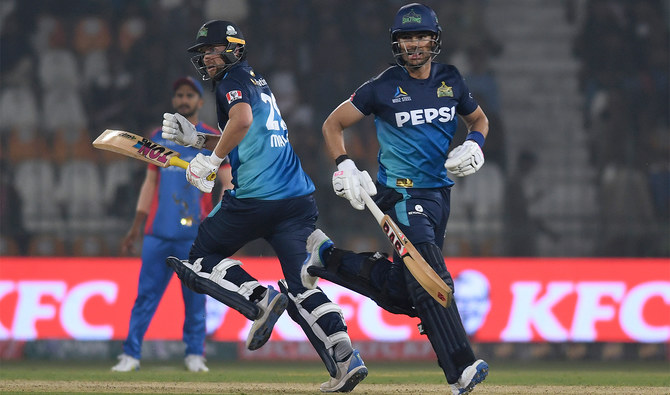
Multan Sultans' Dawid Malan, right, and Reeza Hendricks run between the wickets during the Pakistan Super League T20 cricket match between Multan Sultans and Karachi Kings in Multan, Pakistan, on February 18, 2024 (AP)
Short Url
Updated 19 February 2024
Follow

Multan Sultans and reshuffled Quetta Gladiators make winning starts in PSL cricket

  • Multan’s overseas signings Reeza Hendricks, Dawid Malan scored half-centuries
  • Pacer Mohammad Ali (3-23) ran through Karachi King’s lower order at Qaddafi Stadium

LAHORE, Pakistan: Opening batters Jason Roy and Saud Shakeel shared a beefy 157-run stand as a reshuffled Quetta Gladiators made a triumphant start in Pakistan Super League cricket with a 16-run win over Peshawar Zalmi on Sunday.

Multan Sultans, which lost last year’s PSL thrilling final against Lahore Qalandars by one run, later opened its campaign with a thumping 55-run victory against allrounder-heavy Karachi Kings.

Roy scored a breezy 75 off 48 balls and lefthander Shakeel, who waited for 33 games to get his first opportunity in the PSL, made an equally fine 74 off 47 deliveries that lifted Quetta to 206-5.

Babar Azam (68) and Saim Ayub (42) provided Peshawar with a brisk start of 90 off 51 balls before Peshawar’s chase wobbled in the latter part of the innings and was eventually held to 190-6.

Quetta’s new captain Rilee Rossouw of South Africa was one of the major changes Quetta had made this season. It relieved its long-time skipper Sarfaraz Ahmed after failing to qualify for the playoffs for four successive seasons.

Quetta has also brought in the Australian duo of Shane Watson as its head coach and Shaun Tait as bowling coach while also picking Mohammad Amir in the draft for the first time after the left-arm pace bowler played the last eight seasons for Karachi Kings.

Amir (1-29) bowled brilliantly upfront and was duly rewarded with the late wicket of Rovman Powell in his last over.

Peshawar hit back briefly at the death through Salman Irshad (3-38) after Englishman Luke Wood broke the tall opening stand when Shakeel holed out to Babar. Roy was splendidly caught low at midwicket when he couldn’t clear Irshad’s low full toss as Quetta lost four wickets for 34 runs.

Ayub was needlessly run out in the ninth over and leg spinner Abrar Ahmed (2-29) picked up the key wickets of Babar and Tom Kohler-Cadmore (18) in one over to seal the game for Quetta.

MULTAN STARTS WITH A WIN

Multan’s overseas signings Reeza Hendricks of South Africa and Englishman Dawid Malan struck half centuries in the home team’s challenging total of 185-2 after Karachi won the toss and elected to field.

Veteran Shoaib Malik struck 53 off 35 balls and Karachi’s newly installed captain Shan Masood struggled for his 30 off 31 balls against his former franchise as Multan restricted its opponent to 130-8 in 20 overs.

West Indian power-hitter Kieron Pollard (28 not out) was the other batter to reach double-figures in an otherwise lackluster performance by former champion Karachi.

Hendricks struck an unbeaten 79 off 54 and Malan made a resolute 52 as both set up a strong total with a 121-run second-wicket stand. Malan fell soon after completing his half century when he holed out in the deep off Daniel Sams’ slower delivery, but Khushdil Shah provided a late flourish with a 13-ball 28 not out.

Fast bowler Mohammad Ali (3-23) ran through Karachi’s lower order and David Willey (2-22) chipped in with the wickets of James Vince and Saad Baig off successive deliveries in his second over as Karachi’s chase never got going against Multan’s pace.


Football’s return to Syrian pitches brings fanfare — and friction

Updated 31 December 2025
Follow

Football’s return to Syrian pitches brings fanfare — and friction

RIYADH: Just 10 days after the first anniversary of Syria’s Liberation Day, and one week after the historic performance of the country’s football team at the 2025 Arab Cup — where they reached the quarterfinals — domestic football returned as the Syrian Premier League kicked off its new season.

While league football has continued intermittently since a one-year suspension in 2011, this season represents a notable shift.

For the first time since 2017, the competition features 16 teams playing a full round-robin format — a return to structural normality after years of disrupted campaigns, withdrawals and operational challenges caused by conflict and deteriorating infrastructure.

Foreign players have also returned in significant numbers. A total of 25 overseas players are registered across the 16 clubs in what is now known as the “Prime TV” Syrian Premier League, following the broadcaster’s acquisition of domestic broadcasting rights for the season.

Yet despite the sense of renewal, the league’s reset has been far from smooth. Average attendances remain well below pre-war levels, while the season itself was delayed multiple times before eventually beginning in mid-December — a schedule that is now expected to extend deep into the summer months.

Concerns over facilities and fan safety have already sparked internal tension. The anticipated Matchday Two fixture between Tishreen and Hottin — also known as the Latakia Derby — was postponed by the Syrian Football Association until further notice. No official explanation was provided, but stadium readiness and crowd safety has been at the core of football discussion in Syria.

Supporters have also voiced their frustration over the newly announced ticket prices. Entry fees increased from 5,000 Syrian pounds ($0.45) to 15,000 SYP, a threefold rise announced by the SFA and widely cited as a factor behind subdued crowds.

Infrastructure remains a pressing issue. Historic venues such as Khalid Ibn Al-Walid Stadium in the city of Homs are still not cleared to host games due to pitch conditions and safety requirements, reinforcing the sense of uneven progress — advances made, but frequently offset by new obstacles.

Operational shortcomings were evident as early as the first game of the season. In the opening fixture between Al-Shorta and Hottin, a formal warning was issued to the former by the Disciplinary and Ethics Committee due to a breach in organizational arrangements for the match, including the failure to provide ball boys, which led to a five-minute delay to kick-off.

Political sensitivities have not been easy to navigate either. Al-Karamah were fined 1,500,000 SYP after fans directed verbal abuse at Al-Wahda player Milad Hamad, due to previous political posts made on his Facebook account.

Five days later, Al-Wahda announced Hamad’s suspension from all sporting activities pending review by the relevant committee at the SFA. “This decision comes in solidarity with all our beloved Syrian fans and as a reaffirmation of our commitment to the unity of our people and our land, and to the fact that the blood of our martyrs in the Syrian Revolution has not been shed in vain,” the club said in a statement posted via their official Facebook page.

Rebuilding a sustainable football system in Syria has proven complex. The league’s return has brought moments of excitement alongside renewed tension — a reminder that restoring domestic football is not simply about restarting competition, but about addressing the structures that support it. The Syrian Football Association was contacted for comment, but did not respond.