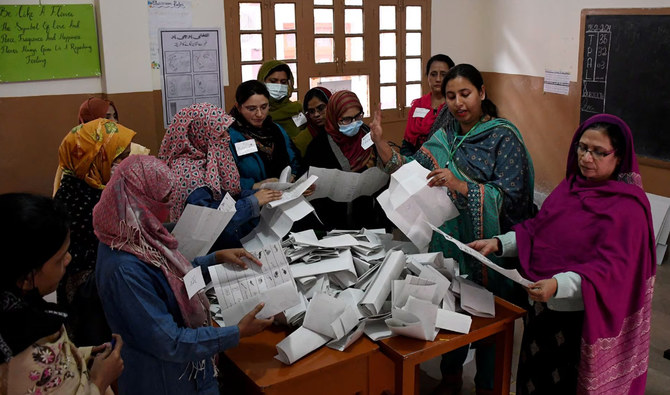
ISLAMABAD: A leading Pakistani election observer group on Sunday urged the country’s election oversight body to audit legally challenged results of Feb. 8 national election, which have been marred by widespread allegations of vote-rigging and result manipulation.
Last week’s vote to choose a new parliament was overshadowed by more than 50 incidents of violence that killed at least 16 people, a nationwide shutdown of mobile phone networks, and prolonged delays in the release of constituency results by election authorities.
While the election failed to present a clear winner, independent candidates, most loyal to former prime minister Imran Khan, won the highest 101 parliamentary seats, according to official results. But Khan’s PTI and other parties claim results in dozens of constituencies were changed in favor of opponents.
The Free and Fair Election Network (FAFEN), a Pakistani observer group monitoring electoral contests in the country since its formation in 2006, said the post-election situation warranted an urgent response by the Election Commission of Pakistan (ECP) to ascertain the veracity of claims of irregularities by political parties and candidates.
It urged the ECP to scrutinize the results of constituencies that have been duly challenged at the appropriate fora using data analytics and forensics to establish the legitimacy of the outcome.
“Such an audit must include representatives nominated by the political parties concerned as well as independent observers to ensure the transparency and credibility of the process,” the election observer group said in a statement.
“FAFEN’s proposed audit is a technical investigation that is purely based on the physical evidence i.e. official election documentation available with the Election Commission under Section 99 of the Elections Act.”
These documents include tamper-evident bags containing ballot papers, packets containing counterfoils of issued ballot papers, marked copies of electoral rolls, ballot paper account, results of the count, provisional and final consolidated statements of results, tendered ballot papers included in and excluded from the count, and others, according to FAFEN.
The first stage of audit will involve assessing the availability, authentication, completeness and correctness of the election documentation, including the result forms, and the consistency of information within and among these forms. The second stage will involve ascertainment of material effect of unverified forms on election outcome and taking corrective action, which would be followed by the determination of the omission and commission and accountability of election officials.
It urged the ECP to encourage political parties and candidates to promptly reach out to the regulator with their complaints of illegalities and violations of the Elections Act.
On Saturday, the Human Rights Commission of Pakistan (HRCP), Pakistan’s top rights group, also recommended an independent audit of polls, saying the integrity of 2024 election had been “compromised.”
The HRCP published a report of its observations on the recent elections on Saturday, with its chairperson Asad Iqbal Butt saying that their representatives carried out spot-checks in 51 constituencies across the country which indicated that Internet and cellular services shutdown and “arbitrary changes” in polling information compromised voter access to polling stations.
“The integrity of the 2024 elections was compromised, not only by lack of competence on the part of the ECP [Election Commission of Pakistan] but also by constant pressure from extra-democratic quarters and questionable decisions by the caretaker government,” Butt was quoted as saying.
The allegations of vote-rigging by several political parties have increased political uncertainty in the South Asian country of more than 241 million people.
It increased further when Liaquat Ali Chattha, a senior bureaucrat and Rawalpindi commissioner, held a news conference on Saturday wherein he admitted to his involvement in manipulation of election results in 13 national constituencies.
Chattha claimed Pakistan’s chief justice and the top ECP official were also involved in manipulating the results. Both have strongly denied the allegations.


![]()

Pakistan watchdog urges election regulator to audit legally challenged poll results
Short Url
https://arab.news/9h95c
Pakistan watchdog urges election regulator to audit legally challenged poll results
- The development comes amid protests by political parties over alleged rigging of February 8 national election
- On Saturday, a senior bureaucrat dropped a bombshell by saying he had helped rig polls in 13 constituencies
Latest updates


© 2026 SAUDI RESEARCH & PUBLISHING COMPANY, All Rights Reserved And subject to Terms of Use Agreement.