

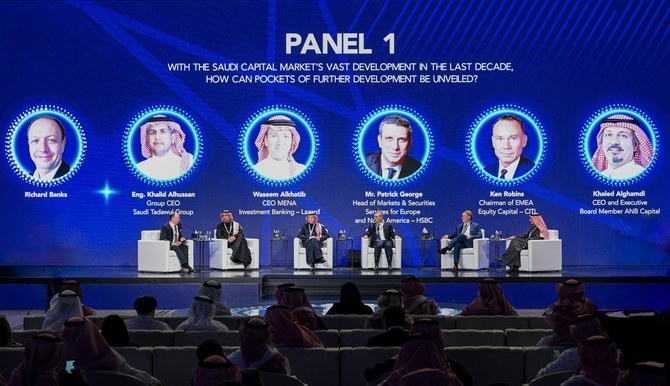

RIYADH: Global financial experts will gather in Riyadh on Monday to discuss the future of finance, evolving strategies, and innovative ideas to boost the sector’s growth at the third Saudi Capital Market Forum.
The two-day event organized by Saudi Tadawul Group, to be held under the theme “Powering Growth,” will serve as a nexus for transformative dialogue and innovation, fostering the convergence of emerging markets with established financial frameworks.
Emphasizing the pivotal role of such events, Mahmoud Khairy, an economist and policy adviser, told Arab News that “the forum facilitates essential dialogue among key stakeholders, fostering collaboration and innovation within the financial sector.”
He added: “By providing a platform for discussions on innovative financial instruments, and strategies, and fostering strategic collaborations, the event contributes to the overall efficiency and attractiveness of the capital markets.”
Khairy said the event also aligns with Vision 2030’s goals by promoting transparency, and good governance, and attracting domestic and international investments.
The educational opportunities offered at the forum also play a vital role in developing a skilled workforce necessary for the effective functioning of capital markets, according to the economist.
Khalid Al-Hussan, CEO of Saudi Tadawul Group, remarked in a statement: “As a pivotal entity in Saudi Arabia’s financial domain, Saudi Tadawul Group spearheads the development of the Kingdom’s capital market, propelling economic metamorphosis forward.”
The chairperson of Saudi Tadawul Group, Sarah Al-Suhaimi, said at the last forum that the Kingdom’s capital market is one of the strongest and fastest-growing investment destinations in the world, with a value exceeding $2.7 trillion.
Saudi Arabia has strategically positioned its capital markets to attract foreign investment by implementing comprehensive reforms, according to Khairy. “These include aligning regulatory frameworks with international standards, achieving inclusion in major global indices, diversifying financial products, conducting extensive investor outreach programs, and investing in technology and infrastructure,” he said.
Khairy added: “The liberalization of foreign ownership and the establishment of strategic partnerships with international institutions further contribute to enhancing the attractiveness and competitiveness of the Saudi capital market on the international stage.”
Culminating in the 2023 Saudi Capital Market Awards ceremony, the forum will laud market participants across 17 categories, recognizing their contributions to the evolution of the Kingdom’s market.
Speaking on the success of market participants in Saudi Arabia, Khairy said that it is contingent on a “combination of factors aligned with the goals of Vision 2030 and the Financial Sector Development Program.”
He went on to explain that “regulatory reforms and enhanced governance contribute to a transparent and stable environment, while the embrace of technology and innovation fosters efficiency and customer-centricity.”
Khairy added: “Inclusivity and talent development contribute to a skilled and diverse workforce, international collaboration enhances market competitiveness, and a focus on sustainable and responsible investing aligns with broader environmental and social objectives.”
Categories such as “IPO of the Year 2023 (Main Market & Nomu – Parallel Market),” “ESG Relations Program of the Year,” and “Broker of the Year” will be spotlighted, celebrating excellence and innovation.
In the Saudi financial sector, there is a notable trend toward integrating environmental, social, and governance considerations into investment practices. Khairy emphasized that it “is evident through increased awareness, regulatory initiatives from entities like the Capital Market Authority, and a growing emphasis on sustainable and responsible investing.”
He explained that “companies and investors are incorporating ESG criteria into decision-making processes, with a particular focus on disclosure and transparency. This trend has influenced market dynamics, driving investments toward entities demonstrating strong ESG practices, and contributing to the broader global shift toward sustainable finance.”
According to the adviser, the government’s initiatives, such as the Saudi Green Initiative and the Green Financing Program, also underscore the commitment to fostering a more sustainable and environmentally conscious financial ecosystem.
The Saudi Capital Market Forum serves as a beacon for global financial luminaries, fostering dialogue and innovation at the intersection of emerging and established markets.
Khairy said: “As the market becomes more transparent and integrated into global indices, portfolio diversification gains prominence, allowing investors to strategically allocate assets across sectors such as technology and renewable energy.
“However, the evolving nature of emerging markets introduces inherent risks, demanding careful risk assessment and dynamic risk management strategies. Currency considerations also play a crucial role, and investors must navigate potential fluctuations to optimize returns.”
The economist said that the overall effect is likely to reshape investment approaches, emphasizing an understanding of Saudi Arabia’s market dynamics and aligning portfolios with the Kingdom’s ongoing economic diversification efforts.
Among the notable figures slated to grace the event is Saudi Finance Minister Mohamad Al-Jadaan, who will deliver a keynote address, shedding light on the trajectory of Saudi Arabia’s financial sector development and elucidating the government's strategic vision.
In addition to keynote addresses, the summit is set to feature an array of engaging panel discussions covering a diverse range of topics pertinent to the capital markets landscape.
Khairy said: “The discussions focus on strategies to mobilize funds and drive investments into non-oil sectors, emphasizing financial market reforms, technology adoption, inclusivity, sustainability, and international collaboration.”
He added: “Initiatives promoting green finance, partnerships to attract foreign investments, and education for workforce development are anticipated topics.”
Moreover, the summit will facilitate intimate one-on-one sessions, providing attendees with a unique opportunity to engage directly with industry leaders and gain invaluable insights into the strategic priorities of key organizations such as oil giant Aramco, giga-project NEOM, and KAFD.
On the second day, the focus will shift toward an in-depth analysis of global economic trends and forecasts.
The CEO of Saudi Tadawul Group is scheduled to lead discussions alongside a panel of economists from renowned institutions such as Al-Rajhi Capital, Morgan Stanley, Goldman Sachs, J.P. Morgan, and EFG Hermes.


