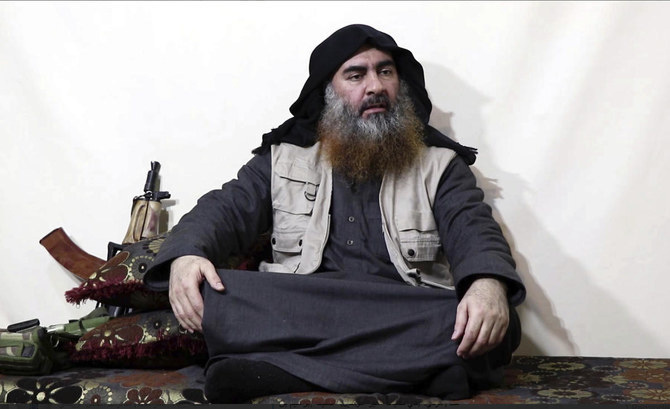
BAGHDAD: The family of slain Daesh group leader Abu Bakr Al-Baghdadi has been brought back to Iraq for interrogation, judicial officials said on Thursday.
Washington announced in October 2019 that US troops had killed Baghdadi in an operation in northwestern Syria, around five years after he proclaimed an Islamic “caliphate” which he and his fighters ruled with brutality across much of Iraq and neighboring Syria.
Iraq’s judiciary has secured “the repatriation of the family of the terrorist Abu Bakr Al-Baghdadi,” the Supreme Judicial Council said on its website.
It did not specify how many family members or where they had been repatriated from.
A judicial source, however, told AFP that Baghdadi’s wife, “detained in Turkiye,” had been returned along with her children.
The source spoke under cover of anonymity because they were not authorized to speak to the press.
According to the Judicial Council, the repatriation fell under efforts to “recover those accused of terrorism who have been on the run outside of Iraq.”
Over several years, Iraqi courts have handed down hundreds of death sentences as well as life prison terms under the penal code for membership in “a terrorist group.”
Among those convicted in Iraq were more than 500 foreign men and women found guilty of joining Daesh.
The Judicial Council said Baghdadi’s relatives had been questioned and “investigations continue with them to bring to light the most important secrets” of Daesh.
Iraq regularly repatriates citizens from Syria, particularly from Al-Hol camp, which hosts about 50,000 people, including family members of suspected militants.
Iraq’s announcement about Baghdadi’s family coincided with a broadcast on Thursday of an interview with “Baghdadi’s wife” by Saudi-owned pan-Arab TV channel Al Arabiya. It named her as Asmaa Mohamed.
In November 2019, Turkiye said it had arrested a wife of the polygamous Baghdadi, whom Turkish media identified as Asma Fawzi Muhammad Al-Qubaysi, in June 2018.
She revealed “a lot of information” about the militant group’s “inner workings,” a Turkish official said at the time.
US-backed forces defeated Daesh in Iraq in 2017, and two years later in Syria.
But remnants of the group continue to attack civilians and security forces in both countries.


![]()

Family of slain Daesh chief repatriated, questioned in Iraq: judiciary
Short Url
https://arab.news/2ys6a
Family of slain Daesh chief repatriated, questioned in Iraq: judiciary
- Iraq’s judiciary has secured “the repatriation of the family of the terrorist Abu Bakr Al-Baghdadi,” the Supreme Judicial Council said
- It did not specify how many family members or where they had been repatriated from


Latest updates


© 2026 SAUDI RESEARCH & PUBLISHING COMPANY, All Rights Reserved And subject to Terms of Use Agreement.