Palestinian President Abbas reaffirms commitment to governing Gaza after war ends

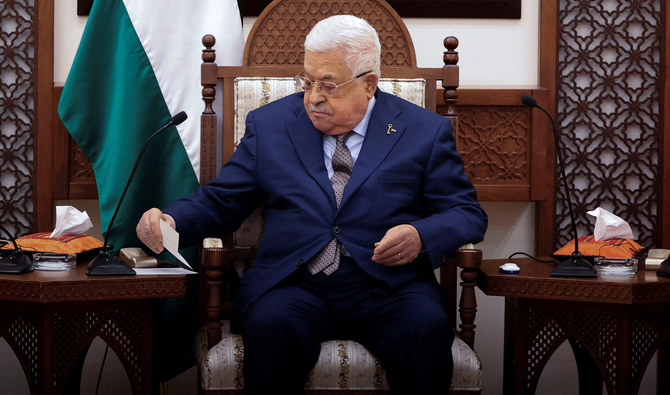
Palestinian President Mahmoud Abbas attends a meeting in Ramallah on 23 November 2023. (REUTERS/File)
Short Url
Updated 15 February 2024
Follow

Palestinian President Abbas reaffirms commitment to governing Gaza after war ends

  • No Israeli partner for lasting peace, Palestinian president tells Asharq Al-Awsat
  • Saudi Arabia praised for ‘historic, honorable, authentic, steadfast’ support

LONDON: Palestinian President Mahmoud Abbas reaffirmed his commitment to running the Gaza Strip once the current conflict ends, but warned that there could be no peace with Israel’s current government.

He told Asharq Al-Awsat that the Palestinian Authority lacks an “Israeli partner for achieving lasting peace,” describing Prime Minister Benjamin Netanyahu as “clearly a stumbling block to a political solution based on international legitimacy and law.”

Abbas said Netanyahu’s “rejection of the two-state solution and his announcement of continuing the war on Gaza are clear evidence of his public refusal of the peace process and achieving security and stability. He believes only in the logic of occupation, power, and settlement.”

Abbas said the PA is collaborating with Arab, regional, and international partners, praising Saudi Arabia for “historic, honorable, authentic, steadfast” support in the search for peace.

“Immediately upon cessation of aggression against our people,” the PA would be ready to fulfill its governing duties in Gaza, he added.

Peace remains dependent upon recognition of Palestinian statehood secured through full UN membership, Abbas said, adding that an international peace conference providing guarantees and a timeline detailing the cessation of Israel’s occupation would be necessary.

While Arab and regional support has been forthcoming, Abbas said despite positive noise coming from the US in support of a two-state solution, words and actions have yet to meet as he called for “genuine American will” to see its realization.

“We’ve had several meetings with top US officials … and they’ve assured us of their commitment to the two-state solution,” he added.

“However, despite these talks, there hasn’t been any tangible progress on the ground. Israel continues to undermine the political process, rejecting international resolutions and escalating violence against Palestinian. What matters most is action on the ground.”

Amid the violence in Gaza, Abbas pointed to growing tensions in both East Jerusalem and the West Bank, accusing Israel of killing Palestinians while protecting extremist settlers.

“We’ve warned world leaders, including the US, that if this continues, things could spiral out of control,” he cautioned, adding that there is not enough pressure on Israel to stop.

“Despite this, we’re working to keep things calm and prevent further escalation,” Abbas said. “Israel wants to avoid a political solution that ends its occupation, so it’s trying to stir up trouble.”


Libya’s Red Castle museum opens for first time since fall of Qaddafi

Updated 3 sec ago
Follow

Libya’s Red Castle museum opens for first time since fall of Qaddafi

Libya’s national museum, formerly known as As-Saraya Al-Hamra or the Red Castle, has reopened in Tripoli, allowing the public access to some of the country’s finest historical treasures for the first time since the revolt that toppled Muammar Qaddafi.
The museum, Libya’s largest, was closed in 2011 during a NATO-backed uprising against longtime ruler Qaddafi, who appeared on the castle’s ramparts to deliver a fiery speech.
Renovations were started in March 2023 by the Tripoli-based Government of National Unity (GNU), which came to power in 2021 in a UN-backed political process.
“The reopening of the National Museum is not just a cultural moment but a live testimony that Libya is building its institutions,” GNU Prime Minister Abdulhamid Al-Dbiebah said at a reopening ceremony on Friday.
Built in the 1980s, the museum’s 10,000 square meters of gallery space features mosaics and murals, sculptures, coins, and artefacts dating back to prehistoric times and stretching through Libya’s Roman, Greek and Islamic periods.
The collection also includes millennia-old mummies from the ancient settlements of Uan Muhuggiag in Libya’s deep south, and Jaghbub near its eastern border with Egypt.
“The current program focuses on enabling schools to visit the museum during this period, until it is officially opened to the public at the beginning of the year,” museum director Fatima Abdullah Ahmed told Reuters.
Libya has since recovered 21 artefacts that were smuggled out of the country after Qaddafi’s fall, notably from France, Switzerland, and the United States, the chairman of the board of directors of the antiquities department Mohamed Farj Shakshoki told Reuters ahead of the opening.
Shakshoki said that talks are ongoing to recover more than two dozen artefacts from Spain and others from Austria.
In 2022, Libya received nine artefacts, including funerary stone heads, urns and pottery from the US
Libya houses five UNESCO World Heritage sites, which it said in 2016 were all endangered due to instability and conflict.
In July, Libya’s delegation to UNESCO said the ancient city of Ghadames, one of the sites, had been removed from the list as the security situation had improved.