Pakistan coalition formation to be finalized today in talks between Sharif’s party, allies

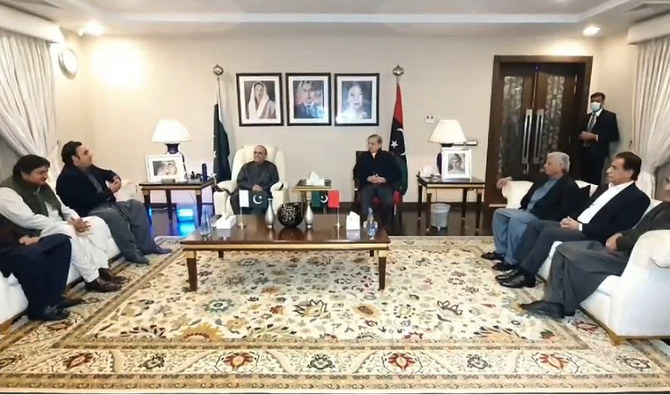
Political leaders from the major Pakistani parties, Pakistan Peoples Party and Pakistan Muslim League-Nawaz, meet in Lahore on February 11, 2024, after elections present no clear winner. (Photo courtesy: X/@MediaCellPPP)
Short Url
Updated 14 February 2024
Follow

Pakistan coalition formation to be finalized today in talks between Sharif’s party, allies

  • PPP, PML-N to meet on Thursday to finalize modalities of new coalition government
  • PTI leader says government and parliament won’t ‘survive’ without ex-PM Imran Khan

ISLAMABAD: Talks are expected to conclude today, Thursday, between the party of Pakistani former Prime Minister Nawaz Sharif and its allies who have agreed to form a coalition government at the center, with discussions revolving around appointments to important posts in the new set-up and convincing junior partners to join the administration and accept cabinet positions.
Talks were held on Wednesday between special committees set up yesterday, Tuesday, to discuss government formation by the Pakistan People’s Party (PPP) of former President Asif Ali Zardari and his son Bilawal Bhutto Zardari, and Sharif’s Pakistan Muslim League-Nawaz (PML-N). 
On Tuesday, Sharif announced that his younger brother Shehbaz Sharif would be the coalition’s prime minister candidate instead of him. He has also nominated his daughter for the post of chief minister of Punjab, the country’s most populous and richest province.
The PML-N emerged as the largest party in parliament following Feb. 8 elections while the PPP was the second largest. The PPP has backed Shehbaz as the choice for PM but has as yet not committed to joining the government, indicating it would support a minority government from the outside.
“A consultative meeting was held between the committees of Pakistan Peoples Party and Muslim League-N,” the PPP said on X.
“Proposals were made regarding inflation, unemployment and relief from poverty in the country. Pakistan People’s Party and Muslim League-N committees agreed on the need for a stable democratic government to deal with economic, political, law and order and terrorism challenges.”

The two committees will now meet tomorrow, Thursday, to finalize the modalities of government formation including getting PPP to join the administration and take cabinet positions.
Analysts say Pakistan needs a stable government with political authority to be able to take tough decisions to help pull the country out of its economic crisis and fight militancy.
It could also face new political tensions with independent members of parliament, backed by jailed former premier Imran Khan, forming the largest group in the legislature. This group is at loggerheads with the powerful military and alleges that the vote was rigged. The caretaker government and election commission have rejected those accusations. The military chief has called for “maturity and unity” after the polls.
Khan is in jail on charges of corruption and revealing state secrets, and his party was barred from contesting the election, forcing members to run as independents.
“This government cannot survive without Imran Khan, neither can the parliament sustain nor will we [PTI] allow it, neither can democracy work nor will we let it, neither can the state work,” PTI leader Latif Khosa told Geo News in an interview.
“This is the ground reality. Imran Khan was awarded three [prison] sentences, but look at how the people expressed their anger [through the vote] … There will be a backlash on PML-N as Nawaz Sharif has decided to make his brother the prime minister and daughter chief minister.”


Back from Iran, Pakistani students say they heard gunshots while confined to campus

Updated 8 sec ago
Follow

Back from Iran, Pakistani students say they heard gunshots while confined to campus

  • Students say they were confined to dormitories and unable to leave campuses amid unrest
  • Pakistani students stayed in touch with families through the embassy amid Internet blackout

ISLAMABAD: Pakistani students returning from Iran on Thursday said they heard gunshots and stories of rioting and violence while being confined to campus and not allowed out of their dormitories in the evening.

Iran’s leadership is trying to quell the worst domestic unrest since its 1979 revolution, with a rights group putting the death toll over 2,600.

As the protests swell, Tehran is seeking to deter US President Donald Trump’s repeated threats to intervene on behalf of anti-government protesters.

“During ‌nighttime, we would ‌sit inside and we would hear gunshots,” Shahanshah ‌Abbas, ⁠a fourth-year ‌student at Isfahan University of Medical Sciences, said at the Islamabad airport.

“The situation down there is that riots have been happening everywhere. People are dying. Force is being used.”

Abbas said students at the university were not allowed to leave campus and told to stay in their dormitories after 4 p.m.

“There was nothing happening on campus,” Abbas said, but in his interactions with Iranians, he ⁠heard stories of violence and chaos.

“The surrounding areas, like banks, mosques, they were damaged, set on fire ... ‌so things were really bad.”

Trump has repeatedly ‍threatened to intervene in support of protesters ‍in Iran but adopted a wait-and-see posture on Thursday after protests appeared ‍to have abated. Information flows have been hampered by an Internet blackout for a week.

“We were not allowed to go out of the university,” said Arslan Haider, a student in his final year. “The riots would mostly start later in the day.”

Haider said he was unable to contact his family due to the blackout but “now that they opened international calls, the students are ⁠getting back because their parents were concerned.”

A Pakistani diplomat in Tehran said the embassy was getting calls from many of the 3,500 students in Iran to send messages to their families back home.

“Since they don’t have Internet connections to make WhatsApp and other social network calls, what they do is they contact the embassy from local phone numbers and tell us to inform their families.”

Rimsha Akbar, who was in the middle of her final year exams at Isfahan, said international students were kept safe.

“Iranians would tell us if we are talking on Snapchat or if we were riding in a cab ... ‌that shelling had happened, tear gas had happened, and that a lot of people were killed.”