

Pakistan Muslim League-Nawaz nominates Shehbaz Sharif as coalition candidate for next PM

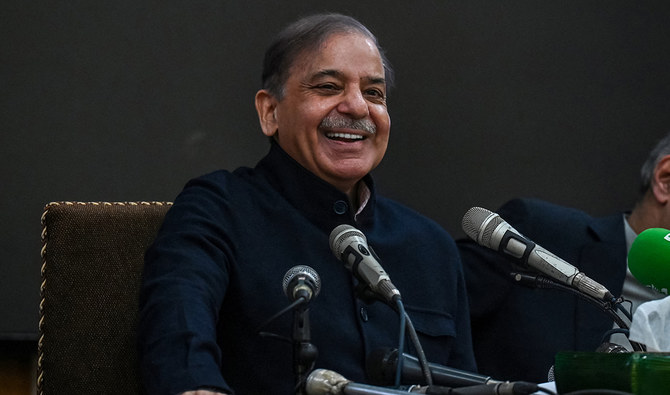
Pakistan's former Prime Minister and leader of the Pakistan Muslim League-Nawaz (PML-N) party Shehbaz Sharif speaks during a press conference in Lahore on February 13, 2024. (AFP)
Short Url
Updated 14 February 2024
Follow

Pakistan Muslim League-Nawaz nominates Shehbaz Sharif as coalition candidate for next PM

  • Nawaz Sharif was widely seen by analysts as the frontrunner for prime minister’s office 
  • PML-N President Shehbaz Sharif served as Pakistan’s PM from April 2022 to August 2023 

ISLAMABAD: Despite being viewed as the frontrunner for the country’s top political office until last week's general elections, the founding Pakistan Muslim League-Nawaz (PML-N) leader Nawaz Sharif on Tuesday nominated his younger brother Shehbaz Sharif as his party’s candidate for the prime minister’s post, a PML-N spokesperson confirmed.

The decision comes as a surprise as the elder Sharif, a former three-time prime minister who returned to the country in October 2023 after nearly four years in self-exile, was seen as the favorite candidate for the PM’s office. He was widely believed to be backed by the country’s powerful army, though both deny this. 

As the PML-N secured the largest number of seats by a political party after last week’s indecisive polls, 75, Nawaz Sharif called on allied parties last Friday to form a coalition government at the center. Many believed he would once again be nominated as the party’s candidate for the PM’s post.

“Pakistan Muslim League-Nawaz leader Muhammad Nawaz Sharif has nominated Muhammad Shehbaz Sharif for the post of prime minister of the Islamic Republic of Pakistan,” Marriyum Aurangzeb, the PML-N’s information secretary, wrote on X. 

Aurangzeb also said that Nawaz Sharif had nominated his daughter, Maryam Nawaz, for the chief minister’s post for Pakistan’s most populous Punjab province. 

“Nawaz Sharif, while thanking the people and all political parties and their leaders for providing political support, has expressed his firm belief that the decisions will help Pakistan be free from economic threats and its people will be rid of inflation,” she added. 

Shehbaz Sharif, 72, served as Pakistan’s prime minister from April 2022 to August 2023 after he led a movement to oust his predecessor, cricketer-turned-politician Imran Khan, from the PM’s office via a parliamentary vote. 

Shehbaz Sharif’s tenure was marked by political and economic instability, with Pakistan almost suffering a sovereign default as an economic crisis enveloped the country, plummeting its foreign exchange reserves and weakening its national currency significantly against the US dollar.

The younger Sharif is credited with launching a series of high-profile projects in Punjab during his multiple stints as the province’s chief minister in the past. The former prime minister enjoys a reputation domestically as an effective administrator. Analysts believe is closer to Pakistan’s powerful military compared to his older brother.

On Tuesday, a coalition of six parties including the PML-N, the PPP, the Muttahida Quami Movement Pakistan (MQM-P) and the Pakistan Muslim League-Q (PML-Q) announced joining forces to support a PML-N-led government. 

The parties vowed to unite to rid the country of its pressing economic and political issues. 
 
If elected to power, Shehbaz Sharif would have to manage a nuclear-armed country deeply in debt and would have to deal with the daunting task of negotiating a fresh bailout program with the International Monetary Fund (IMF) after its current $3 billion standby agreement expires in March.


Pakistan reviews austerity measures amid Middle East crisis, urges strict nationwide implementation

Updated 11 March 2026
Follow

Pakistan reviews austerity measures amid Middle East crisis, urges strict nationwide implementation

  • Deputy Prime Minister Ishaq Dar chairs review meeting of austerity steps
  • Officials briefed on salary cuts, school closures, four‑day week, petrol conservation

ISLAMABAD: Pakistan’s government on Wednesday assessed progress on a sweeping set of austerity measures introduced to mitigate the country’s economic strain from sharply rising global oil prices and supply disruptions linked to the ongoing war in the Middle East.

Prime Minister Shehbaz Sharif this week announced a series of austerity steps, including a four‑day work week for government offices, requiring 50  percent of staff to work from home, cutting fuel allowances for official vehicles by half, grounding up to 60  percent of the government fleet and closing all schools for two weeks to conserve fuel amid the global oil crisis.

The measures were unveiled in response to global oil market volatility triggered by the conflict involving the United States, Israel and Iran, which has disrupted supply routes such as the Strait of Hormuz and pushed crude prices sharply higher, straining Pakistan’s heavily import‑dependent energy sector.

“The meeting stressed the importance of strict and transparent adherence to the austerity measures, promoting fiscal responsibility and prudent use of public resources,” Deputy Prime Minister and Foreign Minister Senator Mohammad Ishaq Dar said in a statement.

He was chairing a meeting of the Committee for Monitoring and Implementation of Conservation and Additional Austerity Measures, constituted under the directions of the PM, bringing together federal and provincial officials to review execution of the broad cost‑cutting plan. 

Dar emphasized the government’s commitment to enforcing the PM’s austerity steps nationwide. The committee’s review also covered reductions in departmental expenditure, deductions from salaries of senior officials earning over Rs. 300,000 ($1,120), and coordination with provincial administrations to ensure uniform implementation of the plan.

Participants at the meeting reiterated that all ministries and divisions must continue strict monitoring and reporting, with transparent oversight mechanisms, as Pakistan navigates the economic pressures from the prolonged Middle East crisis and its fallout on global energy and trade markets.