



ISLAMABAD: Six Pakistani political parties, including the Pakistan Muslim League-Nawaz (PML-N) and the Pakistan Peoples Party (PPP) announced on Tuesday that they have agreed to form a coalition government at the center, seeking to end a political stalemate after last week’s inconclusive elections.
Political parties have been scrambling since last week to forge alliances for a coalition government at the center. Thursday’s general elections saw independent candidates backed by ex-PM Imran Khan’s Pakistan Tehreek-e-Insaf (PTI) win 93 seats, while PML-N obtained 75 seats, and the PPP won 54.
Khan’s PTI ruled out the possibility of a coalition government with the PPP or the PML-N, saying that it would instead forge alliances with religious parties Majlis Wahdat-e-Muslimeen (MWM) and the Jamaat-e-Islami (JI) to form coalition governments in the center, Punjab and Khyber Pakhtunkhwa (KP).
“Friends, we have decided that we will sit together to form a government and pull Pakistan out of its problems,” PPP Co-Chairman Asif Ali Zardari told reporters at a news conference held at the residence of Chaudhry Shujaat Hussain, the leader of the Pakistan Muslim League (Q) party.
The press conference took place after Zardari, PML-N President Shehbaz Sharif, Istehkam-e-Pakistan Party (IPP) leader Aleem Khan, Balochistan Awami Party (BAP) representative Sadiq Sanjrani, Muttahida Quami Movement Pakistan (MQM-P) leader Dr. Khalid Maqbool Siddiqui and Hussain held a detailed meeting.
Zardari called for reconciliation, inviting the PTI to hold talks with other parties on tackling the host of crises that Pakistan faces.
“We welcome them [PTI] to join us in this process, and all political forces are invited to engage in discussions about reconciliation,” the PPP co-chairman said.
In a surprise development, PML-N information secretary Marriyum Aurangzeb announced on social media platform X that the party’s chief, Nawaz Sharif, had nominated his younger brother, Shehbaz Sharif, as its candidate for the prime minister’s post.
She said he had also nominated his daughter, Maryam Nawaz Sharif, for the post of Punjab chief minister.
Speaking at the press conference, Shehbaz Sharif said Pakistan’s economic crisis was the most important challenge facing the country at the moment.
“Only those nations move forward whose leadership unites and decides to end their differences to ensure their people’s progress,” he said. He pointed out that the new government would have to “fight a war” against unemployment and inflation.
MQM-P leader Siddiqui vowed to support a PML-N-led government at the center.
“With mutual cooperation, we will strengthen democracy and support Mian Shehbaz Sharif,” he told reporters. “We have supported him before and will do so in future.”
Political parties need to boost their seat count to the required 169 in the National Assembly. Along with the 266 directly elected seats, there are also 70 reserved seats — 60 for women and 10 for non-Muslims— allocated based on each party’s strength in the National Assembly, to determine their final standing.
A prime ministerial candidate needs to demonstrate a simple majority of 169 seats in the National Assembly, which consists of 336 seats.’
While the PPP, PML-N and MQM-P have a combined strength of 146 seats, the IPP has two seats, the PML-Q has three seats and the BAP has one.
Bhutto Zardari says PPP not to be part of government
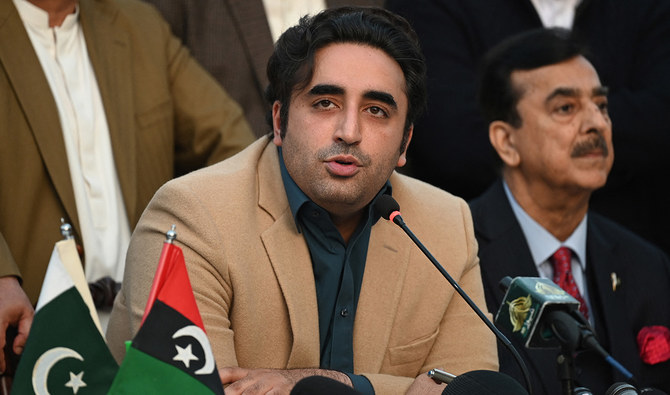
Earlier on Tuesday, PPP Chairman Bilawal Bhutto-Zardari had announced his party would support the PML-N’s candidate for the prime minister’s post. However, he said the PPP would not be part of the government and that he would pull out of the race for the premiership.
“We are not in a position to join the federal government ourselves, we are not interested in taking ministries, but we also don’t want to see political chaos and perpetual chaos in the country,” Bhutto Zardari told reporters at a news conference at Zardari House in Islamabad.
“We will be willing to support [the PML-N] on an issue-to-issue basis, in case of important votes, candidate for prime minister of Pakistan and to ensure the government is formed, and political stability is restored,” he added.
The Bhutto scion said he was pulling out of the race for Pakistan’s prime minister.
“The reality is that the Pakistan Peoples Party does not have a mandate to form the federal government and because of that, I will not be putting myself forward for the candidacy of prime minister of Pakistan,” he announced.
He said the PPP had formed a committee to engage with other parties to form the government. He said the committee would deliberate on the PPP’s vote on important issues such as the national budget, the prime minister’s election, and important legislation. Bhutto Zardari said the party would also field its candidates for the National Assembly speaker, chairman of the Senate, and president.


