

Ex-PM Khan warns against forming government with ‘stolen votes,’ party announces alliance with MWM

1 / 2
Leaders of Pakistan Tehreek-e-Insaf (PTI) party Raoof Hasan along with Ahmad Awais (L) speaks during a press conference in Islamabad on February 6, 2024. (AFP/File)
2 / 2
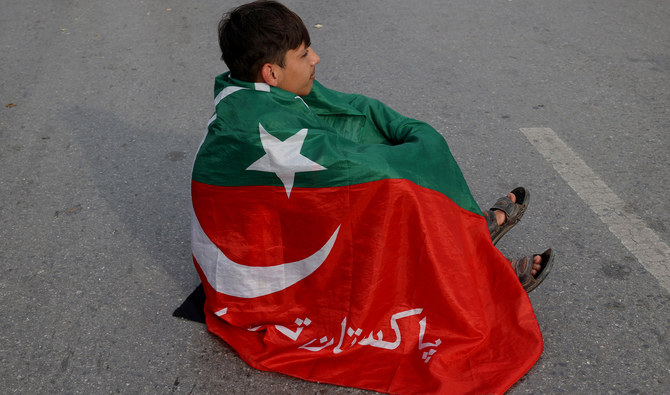
A supporter of Pakistani former Prime Minister Imran Khan's party, the Pakistan Tehreek-e-Insaf (PTI), wrapped in the party flag, sits on a road as demonstrators block the Peshawar-Islamabad motorway as part of a protest against the results of the election, in Peshawar, Pakistan, on February 12, 2024. (REUTERS)
Short Url
Updated 13 February 2024
Follow

Ex-PM Khan warns against forming government with ‘stolen votes,’ party announces alliance with MWM

  • In message from jail, ex-PM Khan says a government without the genuine mandate would send economy in a “downward spiral” 
  • Khan’s PTI announces alliances with religious parties to form coalition governments in center, Punjab, Khyber Pakhtunkhwa 

ISLAMABAD: Former prime minister Imran Khan on Tuesday warned rivals against forming a government with “stolen votes,” hours after his Pakistan Tehreek-e-Insaf (PTI) party announced alliances with religious parties Majlis Wahdat-e-Muslimeen (MWM) and the Jamaat-e-Islami (JI) to form coalition governments in the center, Punjab and Khyber Pakhtunkhwa (KP). 

Last week’s general elections in Pakistan heightened political uncertainty in the country, as the results showed no party won the majority to form its government at the center. Independent candidates backed by PTI won 93 seats, while Pakistan Muslim League-Nawaz (PML-N) obtained 75 seats, and the Pakistan Peoples Party (PPP) won 54.

After Khan’s PTI rejected the possibility of forming a coalition government with the PPP, PML-N or the Muttahida Quami Movement Pakistan (MQM), PPP Chairman Bilawal Bhutto Zardari announced on Tuesday his party would support the PML-N’s candidate for prime minister. 

Khan’s party held nationwide protests over the weekend and on Monday against what it calls rigging during elections. The party has accused Pakistan’s election regulator of rigging the polls, a charge vehemently denied by the Election Commission of Pakistan (ECP). 

In a message from jail shared from his official X account, Khan thanked supporters for entrusting his party with a two-thirds “resounding” majority, adding that there was a dire need for fairness and democracy in Pakistan’s elections. 

“I warn against the misadventure of forming a government with stolen votes,” his message read. 

“Such daylight robbery will not only be a disrespect to the citizens, but will also push the country’s economy further into a downward spiral.”

The former prime minister said his party would “never compromise” on the people’s will.

“I have categorically instructed my party against engaging with any political party that has robbed people’s mandate, including PPP, PMLN & MQM,” he said. 

PTI announces alliances with MWM, JI 

The PML-N and the PPP initiated coalition talks last week to boost their seat count to the required 169, including alliances with smaller parties and defectors from PTI. Along with the 266 directly elected seats, there are also 70 reserved seats — 60 for women and 10 for non-Muslims— allocated based on each party’s strength in the National Assembly, to determine their final standing. 

A prime ministerial candidate needs to demonstrate a simple majority of 169 seats in the National Assembly, which consists of 336 seats.

On Tuesday, the PTI announced it would attempt to form its government in the center, KP and Punjab through alliances with religious parties. 

“I have met Khan in jail today [Tuesday] and he has given the approval to form a coalition [government] with the MWM at the center and Punjab levels, and the JI in KP,” Raoof Hasan, the party’s spokesperson, told reporters at a news conference. 

The MWM, a religious party that advocates for the rights of Shia Muslims, secured victory from only one National Assembly constituency in last week’s elections. Senior leaders of the PTI and MWM both confirmed last week they were in talks for Khan’s independent candidates to merge with the religious party.

If the independents want to gain reserved seats, they must join another party to form a bloc. 

Hasan said the PTI had decided to secure the quota of reserved seats in parliament, which was possible through an alliance with another party. 

“Moreover, Khan has decided to nominate Gandapur as the PTI’s candidate for chief minister in KP,” he said, referring to former federal minister and PTI leader, Ali Amin Gandapur. 

Independent candidates backed by Khan secured the most number of seats in KP, 90, while the JI won three. The Jamiat Ulama-e-Islam Pakistan (JUI-F) won seven seats while the PPP secured victory from four constituencies in the province. 

On Tuesday, former premier Shehbaz Sharif said independent candidates backed by Khan were welcome to form a government if they could prove their majority in parliament. But if they failed to do so, other parties would go ahead and form a government, and his PML-N was in talks with some groups for this purpose.


Pakistan, global crypto exchange discuss modernizing digital payments, creating job prospects 

Updated 05 December 2025
Follow

Pakistan, global crypto exchange discuss modernizing digital payments, creating job prospects 

  • Pakistani officials, Binance team discuss coordination between Islamabad, local banks and global exchanges
  • Pakistan has attempted to tap into growing crypto market to curb illicit transactions, improve oversight

ISLAMABAD: Pakistan’s finance officials and the team of a global cryptocurrency exchange on Friday held discussions aimed at modernizing the country’s digital payments system and building local talent pipelines to meet rising demand for blockchain and Web3 skills, the finance ministry said.

The development took place during a high-level meeting between Finance Minister Muhammad Aurangzeb, Pakistan Virtual Assets Regulatory Authority (PVARA) Chairman Bilal bin Saqib, domestic bank presidents and a Binance team led by Global CEO Richard Teng. The meeting was held to advance work on Pakistan’s National Digital Asset Framework, a regulatory setup to govern Pakistan’s digital assets.

Pakistan has been moving to regulate its fast-growing crypto and digital assets market by bringing virtual asset service providers (VASPs) under a formal licensing regime. Officials say the push is aimed at curbing illicit transactions, improving oversight, and encouraging innovation in blockchain-based financial services.

“Participants reviewed opportunities to modernize Pakistan’s digital payments landscape, noting that blockchain-based systems could significantly reduce costs from the country’s $38 billion annual remittance flows,” the finance ministry said in a statement. 

“Discussions also emphasized building local talent pipelines to meet rising global demand for blockchain and Web3 skills, creating high-value employment prospects for Pakistani youth.”

Blockchain is a type of digital database that is shared, transparent and tamper-resistant. Instead of being stored on one computer, the data is kept on a distributed network of computers, making it very hard to alter or hack.

Web3 refers to the next generation of the Internet built using blockchain, focusing on giving users more control over their data, identity and digital assets rather than big tech companies controlling it.

Participants of the meeting also discussed sovereign debt tokenization, which is the process of converting a country’s debt such as government bonds, into digital tokens on a blockchain, the ministry said. 

Aurangzeb called for close coordination between the government, domestic banks and global exchanges to modernize Pakistan’s payment landscape.

Participants of the meeting also discussed considering a “time-bound amnesty” to encourage users to move assets onto regulated platforms, stressing the need for stronger verifications and a risk-mitigation system.

Pakistan has attempted in recent months to tap into the country’s growing crypto market, crack down on money laundering and terror financing, and promote responsible innovation — a move analysts say could bring an estimated $25 billion in virtual assets into the tax net.

In September, Islamabad invited international crypto exchanges and other VASPs to apply for licenses to operate in the country, a step aimed at formalizing and regulating its fast-growing digital market.