

Greece must address role in migrant vessel disaster that killed 600: Amnesty

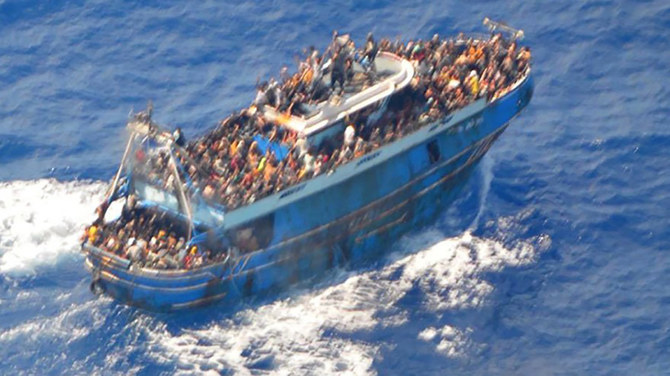
This image released by The Hellenic Coastguard on June 14, 2023, shows an aerial view taken from a rescue helicopter, of migrants onboard a fishing vessel in the waters off the Peloponnese coast of Greece on June 13, 2023. (AFP)
Short Url
Updated 12 February 2024
Follow

Greece must address role in migrant vessel disaster that killed 600: Amnesty

  • Fishing trawler capsized off Greek coast last year, killing Syrians, Pakistanis and Egyptians
  • Evidence implicates Greek authorities, EU border agency in sinking and failed rescue effort

LONDON: Greece must address its responsibilities over the capsizing of a migrant vessel last year that led to the deaths of more than 600 people, Amnesty International said on Monday ahead of its participation in a European Parliament committee on Wednesday to discuss the sinking of the Adriana off the cost of Pylos on June 14, 2023.

The human rights group previously released evidence implicating Greek authorities and the Hellenic Coast Guard in the disaster, and criticized the government’s subsequent investigation into the incident.

“Consistent and credible allegations implicate the responsibility of the Greek authorities and the Hellenic Coast Guard in the devastating capsizing of the Adriana, and in a deeply flawed rescue response, which resulted in the tragic loss of more than 600 lives,” said Adriana Tidona, Amnesty’s migration researcher.

“Eight months have passed since this preventable disaster, yet the lack of accountability surrounding the Pylos shipwreck persists, denying survivors and victims’ families the truth and justice they deserve.

“There is little indication that Greek authorities learned any lessons from this unacceptable loss of life, as reports of violent pushbacks of migrants at the country’s borders continue unabated. In the aftermath of this disaster, it is imperative that authorities are held to account.”

Migrants from Syria, Pakistan and Egypt made up the majority of the deaths from the disaster.

Amnesty has also criticized Frontex, the European Border and Coast Guard Agency, over its role in the failed rescue mission.

The EU must ensure that Greece’s border protection is monitored by independent human rights organizations, Tidona said.

“European institutions must intensify their efforts to ensure that any funding for Greece’s migration management does not contribute to human rights violations, and to guarantee that effective and independent human rights monitoring mechanisms are put in place in border and search and rescue operations to prevent further loss of life.”


Afghan man goes on trial over deadly Munich car-ramming

Updated 4 sec ago
Follow

Afghan man goes on trial over deadly Munich car-ramming

  • The suspect, partially identified as Farhad N., 25, remained silent and did not offer a statement at the opening of the trial
  • He faces two charges of murder and 44 of attempted murder

MUNICH: An Afghan man went on trial in Germany on Friday accused of ramming a car into a crowd in Munich last year, killing a two-year-old girl and her mother and injuring dozens.
The suspect, partially identified as Farhad N., 25, remained silent and did not offer a statement at the opening of the trial, sitting in the dock wearing a green fur-lined hooded jacket.
He faces two charges of murder and 44 of attempted murder, with prosecutors saying he acted out of a “religious motivation” and expected to die in the attack.
The vehicle rampage in February 2025 was one of several deadly attacks linked to migrants which inflamed a heated debate on immigration ahead of a general election that month.
Farhad N. is accused of deliberately steering his car into a 1,400-strong trade union street rally in Munich on February 13.
The vehicle came to a halt after 23 meters (75 feet) “because its front wheels lost contact with the ground due to people lying in front of and underneath the car,” according to the charge sheet.
A 37-year-old woman and her young daughter were both hurled through the air for 10 meters and sustained severe head injuries, of which they died several days later.
Prosecutors have said Kabul-born Farhad N. “committed the act out of excessive religious motivation,” and that he had uttered the words “Allahu Akbar,” meaning “God is the greatest,” after the car rampage.
“He believed he was obliged to attack and kill randomly selected people in Germany in response to the suffering of Muslims in Islamic countries,” they said when he was charged in August.
However, he is not believed to have been part of any Islamist militant movement such as the Daesh group.
Farhad N. was examined by a psychiatrist after exhibiting “certain unusual behaviors” during pretrial detention, including a tic in which he sometimes twitches his head, a court spokesman said on Friday.
The preliminary psychiatric report concluded that he is criminally responsible, but the presiding judge has said that the issue could be considered during the proceedings, according to the spokesman.
The trial is scheduled to run for 38 days until the end of June.

- Spate of attacks -

Farhad N. arrived in Germany in 2016 as an unaccompanied teenager, having traveled overland at the height of the mass migrant influx to Europe.
His asylum request was rejected but he was spared deportation, found work with a series of jobs and was able to remain in the country.
Police said Farhad N. worked in security and was heavily engaged in fitness training and bodybuilding.
The Munich attack came a month after another Afghan man had carried out a knife attack on a kindergarten group that killed two people, including a two-year-old boy, in the city of Aschaffenburg.
The perpetrator was later confined to a psychiatric facility after judges found he had acted during an acute psychotic episode.
In December 2024, six people were killed and hundreds wounded when a car plowed into a Christmas market in the eastern city of Magdeburg. A Saudi man was arrested and is currently on trial.
Several Syrian nationals were also arrested over attacks or plots at around the same time, including a stabbing spree that killed three people at a street festival in the city of Solingen.
Germany took in more than a million asylum seekers in 2015-2016 — an influx that has proved deeply divisive and helped fuel the rise of the far-right AfD.
Chancellor Friedrich Merz, who took power last May, has vowed to crack down on criminal migrants and has ramped up deportations of convicts to Afghanistan.
Germany in December also deported a man to Syria for the first time since that country’s civil war broke out in 2011.