

Prominent scholar honors Faiz Ahmed Faiz, Pakistani poet who wrote odes to Gaza

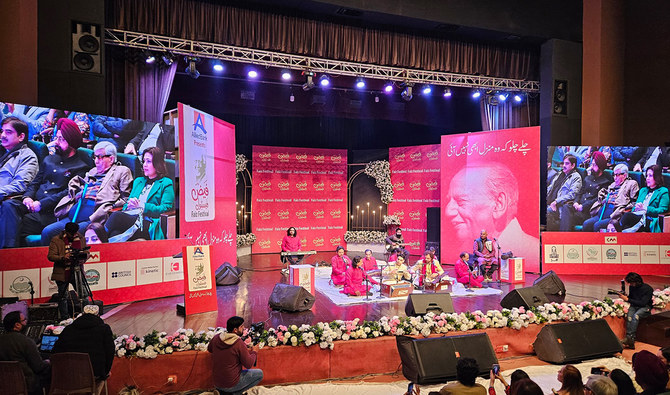
Musicians perform at the Faiz International Festival in Lahore, Pakistan on February 10, 2024. (Photo courtesy: @NimerSultany/X)
Short Url
Updated 12 February 2024
Follow

Prominent scholar honors Faiz Ahmed Faiz, Pakistani poet who wrote odes to Gaza

  • Palestinian author Dr. Nimer Sultany attends Lahore’s annual Faiz Festival, holds panel with Palestinian students 
  • Faiz penned powerful poems giving voice to the pain, anger, and resilience of Palestinian people and children 

LAHORE: Prominent Palestinian scholar Dr. Nimer Sultany honored one of Pakistan’s greatest poets, Faiz Ahmed Faiz, during a visit to Lahore this month, remembering his odes to the Palestinian cause and people and the friendships he developed with the territory’s poets and political leaders.

Sultany, who holds a Doctor of Juridical Science degree from Harvard Law School, was in Lahore on Sunday to attend the Faiz Festival, an annual cultural event that honors the life and work of Faiz Ahmed Faiz, one of Pakistan’s most renowned Urdu poets, intellectuals and political activists. 

On Sunday, he appeared on a panel called ‘Lahu Ka Parcham: Palestine-Everyday Battles’ in conversation with three young Palestinian students currently enrolled at Pakistani universities. The panel was hosted by Dr. Osman Siddique, an author and law professor at the Lahore University of Management Sciences.

“I’m very pleased to be here at the Faiz Festival [in Lahore] and that’s because of the connection that Faiz, as one of the great poets of Pakistan, [had] with the Palestinian revolution and the Palestinian movement for liberation,” Sutany, at present a Reader in Public law at SOAS in London, told Arab News in an interview. 

Faiz had close ties with Yasser Arafat, former chairman of the Palestinian Liberation Organization (PLO), and named one of his grandchildren after the Palestinian politican leader. He was also close to the celebrated Arab poet Mahmood Darwish, regarded as Palestine’s national poet. During his years in exile, Faiz also met Edward Said, the towering Palestinian intellectual, through a common friend Eqbal Ahmad, another Pakistani scholar and activist.

In 1978, during his exile in Beirut, Faiz became the first non-Arab editor of Lotus, a magazine of Afro-Asian writers, after its editor, the Egyptian writer Youssef Al-Sebai, was assassinated in Cyprus.

Marred by his own exile and loss, Faiz penned powerful poems giving voice to the pain, anger, and resilience of Palestinians. Memorable odes included “Falastini Bachche Ke Liye Lori” (A Lullaby for Palestinian Children) and “Falastini Shohda Jo Pardes Mein Kaam Aae” (Palestinian Martyrs Who Died Abroad).

“Not only did he [Faiz] write poems for Palestine but he also lived, in fact, in Beirut in the late ‘70s, early 1982, until Israel invaded Lebanon and then he, alongside other Palestinians there, had to leave Beirut and Lebanon,” Sultany said.

“So this form of solidarity [by Faiz], this form of intertwinement of the cause of human freedom generally and Palestinian freedom specifically which we personally cherish and we would like to maintain it, and foster it.”

Sultany said he was grateful to the Pakistani people’s continuing solidarity with Palestinians:

“Anything that the Pakistani government and the Pakistani people can do, to alleviate the suffering in Gaza and Palestine more generally, would be much appreciated because these acts of solidarity show that the people who are being brutalized, who are under the genocidal war, under apartheid, they know that they are not forsaken and people elsewhere in the world sympathize with them and, to the extent they can, help as much as they can to alleviate the suffering of the Palestinians.” 

Palestinian students who were part of the panel also shared their experiences of living under Israeli occupation and praised their Pakistani peers for their support. 

Mahmoud Younis, a student at the University of Central Punjab in Lahore, described the daily anguish of Gazan students living in Pakistan who did not know if their families were alive amid Isarel’s relentless military campaign in Gaza, in which over 28,000 Palestinians have been killed since Oct. 7. 

The Israeli bombardment and ground offensive began after Hamaz carried out an attack on Isarel in October, the deadliest day for Israel in decades, with around 1,200 people killed and some 240 seized and taken as hostages into Gaza, according to Israeli tallies.

“For two weeks, they [Palestinian students] don’t know if their families are alive or not, so it’s very difficult,” Younis said. 

“They have uprooted 600 olive trees in my home village since October,” Izzeldine Ayaad, a student of the University of Lahore (UOL), saud. “Six hundred olive trees are not Hamas; they don’t have an ideology or a religion. This is simply an empire expanding its land at the cost of Palestine.”

Ibrahim Bilal, a Palestinian civil engineering student, said he had organized many protests in Pakistan and participated in numerous campaigns to help his people. 

“Speaking of my experience with my Pakistani friends,” he said, “I have seen the support [for Palestine] in every eye I have seen here in Pakistan.”


Pakistan opposition to hold protest today over jailed ex-PM Khan’s deteriorating eye condition

Updated 34 min 27 sec ago
Follow

Pakistan opposition to hold protest today over jailed ex-PM Khan’s deteriorating eye condition

  • A court-appointed lawyer this week visited Imran Khan at prison and recommended independent ophthalmology review of his right eye
  • Information Minister Attaullah Tarar said Khan party’s narrative has ‘fallen flat on its face’ after ex-PM voiced ‘satisfaction’ with facilities

ISLAMABAD: Pakistan’s opposition alliance has announced a sit-in outside the Parliament House in Islamabad today, Friday, over jailed former prime minister Imran Khan’s deteriorating eye condition, following a rare prison visit by a Supreme Court-appointed lawyer this week.

Barrister Salman Safdar, who was appointed ‘amicus curiae,’ or friend of the court, visited Khan at Rawalpindi’s Adiala jail on Feb. 10 and filed a detailed report on his living conditions and health, which was made public on Thursday.

The report stated that in view of the seriousness of Khan’s ocular condition, “it is imperative that the seriousness of the condition be independently ascertained without delay.” There was no immediate response from prison authorities on the findings.

The Tehreek-e-Tahafuz-e-Ayin-e-Pakistan opposition alliance late Thursday demanded that Khan be transferred to Al-Shifa Hospital and announced a sit-in outside parliament until the former prime minister is allowed treatment in the presence of his personal physicians.

“The sit-in will be held tomorrow,” Mahmood Khan Achakzai, the head of the opposition alliance, told reporters in Islamabad, adding that they will peacefully lay down all demands at the sit-in. “If, God forbids, something happens, then the government will be responsible for that.”

Khan, 73, has been in custody since August 2023 in connection with multiple cases that he and his party describe as politically motivated. The government denies the allegation.

Concerns about Khan’s health have resurfaced in recent weeks after authorities confirmed he had been briefly taken from prison to a hospital in Islamabad for an eye procedure. The government said at the time his condition was stable, while Khan’s family and his Pakistan Tehreek-e-Insaf (PTI) political party complained they had not been informed in advance and alleged he was being denied timely and independent medical access.

The issue was then taken up by the Supreme Court earlier this week, which tasked Safdar, who has represented Khan in the past, with visiting the ex-premier and submitting a written report.

According to a medical condition report from the Pakistan Institute of Medical Sciences (PIMS), dated Feb. 6, 2026 and referenced in Safdar’s court filing, Khan was diagnosed with “right central retinal vein occlusion” after reporting reduced vision in his right eye.

The report states that he underwent anti-VEGF intravitreal injection treatment at PIMS and was discharged with follow-up advice.

However, in his interaction with Safdar, Khan said he had experienced “rapid and substantial loss of vision over the preceding three months” and claimed his complaints had not been addressed promptly while in custody. He further stated that despite treatment, he had been left with “only 15 percent vision in his right eye.”

Safdar’s report notes that the former premier appeared “visibly perturbed and deeply distressed by the loss of vision and the absence of timely and specialized medical intervention.” The amicus also recommended that the Supreme Court consider directing involvement of Khan’s personal physicians or other specialists of his choice, warning that “any further delay poses a serious risk to the Petitioner’s well-being.”

Beyond medical concerns, the report addressed Khan’s confinement conditions, noting that he expressed “satisfaction regarding his safety and security within the cell-block,” as well as contentment with basic amenities and food provisions.

Responding to the report, Information Minister Attaullah Tarar rejected claims of mistreatment, saying the “narrative being propagated to international media” by Khan’s family had “fallen flat on its face.”

He said the prison report on Khan’s daily routine and diet had removed any ambiguity and maintained that all facilities were available to the former premier, who he said enjoyed privileges “more than any other prisoner.” His X post did not address the allegations on Khan’s health issues.