

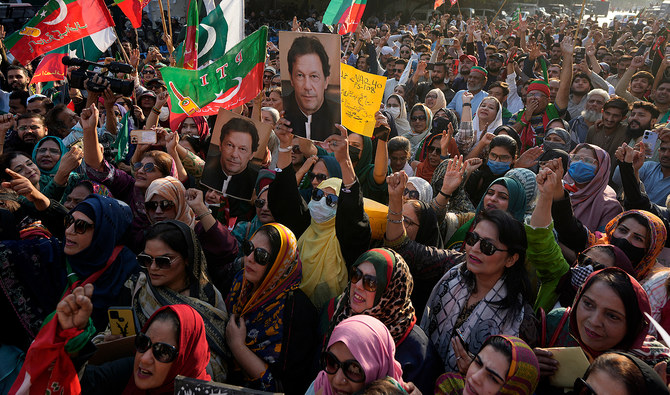

ISLAMABAD/KARACHI/QUETTA/PESHAWAR: Former prime minister Imran Khan’s Pakistan Tehreek-e-Insaf (PTI) and several other political parties on Sunday staged demonstrations in multiple Pakistani cities over what they called “rigging” and manipulation of results of this week’s national election.
The February 8 national election in Pakistan experienced significant delays in vote count, raising suspicions of electoral manipulation and prompting calls for protests from various political factions who alleged their mandate had been “compromised.”
As the final results trickled in late Saturday, independent candidates, most of whom were loyal to PTI, had won 101 seats of the 266-member National Assembly, according to official results shared by the Election Commission of Pakistan (ECP). The Pakistan Muslim League-Nawaz (PML-N) won 74 seats, followed by the Pakistan Peoples Party (PPP) with 54 seats. The rest of the seats went to smaller parties.
In a message on X, Khan’s PTI issued a call for “peaceful protests” in various parts of Punjab against alleged irregularities after its chairman said a day earlier the party’s victory had been turned into defeat on 22 National Assembly seats, including three in Islamabad, four in Sindh and the rest in the Punjab province.
Seemabia Tahir, president of the PTI North Punjab chapter who contested elections in NA-57 Rawalpindi constituency, led a protest in front of office of the returning officer (RO) at Rawalpindi’s Sadiqabad roundabout.
“Our demand is very simple, they have to provide us the result on the basis of form 45 and that’s it, nothing else,” she told Arab News.
“We just want our right and we are not demanding anything else. We are holding a peaceful protest here and we will disperse after a few minutes.”
Form 45 is the document distributed to the polling agents of all political parties at every polling station, which mentions the results of that particular polling station with signatures of the concerned polling officer, while Form 47 is the overall result document issued by the returning officer of each constituency, which is then sent to the ECP as the final result. Form 47 contains the number of rejected votes and the breakdown of votes for each candidate about the unofficial results of an electoral constituency.
Tahir said Form 45 and Form 47 in her constituency had discrepancies and did not correspond with each other. “We are demanding the election commission provide us our result on the basis of form 45 and that’s it,” she added.
Authorities warned they would take strict action, saying Section 144 orders were in place — a colonial-era law banning public gatherings.
“Some individuals are inciting illegal gatherings around the Election Commission and other government offices,” a statement from Islamabad’s police force said on Sunday.
“Legal action will be taken against unlawful assemblies. It should be noted that soliciting for gatherings is also a crime,” it said.
A similar warning was also issued in Rawalpindi, where police fired tear gas at a crowd of dozens of PTI supporters after they refused orders to stop picketing an office used to collect election results.
In Lahore, dozens of police equipped with riot gear assembled near the Liberty Market, while another gathering of around 200 PTI supporters dispersed quickly when police moved in with riot shields and batons.
In the southern city of Karachi, hundreds of PTI supporters gathered outside the ECP office to protest what they said was manipulation of election results in different constituencies. The protesters held placards and demanded officials reissue the “correct results.”
“Our candidates were leading, but overnight the results changed, and other candidates move ahead. They cannot commit this injustice, Zainab, a PTI protester who gave only her first name, told Arab News.
“The people here not only know how to cast their votes but also how to protect them. We will fully safeguard our mandate.”
Local media reported several people were detained in the southern Pakistani city, when they refused orders to clear the area.
“We are here to protest because the elections have been rigged,” said Sana Raees, another protester. “The PTI was winning on many seats, but they changed the results and snatched seats from us.”
The Jamaat-e-Islami also held demonstrations at six different locations across Karachi to protest alleged irregularities, while the Jamiat Ulema-e-Islam (JUI), which is led by Maulana Fazlur Rehman, blocked the Quetta-Karachi highway near Hub in Balochistan to protest alleged rigging of polls in the Sindh province.
The PPP won majority of seats in Sindh in Thursday’s vote, followed by the Muttahida Qaumi Movement-Pakistan (MQM-P) that emerged as the biggest party in Karachi.
In Balochistan’s provincial capital of Quetta, several political parties continued their protest for the third consecutive day on Sunday, saying the Feb. 8 elections were “rigged.”
These parties included the PTI, PPP, JUI, Balochistan National Party-Mengal (BNP-M), National Party (NP), Hazara Democratic Party (HDP) and the PashtoonKhwa Mili Awami Party (PKMAP). The protesters, who were camped outside the deputy commissioner’s office in Quetta, said Form-45 results were changed in many constituencies of the southwestern province.
“Blatant rigging happened in Balochistan, many candidates got elected but later on the results were manipulated on 9th, 10th and 11th February,” Sana Baloch, a BNP-M candidate from Kharan, told Arab News.
“Presiding officers were directly involved in manipulating the results, hence we have submitted an application to investigate the systematic rigging in majority parts of Balochistan.”
The PPP and JUI each won 11 provincial seats, followed by the PML-N with 10 seats in Balochistan.
Protests against alleged manipulation of results disrupted traffic in Quetta, Chaman, Kalat, Chaghi, Sibi, Loralai and Killa Saifullah districts of Balochistan.
Munawara Baloch, a former lawmaker, said they were out on the streets to protect the mandate given to them by the people of Balochistan.
“People in the southwestern province voted for Imran Khan, but results of PTI candidates were manipulated,” she told Arab News.
In Peshawar, provincial capital of the Khyber Pakhtunkhwa province, where the independents swept the polls by winning 90 out of 112 provincial seats, the Awami National Party (ANP) said it rejected the results of Feb. 8 polls, describing them as the “worst elections.”
The ANP ruled the Khyber Pakhtunkhwa province along with the PPP from 2008 till 2013, however, it could only secure one provincial seat in Thursday’s vote.
“We reject these results and are not ready to accept them under any circumstances,” Aimal Wali Khan, the ANP provincial president told reporters in Peshawar. “ANP demands that all constituencies of Khyber Pakhtunkhwa be opened as a large number of bogus votes were cast.”
Aimal said they would soon announce a protest campaign throughout the province, if their demands were not accepted by authorities.


