NEW YORK: Republican front-runner Donald Trump said Saturday that, as president, he warned NATO allies that he “would encourage” Russia “to do whatever the hell they want” to countries that are “delinquent” as he ramped up his attacks on foreign aid and longstanding international alliances.
Speaking at a rally in Conway, South Carolina, Trump recounted a story he has told before about an unidentified NATO member who confronted him over his threat not to defend members who fail to meet the trans-Atlantic alliance’s defense spending targets.
But this time, Trump went further, saying had told the member that he would, in fact, “encourage” Russia to do as it wishes in that case.
“‘You didn’t pay? You’re delinquent?’” Trump recounted saying. “‘No I would not protect you. In fact, I would encourage them to do whatever the hell they want. You gotta pay. You gotta pay your bills.’”
NATO allies agreed in 2014, after Russia annexed Ukraine’s Crimean Peninsula, to halt the spending cuts they had made after the Cold War and move toward spending 2 percent of their GDPs on defense by 2024.
Trump’s comments come as Ukraine remains mired in its efforts to stave off Russia’s 2022 invasion and as Republicans in Congress have become increasingly skeptical of providing additional aid money to the country as it struggles with stalled counteroffensives and weapons shortfalls.
They also come as Trump and his team are increasingly confident he will lock up the nomination in the coming weeks following commanding victories in the first votes of the 2024 Republican nominating calendar.
Earlier Saturday, Trump called for the end of foreign aid “WITHOUT “STRINGS” ATTACHED,” arguing that the US should dramatically curtail the way it provides money.
“FROM THIS POINT FORWARD, ARE YOU LISTENING US SENATE(?), NO MONEY IN THE FORM OF FOREIGN AID SHOULD BE GIVEN TO ANY COUNTRY UNLESS IT IS DONE AS A LOAN, NOT JUST A GIVEAWAY,” Trump wrote on his social media network in all-caps letters.
Trump went on to say the money could be loaned “ON EXTRAORDINARILY GOOD TERMS,” with no interest and no date for repayment. But he said that, “IF THE COUNTRY WE ARE HELPING EVER TURNS AGAINST US, OR STRIKES IT RICH SOMETIME IN THE FUTURE, THE LOAN WILL BE PAID OFF AND THE MONEY RETURNED TO THE UNITED STATES.”
During his 2016 campaign, Trump alarmed Western allies by warning that the United States, under his leadership, might abandon its NATO treaty commitments and only come to the defense of countries that meet the alliance’s guidelines by committing 2 percent of their gross domestic products to military spending.
Trump, as president, eventually endorsed NATO’s Article 5 mutual defense clause, which states that an armed attack against one or more of its members shall be considered an attack against all members. But he often depicted NATO allies as leeches on the US military and openly questioned the value of the military alliance that has defined American foreign policy for decades.
As of 2022, NATO reported that seven of what are now 31 NATO member countries were meeting that obligation — up from three in 2014. Russia’s 2022 invasion of Ukraine has spurred additional military spending by some NATO members.
Trump has often tried to take credit for that increase, and bragged again Saturday that, as a result of his threats, “hundreds of billions of dollars came into NATO”— even though countries do not pay NATO directly.

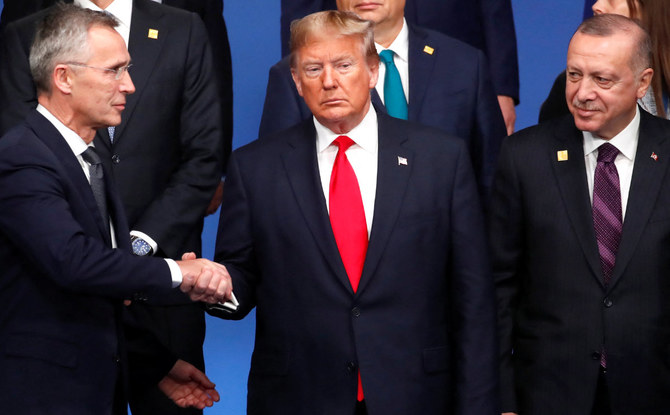
Trump says he warned NATO ally: Spend more on defense or Russia can ‘do whatever the hell they want’
https://arab.news/pk7wy
Trump says he warned NATO ally: Spend more on defense or Russia can ‘do whatever the hell they want’
- Trump, as president, often depicted NATO allies as leeches on the US military and openly questioned the value of the military alliance that has defined American foreign policy for decades
Justice Department sees no basis for civil rights probe in Minnesota ICE shooting, official says
- And on Tuesday, Deputy Attorney General Todd Blanche said in a statement that “there is currently no basis for a criminal civil rights investigation”
WASHINGTON: The Justice Department does not believe there is currently any basis to open a criminal civil rights investigation into the killing of a woman by a US Immigration and Customs Enforcement officer in Minneapolis, a top department official said Tuesday.
The decision to keep the Justice Department’s Civil Rights Division out of the investigation into the fatal shooting of Renee Good marks a sharp departure from past administrations, which have moved quickly to probe shootings of civilians by law enforcement officials for potential civil rights offenses.
While an FBI probe is ongoing, lawyers in the Civil Rights Division were informed last week that they would not play a role in the investigation at this time, according to two people familiar with the matter who spoke on the condition of anonymity to discuss internal department deliberations.
And on Tuesday, Deputy Attorney General Todd Blanche said in a statement that “there is currently no basis for a criminal civil rights investigation.” The statement, first reported by CNN, did not elaborate on how the department had reached a conclusion that no investigation was warranted.
Federal officials have said that the officer acted in self-defense and that the driver of the Honda was engaging in “an act of domestic terrorism” when she pulled forward toward him.
The quick pronouncement by administration officials before any meaningful investigation could be completed has raised concerns about the federal government’s determination to conduct a thorough review of the chain of events precipitating the shooting. Minnesota officials have also raised alarm after federal officials blocked state investigators from accessing evidence and declared that Minnesota has no jurisdiction to investigate the killing.
Also this week, roughly half a dozen federal prosecutors in Minnesota resigned and several supervisors in the criminal section of the Civil Rights Division in Washington gave notice of their departures amid turmoil over the federal probe, according to people familiar with the matter.
Among the departures in Minnesota is First Assistant US Attorney Joseph Thompson, who had been leading the sprawling investigation and prosecution of fraud schemes in the state, two other people said. At least four other prosecutors in the Minnesota US attorney’s office joined Thompson in resigning amid a period of tension in the office, the people said. The people spoke on the condition of anonymity to discuss personnel matters.
They are the latest in an exodus of career Justice Department attorneys who have resigned or been forced out over concerns over political pressure or shifting priorities under the Trump administration. Hundreds of Justice Department lawyers have been fired or have left voluntarily over the last year.
Minnesota Democratic lawmakers criticized the departures, with Sen. Amy Klobuchar, a member of the Senate Judiciary Committee, calling the resignations “a loss for our state and for public safety” and warning that prosecutions should not be driven by politics. Gov. Tim Walz said the departures raised concerns about political pressure on career Justice Department officials.
The resignations of the lawyers in the Civil Rights Division’s criminal section, including its chief, were announced to staff on Monday, days after lawyers were told the section would not be involved in the probe. The Justice Department on Tuesday said those prosecutors had requested to participate in an early retirement program “well before the events in Minnesota,” and added that “any suggestion to the contrary is false.”
Founded nearly 70 years ago, the Civil Rights Division has a long history of investigating shootings by law enforcement even though prosecutors typically need to clear a high bar to mount a criminal prosecution.
In prior administrations, the division has moved quickly to open and publicly announce such investigations, not only to reflect federal jurisdiction over potential civil rights violations but also in hopes of soothing community angst that sometimes accompanies shootings involving law enforcement.
“The level of grief, tension and anxiety on the ground in Minnesota is not surprising,” said Kristen Clarke, who led the Civil Rights Division under the Biden administration. “And historically the federal government has played an important role by being a neutral and impartial agency committing its resources to conducting a full and fair investigation, and the public loses out when that doesn’t happen,” she said.
In Minneapolis, for instance, the Justice Department during the first Trump administration opened a civil rights investigation into the 2020 death of George Floyd at the hands of city police officers that resulted in criminal charges. The Minneapolis Police Department was separately scrutinized by the Biden administration for potential systemic civil rights violations through what’s known as a “pattern or practice” investigation, a type of police reform inquiry that is out of favor in the current Trump administration Justice Department.