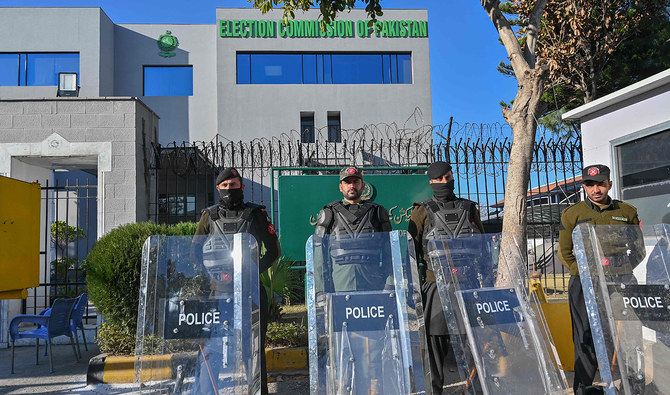
KARACHI: Pakistan’s election regulatory on Saturday ordered repeat voting at 43 polling stations in three national and provincial constituencies due to incidents of snatching and destruction of polling materials during the general elections held on Thursday.
Amid a backdrop of security challenges and political controversies, the 2024 Pakistani polls experienced significant delays in vote counting, igniting suspicions of electoral manipulation and prompting protests from various political factions who alleged that their mandate had been compromised.
The international community, represented by the United States, United Kingdom and European Union, voiced concerns over the integrity of the electoral process and advocated for a comprehensive investigation into the allegations of rigging.
“According to the Election Commission’s spokesperson, re-polling has been ordered at 26 polling stations in the NA-88 Khushab-2 constituency due to the burning of polling materials by a mob at the Returning Officer’s office,” the ECP said in a statement. “Similarly, re-polling has been ordered at two polling stations in PS-18 Ghotki-1 Sindh, where polling materials were snatched by unidentified individuals.”
“In another incident,” the statement added, “the Commission has ordered re-polling at 15 polling stations in PK-90 Kohat-1 Khyber Pakhtunkhwa, where polling materials were destroyed by terrorists.”
Furthermore, the ECP directed its regional office in Sindh to conduct an inquiry into reported acts of vandalism at a polling station in NA-242 Karachi and to submit a detailed report within a three-day timeframe.


Pakistan orders election rerun at dozens of polling stations amid rigging claims, international concerns
https://arab.news/gccqz
Pakistan orders election rerun at dozens of polling stations amid rigging claims, international concerns

- The repeat voting will be held on Feb. 15 due to incidents of snatching and destruction of polling material
- The election authorities are also probing reported acts of vandalism at a polling station in NA-242 Karachi

Pakistan, 21 other countries condemn Israeli West Bank measures, warn of ‘de facto annexation’
- Joint statement says settlement expansion violates international law, cites UN resolutions, ICJ advisory opinion
- Signatories include European and Latin American nations such as France and Brazil , alongside Muslim countries
ISLAMABAD: Pakistan and 21 other countries, including France, Brazil, Spain and Denmark, on Tuesday condemned sweeping Israeli measures to expand control over the occupied West Bank, warning the steps risk advancing “unacceptable de facto annexation” and undermining prospects for a two-state solution.
In a joint statement issued by the foreign ministers of countries from the Middle East, Europe and Latin America, as well as the secretaries general of the League of Arab States and the Organization of Islamic Cooperation, the signatories urged Israel to immediately reverse recent decisions reclassifying Palestinian land and accelerating settlement activity.
The statement marks a broadening of international criticism beyond Muslim-majority states that have long denounced Israeli settlement expansion, bringing together countries like Norway, Sweden, Portugal, Finland, Iceland, Ireland and Luxembourg alongside Arab and other Muslim-majority nations.
“Israel’s illegal settlements, and decisions designed to further them, are a flagrant violation of international law, including previous United Nations Security Council Resolutions and the 2024 Advisory Opinion of the International Court of Justice,” the ministers said.
They added the measures were “part of a clear trajectory that aims to change the reality on the ground and to advance unacceptable de facto annexation,” warning that they undermine ongoing efforts for regional peace and stability, including a proposed 20-Point Plan for Gaza, and threaten prospects for broader regional integration.
The ministers called on Israel “to reverse them immediately, to respect its international obligations, and to refrain from actions that would result in permanent changes to the legal and administrative status of the occupied Palestinian Territory.”
The latest statement follows mounting concern over Israel’s land and settlement policies in the West Bank.
Last week, Pakistan and seven other Muslim nations condemned Israel’s decision to approve land registration procedures in parts of the West Bank for the first time since 1967, a move widely seen as easing the path for settlement expansion and potential annexation.
Members of the Israeli cabinet have backed measures to tighten administrative control over areas of the West Bank, including Area C, which makes up around 60 percent of the territory and remains under full Israeli security and administrative control under the Oslo accords.
More than 500,000 Israeli settlers live in settlements and outposts in the West Bank, excluding Israeli-annexed East Jerusalem, alongside around three million Palestinians.
Settlements are considered illegal under international law, a position Israel disputes.
In the latest statement, the foreign ministers reiterated their rejection of “all measures aimed at altering the demographic composition, character and status of the Palestinian Territory occupied since 1967, including East Jerusalem,” and said they oppose “any form of annexation.”
“In view of the alarming escalation in the West Bank, we also call on Israel to put an end to settler violence against Palestinians, including by holding those responsible accountable,” they added.
The ministers pledged to take “concrete steps, in accordance with international law,” to counter the expansion of illegal settlements and policies or threats of forcible displacement and annexation.
Highlighting sensitivities around Jerusalem during Ramadan, they stressed the importance of preserving the historic and legal status quo at the city’s holy sites, recognizing the special role of the Hashemite custodianship of Jordan.
Reaffirming support for a negotiated settlement, the signatories said they remain committed to achieving “a just, comprehensive and lasting peace” on the basis of a two-state solution, in line with the Arab Peace Initiative and relevant UN resolutions, based on the June 4, 1967 lines.
“As reflected in the New York Declaration, the end of the Israeli-Palestinian conflict is imperative for regional peace, stability and integration,” the statement said, adding that only the realization of an independent, sovereign and democratic Palestinian state would allow coexistence among the region’s peoples and states.


