

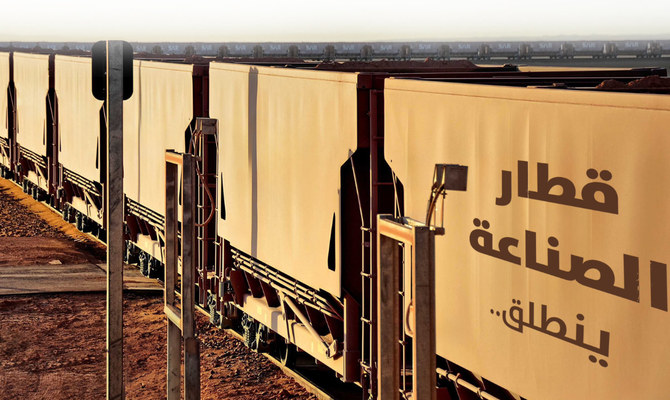
Saudi Arabia Railways transports 11m passengers, 25m tonnes of cargo in 2023

Saudi Arabia Railways said on Wednesday that the total amount of cargo transported increased by more than 25 million tonnes, which represented a growth rate in excess of 10 percent. (X: @SaudiTransport)
Short Url
Updated 08 February 2024
Follow

Saudi Arabia Railways transports 11m passengers, 25m tonnes of cargo in 2023

  • The figures were revealed as the company signed two memorandums of understanding for the development of rail transport and logistics solutions in industrial cities

RIYADH: Saudi Arabia Railways transported more than 11 million passengers in 2023, a growth rate of more than 50 percent.

The company said on Wednesday that the total amount of cargo transported increased by more than 25 million tonnes, which represented a growth rate in excess of 10 percent. This resulted in the removal of more than 2 million trucks from the nation’s roads each year, the Saudi Press Agency reported.

The figures were revealed on Wednesday as the Saudi Authority for Industrial Cities and Technology Zones, also known as MODON, and SAR signed two memorandums of understanding for the development of rail transport and logistics solutions in industrial cities, in support of the National Industrial Development and Logistics Program.

During the signing ceremony, which took place in Dammam’s 2nd Industrial City, Saleh Al-Jasser, the minister of transport and logistic services and chairman of SAR’s board of directors, said that the latest international indicators, including the Logistics Performance Index, the Quality Interdependence Index and the Maritime Interdependence Index, showed that the Kingdom is making progress in global rankings for transportation and logistics as a result of major projects in the country.

“The partnership with the industrial sector is a long-established one, which started with the construction of roads over the decades that benefit the industrial sector,” he said.

Various projects, including the development of the northern railway, have helped support the industrial and mining sectors by connecting the cities of Dammam, Jubail and Ras Al-Khair to ports in the Eastern Province, he added, and other projects are under way that will provide more benefits.

Efforts to improve the integration of transport and logistics systems with the industrial sector, through the work of the National Industrial Development and Logistics Program, reflect the importance of cooperation and integration between government sectors, Al-Jasser said, which aids the development of Saudi industry.

Speaking at the same event, Minister of Industry and Mineral Resources Bandar Alkhorayef stressed the importance of the role of the transportation and logistics sector in developing the industrial and mining industry, and consolidating the Kingdom’s position as a global logistics hub in line with the goals of Saudi Vision 2030.

Linking the industrial cities in the Riyadh and eastern regions to the train network will contribute to raising the efficiency of logistical operations in the industrial sector and opening new paths for trade and export, he said.

Alkhorayef emphasized that NIDLP plays an important role in maximizing the benefits achieved from the four sectors that it supervises — industry, mining, energy, and logistics services — noting that the cost associated with transportation is an essential element for the penetration of industrial goods and their access to local and global markets.

He went to say that railway transportation is one of the best means in terms of cost, price of products and the environment.

The minister concluded by saying that the signing of the MoUs between MODON and SAR aims to enhance integration and partnership between the industrial and transportation systems, empower industrial sector supply chains in the central and eastern regions and support supply chains with global standards.


Egypt’s annual inflation falls to 10.3% in December: CAMPAS  

Updated 15 sec ago
Follow

Egypt’s annual inflation falls to 10.3% in December: CAMPAS  

RIYADH: Egypt’s annual headline inflation rate slowed sharply to 10.3 percent in December, down from 23.4 percent in the same month a year earlier, official data showed. 

According to the Central Agency for Public Mobilization and Statistics, the overall consumer price index reached 264.2 points in December. On a monthly basis, inflation rose marginally by 0.1 percent. 

CAPMAS attributed the annual deceleration primarily to a decline in food prices, including a 1.1 percent drop in meat and poultry, 1.2 percent in dairy, cheese and eggs, 1 percent in fruits, 2 percent in vegetables, and 0.1 percent in sugar and sugary products. 

Prices of household appliances, audio-visual equipment and information technology devices also declined by 0.5 percent and 0.4 percent, respectively. 

However, other categories recorded increases, including grains and bread by 0.1 percent, oils and fats by 0.3 percent, and beverages such as coffee, tea and cocoa by 0.1 percent. 

Month-on-month inflation showed limited movement, with food and beverage prices falling by 0.8 percent due to similar declines in meat, dairy, fruit and vegetable prices. In contrast, modest cost increases were recorded in grains, oils and beverages. 

Alcohol and tobacco prices rose by 0.2 percent, while clothing and footwear increased by 0.7 percent, driven by higher prices for fabrics, up 1.6 percent, ready-made garments, up 0.4 percent, and footwear, up 1.6 percent. 

Housing and utilities recorded an increase of 1.5 percent, reflecting a 1.9 percent rise in actual rents, a 1.6 percent increase in electricity, gas and other fuels, and a 0.5 percent rise in maintenance costs. 

Furniture and household equipment prices climbed 0.9 percent, while healthcare rose by 0.5 percent, led by outpatient services, up 1 percent, and hospital services, up 1.8 percent. Transport costs increased by 0.2 percent, and recreational and cultural services rose by 0.6 percent, including a 1.5 percent increase in organized travel. 

Annual inflation data showed a broad-based increase across most sectors. Food and beverages rose by 0.9 percent year on year, with fruits up 22.6 percent, despite a 4.1 percent decline in meat and poultry and a 4.8 percent drop in vegetables. 

Alcohol and tobacco prices jumped 18.2 percent, while clothing and footwear climbed 14 percent. Housing and utilities surged 22.5 percent, largely due to higher rents and energy prices. 

Healthcare recorded one of the highest annual increases at 23.9 percent, driven by a 28.9 percent rise in medical equipment prices and a 21 percent increase in hospital services. Transport costs rose by 21.1 percent, education by 10 percent, and restaurants and hotels by 13 percent. 

The category of miscellaneous goods and services registered a 12.2 percent annual increase, with personal care products rising 13 percent and personal belongings up 27.2 percent.