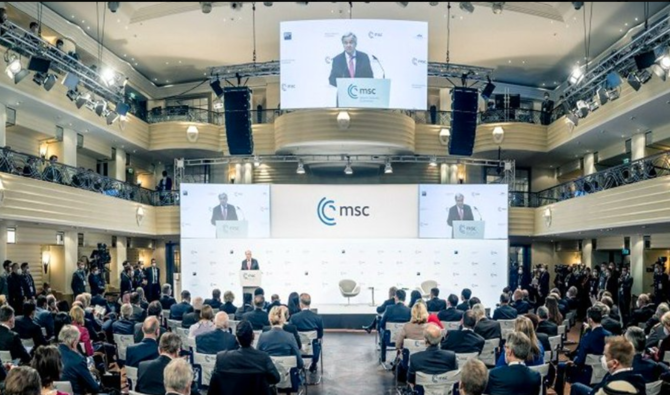
BERLIN: Russian and Iranian government officials have not been invited to this year’s Munich Security Conference, as they did not seem open to meaningful dialogue, according to the man chairing the annual event.
The conference, attended by the world’s defense and security elite and sometimes known as “Davos for defense,” will take place in the southern German city on Feb. 16-18.
The event will open days before the second anniversary of Russia’s invasion of Ukraine and four months after the start of the Israel-Hamas war, which has deepened instability across the Middle East as Western nations battle Iran-backed groups in Iraq, Yemen and Syria.
Christoph Heusgen said on Tuesday he hoped the meeting would discuss these conflicts as well as others that received less attention but were causing major humanitarian crises such as the 10-month-old war in Sudan, which has displaced millions.
US and Chinese officials for example had spoken with one another for the first time in a long while at last year’s event, which led to further engagement, he told Reuters.
“So, we hope Munich offers the opportunity to make these small steps,” said Heusgen, who was a longtime foreign policy adviser to former Chancellor Angela Merkel.
He also expected the attendance of high-ranking Chinese officials. Last year top diplomat Wang Yi attended the event.
Heusgen told German press agency DPA the Iranian and Russian governments had not been invited because they had not shown a serious interest in negotiations. However, Iranian and Russian non-governmental organizations had been invited, he said.
Heusgen, roundly condemned by Israel’s ambassador to Germany for warning in October against an Israeli ground offensive in Gaza, said he expected high-ranking Israeli officials to attend.
Germany was in a dilemma on Israel, he said, as it was committed to the country’s security but also disagreed with its current leadership on a number of issues and had therefore suspended bilateral government consultations.
Heusgen praised Germany’s support for Ukraine, as the second biggest provider of military help to Kyiv. However, it would need to have a discussion throughout society on the importance of higher defense spending and how to finance this, he said.

Munich Security Conference did not invite Russian, Iran officials this year
Short Url
https://arab.news/27bq6
Munich Security Conference did not invite Russian, Iran officials this year
- Christoph Heusgen said on Tuesday he hoped the meeting would discuss these conflicts as well as others
- Iranian and Russian governments had not been invited because they had not shown a serious interest in negotiations
Chinese, Iranian warships in South Africa for exercises
- China-led exercises near main navy base are also meant to involve Russia
- Drills risk further straining South Africa’s ties with the United States
SIMON’S TOWN, South Africa: Chinese and Iranian warships were docked off South Africa’s main navy base Thursday ahead of exercises that officials said were also meant to involve Russia.
The January 9-16 “Will for Peace” drill hosted by South Africa risks further straining its ties with the United States, which is in dispute with many of the countries taking part.
AFP journalists saw two Chinese ships in Cape Town’s False Bay harbor on Wednesday, joined by an Iranian vessel on Thursday.
South African navy officials said warships from Russia were also expected to take part in the China-led exercises.
The drill was focused on the “safety of shipping and maritime economic activities,” the South African defense force said in December when it announced the maneuvers.
It was intended to “deepen cooperation in support of peaceful maritime security initiatives,” it said.
The statement said the exercise would involve navies from BRICS countries.
BRICS, originally made up of Brazil, Russia, India, China and South Africa, has expanded to include Egypt, Ethiopia, Iran, Saudi Arabia, the United Arab Emirates and, more recently, Indonesia.
The joint drills — previously known as Exercise Mosi — were initially scheduled for November 2025 but were postponed due to a clash with the G20 summit in Johannesburg.
South Africa’s Democratic Alliance (DA), a member of the ruling unity government, said parliament had not been “properly briefed” on the drills, including cost, command structure and diplomatic consequences.
“South Africa’s defense and foreign policy must be transparent, constitutional, and principled and certainly not being quietly reshaped through military exercises that contradict our stated neutrality and damage our standing in the world,” DA spokesperson on defense, Chris Hattingh, said in a statement.
The center-right party — which joined government after the African National Congress lost its majority in 2024 due to voter disillusionment with corruption and mismanagement — vowed to demand full transparency in parliament.
President Donald Trump has accused countries in the BRICS group of emerging nations of “anti-American” policies.
South Africa has drawn US criticism for its close ties with Russia and a range of other policies, including its decision to bring a genocide case against Israel at the International Court of Justice over the Gaza war.
South Africa’s military was criticized for hosting naval exercises with Russia and China in 2023 that coincided with the one-year anniversary of the Kremlin’s invasion of Ukraine.
The three countries first conducted joint naval drills in 2019.
The January 9-16 “Will for Peace” drill hosted by South Africa risks further straining its ties with the United States, which is in dispute with many of the countries taking part.
AFP journalists saw two Chinese ships in Cape Town’s False Bay harbor on Wednesday, joined by an Iranian vessel on Thursday.
South African navy officials said warships from Russia were also expected to take part in the China-led exercises.
The drill was focused on the “safety of shipping and maritime economic activities,” the South African defense force said in December when it announced the maneuvers.
It was intended to “deepen cooperation in support of peaceful maritime security initiatives,” it said.
The statement said the exercise would involve navies from BRICS countries.
BRICS, originally made up of Brazil, Russia, India, China and South Africa, has expanded to include Egypt, Ethiopia, Iran, Saudi Arabia, the United Arab Emirates and, more recently, Indonesia.
The joint drills — previously known as Exercise Mosi — were initially scheduled for November 2025 but were postponed due to a clash with the G20 summit in Johannesburg.
South Africa’s Democratic Alliance (DA), a member of the ruling unity government, said parliament had not been “properly briefed” on the drills, including cost, command structure and diplomatic consequences.
“South Africa’s defense and foreign policy must be transparent, constitutional, and principled and certainly not being quietly reshaped through military exercises that contradict our stated neutrality and damage our standing in the world,” DA spokesperson on defense, Chris Hattingh, said in a statement.
The center-right party — which joined government after the African National Congress lost its majority in 2024 due to voter disillusionment with corruption and mismanagement — vowed to demand full transparency in parliament.
President Donald Trump has accused countries in the BRICS group of emerging nations of “anti-American” policies.
South Africa has drawn US criticism for its close ties with Russia and a range of other policies, including its decision to bring a genocide case against Israel at the International Court of Justice over the Gaza war.
South Africa’s military was criticized for hosting naval exercises with Russia and China in 2023 that coincided with the one-year anniversary of the Kremlin’s invasion of Ukraine.
The three countries first conducted joint naval drills in 2019.
© 2026 SAUDI RESEARCH & PUBLISHING COMPANY, All Rights Reserved And subject to Terms of Use Agreement.


