Future stability of Pakistani rupee, bonds linked to peaceful elections, IMF review — experts 

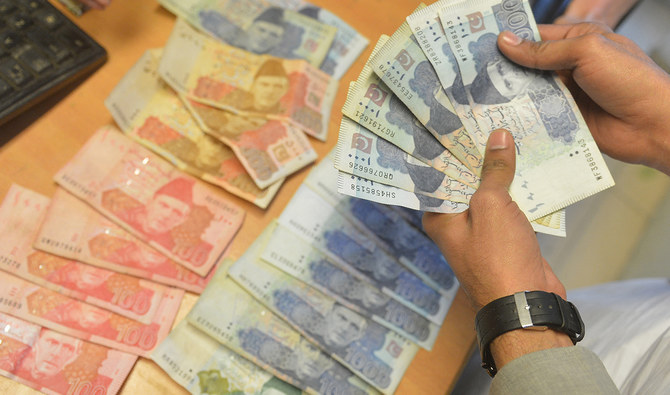
A money changer counts Pakistan's currency at a market in Karachi on January 6, 2023. (AFP/File)
Short Url
Updated 06 February 2024
Follow

Future stability of Pakistani rupee, bonds linked to peaceful elections, IMF review — experts 

  • The South Asian country of more than 241 million will be holding national elections on February 8
  • An IMF review is expected later this month, with Pakistan’s $1 billion dollar bonds maturing in April

KARACHI: The stability of Pakistan’s currency and international bonds is linked with a successful second review of the country’s ongoing International Monetary Fund (IMF) program and a peaceful transition of government after this week’s national elections, financial experts said on Tuesday.

Pakistan’s rupee has regained its value by 9 percent to about Rs279 against the US dollar from an all-time low of Rs307 in September last year, due to the government’s clampdown on illicit foreign currency trade and smuggling, completion of first review of the ongoing $3 billion IMF program and inflows from various sources.

Similarly, Pakistan’s international bonds also posted gains and remained top performer in Asia in Jan 2024, according to the analysts and Bloomberg data. The investors got almost 100 percent returns in 2023.

The South Asian nation of more than 241 million is now set to go to the ballot box on Feb 8 to elect a new government that is widely expected to negotiate a new IMF bailout after the current short-term facility expires in March.

Pakistani analysts believe the stability of the national currency and the bonds is based on the IMF review, which is due this month, and a smooth transition of the government.

“If the review goes smooth then chances are bright that the IMF and the new government will strike a new long-term deal,” Muhammad Sohail, chief executive officer (CEO) of the Karachi-based Topline Securities brokerage house, told Arab News.

“If that happens, I don’t see any substantial pressure on the Pakistani rupee and Eurobonds.”

However, Shahid Ali Habib, CEO of the Arif Habib Limited brokerage and securities firm, believes the rupee may still shed 4-6 percent of its value due to the interest rate differential and high inflation.

“A natural rupee devaluation has to take place because of the interest rate differential and high inflation rate that is likely to close the year at around 24 percent,” Habib told Arab News.

“I don’t see any sudden devaluation.”

He said the next IMF program was important for fiscal stability in Pakistan, warning that without it the situation would worsen to what it was in June last year, when Pakistan barely averted a sovereign debt default.

“I hope the next government will negotiate a fresh program with the IMF spanning over 4-5 years,” Habib added.

Pakistan’s caretaker finance minister, Dr. Shamshad Akhtar, has also hinted recently that the South Asian country may need a new IMF program.

Samiullah Tariq, a director at the Pakistan Kuwait Investment Company, believed a peaceful conduct of elections and a smooth transition of power would lead to capital market stability.

“There should be no problem in negotiating a new program with the IMF, because the things are under control,” he told Arab News.

The analyst, however, warned that any uncertainty may dent the performance of the country’s dollar bonds in the international market. 

Pakistan’s $1 billion dollar-denominated bond is maturing on April 15 this year. Last week, the central bank governor assured that the country was in a “comfortable position” to pay the amount upon the maturity of the bond.


Excavations resume at Mohenjo-Daro to study early Harappan city wall

Updated 6 sec ago
Follow

Excavations resume at Mohenjo-Daro to study early Harappan city wall

  • A joint Pakistani-US team probes multi-phase wall dating to around 2800 BC
  • Research remains limited despite Mohenjo-Daro’s archaeological importance

ISLAMABAD: Archaeologists working at the ancient site of Mohenjo-Daro have resumed excavations aimed at better understanding the city’s early development, including the structure and chronology of a massive perimeter wall first identified more than seven decades ago, officials said on Saturday.

The latest excavation season, launched in late December, is part of a joint Pakistani-US research effort approved by the Technical Consultative Committee of the National Fund for Mohenjo-Daro, which met at the site this week to review conservation and research priorities. The work focuses on reassessing the city’s defensive architecture and early occupation layers through controlled excavation and carbon dating.

Jonathan Mark Kenoyer, a senior archaeologist involved in the project, told the committee that the excavation targets a section of the city wall originally uncovered by British archaeologist Mortimer Wheeler in 1950.

“This wall was over seven meters wide and built in multiple phases, reaching a height of approximately seven meters,” Kenoyer said, according to an official statement circulated after the meeting. “The lowest part of the wall appears to have been constructed during the early Harappan period, around 2800 BC.”

Organic material recovered from different excavation levels is being analyzed for carbon dating to establish a clearer timeline of the site’s development, the statement continued, adding that the findings would be published after detailed study.

The committee noted that despite Mohenjo-Daro’s status as one of the world’s earliest and largest urban centers, systematic research at the site has remained limited in recent decades. Its members agreed to expand archaeological studies and invited new research proposals to help formulate a long-term strategy for the site.

The committee also approved the continuation of conservation work on previously excavated material, including dry core drilling data, and reviewed progress on preserving a coin hoard discovered at the site in 2023, the results of which are expected to be published after conservation is completed.

Mohenjo-Daro, a UNESCO World Heritage site in Pakistan’s Sindh province, was a major center of the Indus Valley Civilization, which flourished more than 4,000 years ago.