- Economists see bringing inflation and policy rate down to reasonable level as 'immediate challenges' for new government
- Persistent political instability following ouster of former PM Imran Khan in 2022 contributed to economic crisis, experts say
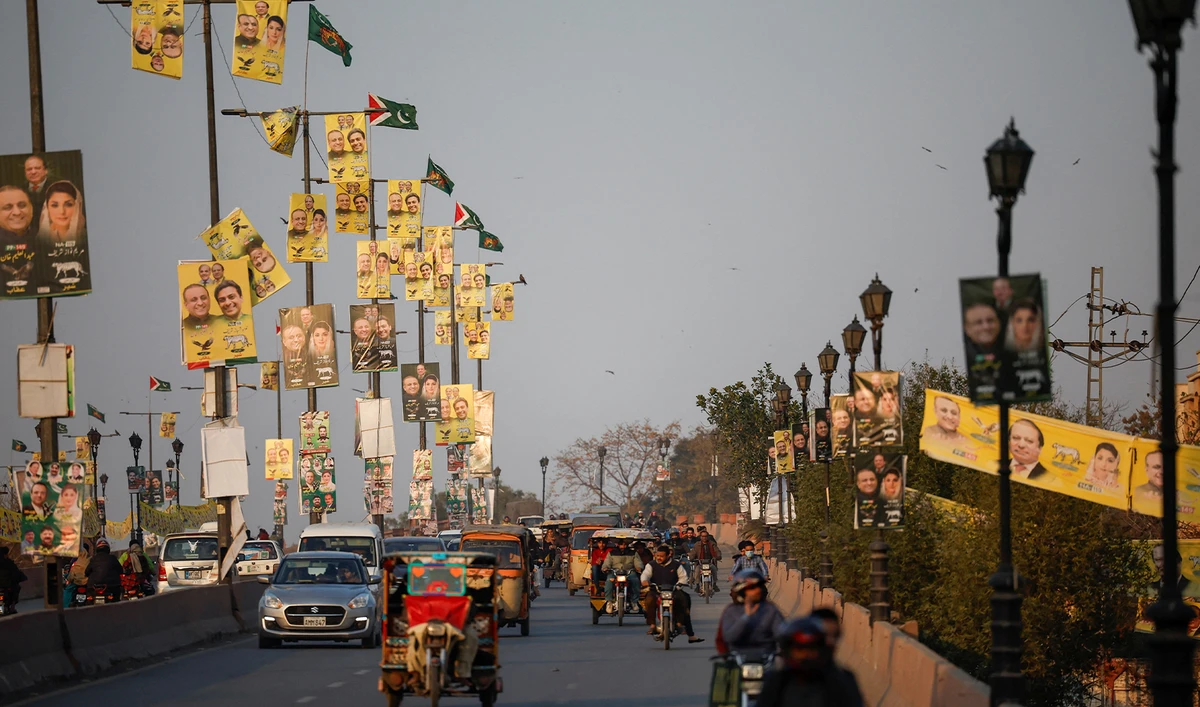
KARACHI: Pakistani political parties have failed to go beyond “rosy promises” and present a clear roadmap for the revival of the economy in their manifesto documents released before general elections on Feb. 8, analysts have said.
Elections come as the South Asian country of more than 241 million is grappling with high inflation, an energy crisis, persistent fiscal deficits due to high government expenditures and low revenues and rising public debt.
“No party has adequately addressed the economic situation in its manifesto,” Dr Ikram-ul-Haq, a Lahore-based economist, told Arab News on Sunday, commenting on policy statement documents released by major political parties.
“All the manifestos are mainly concerned with rosy promises to appease and win voters. None of the parties has even the capacity to meet commitments.”
Economists see bringing down inflation and the policy rates to a reasonable level as "immediate challenges" for a new government and believe it would require long-overdue structural reforms.
According to Haq, the highest-ever policy rate of 22% had eroded business growth and increased debt-servicing to an "unsustainable level."
“High policy rate has failed to stem the rising tide of inflation,” he said. “None of the party has any concrete plans to overcome this mess.”
Due to flawed policies of all the three main parties in the past, namely the Pakistan Tehreek-e-Insaf, Pakistan Muslim League-Nawaz and Pakistan Peoples Party, Haq believed the country was facing the “worst economic crisis of its history.” The Pakistan Peoples Party last ruled from 2008-2013, the PML-N from 2013-2018 and PTI from 2018-2022.
“The root cause is the reckless borrowing and ruthless spending [of past governments],” Haq added. "The debt serving alone is now consuming more than the net income of the federal government after transferring shares in taxes to the provinces.”
Dr Sajid Amin, deputy executive director at the Islamabad-based Sustainable Development Policy Institute (SDPI), said political parties had tried to focus on economic issues as per their ideology and priorities, but the PML-N’s manifesto had been the "more focused" one in terms of economic revival.
"[The manifestos] are currently more of a set of good promises as we do not find any clear action plan backing up these promises," he said. "On face value, however, the PML-N seems to be more focused on the economic revival agenda."
The PML-N has promised to create 10 million jobs in the next five years, bring down inflation to below 10% from 28.3%, and take economic growth to 6% from the 2-3% projected by the IMF and the central bank for the current fiscal year till June-end.
“How will 10 million jobs be created? It requires a 6-7% GDP growth rate which comes from the sectors that have higher margin for producing jobs,” Haq questioned. "It seems difficult if we assume that the government will have to immediately go for a new [International Monetary] Fund program."
Ammar Habib Khan, a senior research economist, said no political party had addressed major economic issues like high circular debt, low industrial growth and a prevalent energy crisis.
“The PPP (Pakistan Peoples Party) has talked about social protection and issuance of various cards and that could be re-allocation in the budget on the expenditure side,” Ammar said, adding that the PPP manifesto lacked a concrete plan for revenue generation.
In its ‘Charter of Economy,’ the PPP has promised to reduce inflation, unemployment and poverty, calling for an overhaul of Pakistan’s development priorities. The party has also pledged to increase social spending and cut the number of ministries.
Dr Ashfaque Hassan Khan, a former member of the Economic Advisory Committee, called the manifestos “merely a formality.”
"This is a requirement of the Election Commission that you should release a manifesto of your party," Khan said. "This is merely a formality. Even the leaders [of these parties] don't know what is written in the party’s manifesto, because nobody cares to implement it in letter and spirit."
Calling the manifestos a set of “hollow promises,” Khan noted that some parties had even claimed they would provide 300 units of electricity to poor people free of cost:
"When you are in IMF program, will the Fund allow you to supply free electricity? It is a question of common sense.”
Analysts say persistent political instability in Pakistan following the ouster of PTI founder and former PM Imran Khan in April 2022 contributed to the economic crisis, with Pakistan barely averting a debt default in June 2023, thanks to a last-gasp $3 billion International Monetary Fund (IMF) bailout.
The current 9-month stand-by agreement between Pakistan and the IMF will end in March 2024. The fund has so far disbursed $1.9 billion under the SBA.
The South Asian country is expected to negotiate another program after the new government is formed following the elections.
“The major challenge for the new government will be meeting stringent requirements of the IMF’s ongoing Stand-By Arrangement and negotiating a new Extended Fund Facility (EFF) program,” Haq said, adding that an immediate need of $27 billion by Nov. 2024 would pose a "serious threat" to the new government, if the IMF didn't okay another bailout program.