Yemen’s Houthi militia ‘ready for peace’ with Saudi Arabia

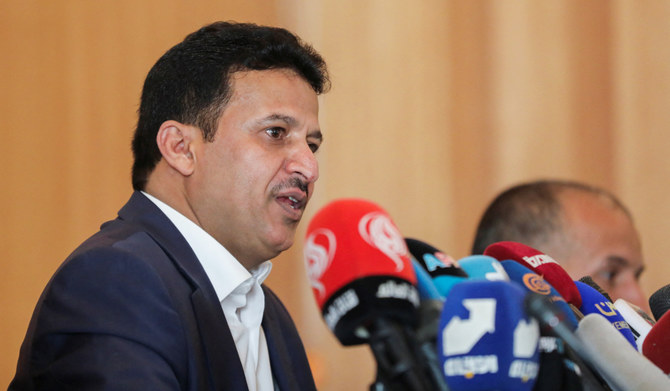
Hussein al-Ezzi, deputy foreign minister in the Houthi-led government, addresses a news conference in Sanaa, Yemen February 5, 2024. (REUTERS)
Short Url
Updated 05 February 2024
Follow

Yemen’s Houthi militia ‘ready for peace’ with Saudi Arabia

  • “America is the one assaulting us, and it will not escape retribution, and we will never remain mute about the aggression against our nation, and it will have no impact on our stance toward Gaza and Palestine”

AL-MUKALLA: Yemen’s Houthi militia is ready to make peace with Saudi Arabia, the groups’ deputy foreign minister said on Monday, accusing the US of obstructing efforts to reach a settlement.

Speaking to reporters in Sanaa, Hussein Al-Ezzi expressed “special gratitude” to Saudi Arabia for its unwillingness to join US-UK strikes on Yemen, adding that the militia is “eager” to enter peace negotiations with the Kingdom.

“Sanaa is prepared for peace with Riyadh despite the challenges posed by the US and its associated Yemeni groups,” Al-Ezzi said.

The US and UK have carried out about 300 strikes in Yemen since Jan. 12, the official said, threatening to make the US pay a “heavy price” for the attacks. “America is the one assaulting us, and it will not escape retribution, and we will never remain mute about the aggression against our nation, and it will have no impact on our stance toward Gaza and Palestine.”

Since November, the Houthis have seized a commercial ship and launched dozens of missiles and drones at civilian as well as military vessels in the Red Sea. Al-Ezzi said that the militia, in a show of support to Palestine, only targets Israel-linked ships or vessels on their way to the country.

US and UK military and commercial ships were added to the militia’s list of targets after the two countries launched strikes on Yemen, he added.

The Houthi warning to strike US and UK ships came as Houthi media and Yemenis in the Houthi-controlled western province of Hodeidah reported explosions on Sunday night when jets struck targets in the Ras Isa, Al-Zaydiyah and Al-Hawak districts. On Monday afternoon, the Houthi-run Al-Masirah TV channel claimed that the US and UK forces conducted attacks on Hodeidah’s Al-Katheeb area.

Meanwhile, Yemen’s internationally recognized government said that UN pressure to end its offensive on Hodeidah city in 2018 had led to the escalating Houthi violence on the Red Sea since last year.

Yemeni Information Minister Muammar Al-Eryani on Sunday blamed the UN and its former Yemen envoy, Martin Griffiths, for pressuring the Yemeni government to abandon its military offensive on the Houthi-controlled port city and sign the UN-brokered Stockholm Agreement.

Government forces controlled Hodeidah’s airport, as well as the city’s southern and eastern entrances, and were only a few kilometers from the city’s port before the UN urged an end to the offensive, he added.

At the time, the UN warned that conflict in Hodeidah would halt the supply of 70 percent of the country’s humanitarian aid and other essential items through the city’s port.

“The entire world is paying the price for ignoring government warnings about the dangers of allowing the Iranian regime and its arms in the region, most notably the Houthi militia, to control the city of Hodeidah and its ports,” Al-Eryani said, according to the SABA news agency.


MSF calls Israeli ban a ‘grave blow’ to Gaza aid

Updated 10 sec ago
Follow

MSF calls Israeli ban a ‘grave blow’ to Gaza aid

  • Doctors Without Borders is among 37 foreign humanitarian organizations banned from the territory
  • The group, which has hundreds of staff in Gaza, says: 'Denying medical assistance to civilians is unacceptable'
JERUSALEM: International charity Doctors Without Borders Friday condemned a “grave blow to humanitarian aid” after Israel revoked the status it needs to operate in Gaza for refusing to share Palestinian staff lists.
Israel on Thursday confirmed it had banned access to the Gaza Strip to 37 foreign humanitarian organizations for refusing to share lists of their Palestinian employees.
Doctors Without Borders (MSF), which has 1,200 staff members in the Palestinian territories, the majority of them in Gaza, said in a statement that “denying medical assistance to civilians is unacceptable under any circumstances.”
The medical organization argued that it had “legitimate concerns” over new Israeli requirements for foreign NGO registration, specifically the disclosing of personal information about Palestinian staff.
It pointed to the fact that 15 MSF staff had been “killed by Israeli forces,” and that access to any given territory should not be conditional on staff list disclosure.
“Demanding staff lists as a condition for access to territory is an outrageous overreach,” the charity said.
MSF also denounced “the absence of any clarity about how such sensitive data will be used, stored, or shared,” charging that Israeli forces “have killed and wounded hundreds of thousands of civilians” in Gaza during the course of the war.
It also charged that Israel had “manufactured shortages of basic necessities by blocking and delaying the entry of essential goods, including medical supplies.”
Israel controls and regulates all entry points into Gaza, which is surrounded by a wall that began to be built in 2005.
Felipe Ribero, MSF head of mission in the Palestinian territories, told AFP that all of its operations were still ongoing in Gaza.
“We are supposed to leave under 60 days, but we don’t know whether it will be three or 60 days” before Israeli authorities force MSF to leave, he said.
Prominent humanitarian organizations hit by the Israeli ban include the Norwegian Refugee Council (NRC), World Vision International and Oxfam, according to an Israeli ministry list.
The ban, which came into effect on December 31, 2025 at midnight, has triggered widespread international condemnation.
Israel says the new regulation aims to prevent bodies it accuses of supporting terrorism from operating in the Palestinian territories.
MSF says it currently supports one in five hospital beds in Gaza and assists one in three mothers in the territory, and urged the Israeli authorities to meet to discuss the ban.