

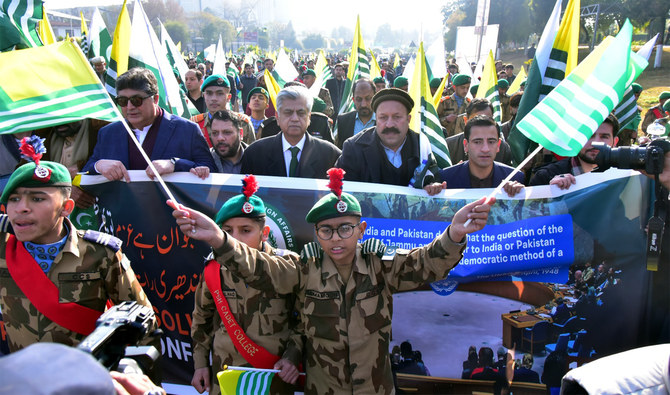
Pakistan observes Kashmir Solidarity Day today with rallies, speeches

Children wave Pakistan-administered Kashmir flags during a rally to mark Kashmir Solidarity Day in Islamabad, Pakistan, on February 5, 2024. (Government of Pakistan)
Short Url
Updated 05 February 2024
Follow

Pakistan observes Kashmir Solidarity Day today with rallies, speeches

  • Pakistan observes Kashmir Solidarity Day every year on Feb. 5 to express its support for people living in Indian-administered Kashmir 
  • Internationally disputed region has been a flashpoint between India and Pakistan since their independence from British rule in 1947

ISLAMABAD: Caretaker Prime Minister Anwaar-ul-Haq Kakar expressed his “unwavering support” for the people of Indian-administered Kashmir territory as Pakistan observes a public holiday today, Monday, to show solidarity with Kashmiris. 

The Muslim-majority Himalayan region of Kashmir has been a flashpoint between Pakistan and India since their independence from British rule in 1947. Both Pakistan and India rule parts of the Himalayan territory, but claim it in full and have fought two out of three wars over the disputed region. 

Pakistan has repeatedly called for the right of self-determination for the people of Indian-administered Kashmir and urged New Delhi to hold a plebiscite in line with the resolutions of the UN Security Council. 

“He [Kakar] said that the ‘Kashmir Solidarity Day’ was annually observed on the 5th February to express Pakistan’s unwavering support to the Kashmiri people’s just struggle for realization of their right to self-determination,” the state-run Associated Press of Pakistan (APP) said, quoting Kakar. 

Every year on Feb. 5, people from all walks of life hold demonstrations, form human chains and organize events in many parts of the country to express their support for the people of Indian-administered Kashmir. 

In connection with the Kashmir Solidarity Day, a walk is scheduled to be held in the Pakistani capital of Islamabad today, which would see participation from cabinet members, parliamentarians and people from different walks of life, according to the state-run Radio Pakistan.

In his message for Kashmir Solidarity Day, Pakistan’s President Dr. Arif Alvi said Kashmiris have been struggling for their rights for the past 76 years. 

“Today, IIOJK [Indian Illegally Occupied Jammu and Kashmir] is one of the most militarized zones in the world. Kashmiris are living in an environment of fear and intimidation,” Alvi said. 

In December last year, India’s Supreme Court upheld a 2019 decision by the government of Prime Minister Narendra Modi to revoke special autonomous status for Indian-administered Kashmir and set a deadline of Sept. 30 next year for state polls to be held.

The Modi government’s repealing of Article 370 of the constitution in 2019 allowed people from the rest of the country to have the right to acquire property in Indian-administered Kashmir and settle there permanently.

Kashmiris, rights groups and critics of the Indian government had termed the move an attempt to dilute the demographics of the only Muslim-majority Indian state.

It also heightened tensions between Pakistan and India, with Islamabad vowing not to normalize ties with New Delhi until it reverses its August 5 move. 


Pakistan passes Virtual Assets Act 2026, empowers regulator to combat money laundering

Updated 5 sec ago
Follow

Pakistan passes Virtual Assets Act 2026, empowers regulator to combat money laundering

  • Legislation introduces licensing for virtual asset service providers, market surveillance mechanisms
  • Pakistan is one of the world’s top cryptocurrency markets, with millions actively using virtual assets

KARACHI: Pakistan’s parliament on Friday passed the Virtual Assets Act 2026, granting the Pakistan Virtual Assets Regulatory Authority (PVARA) powers to combat money laundering, militant financing and other illicit activities, the regulator said.

The legislation introduces regulatory provisions including mandatory licensing for virtual asset service providers, market surveillance mechanisms, anti-money laundering and counter-terrorism financing compliance, and coordination with Pakistani financial regulators including the State Bank of Pakistan and the Securities and Exchange Commission of Pakistan.

Pakistan has in recent months stepped up efforts to draft rules for regulating the fast-expanding market for digital coins and tokens, requiring virtual asset service providers to secure government approval. Islamabad’s move to embrace digital currency marks a significant policy shift as it had banned cryptocurrency in 2018, citing financial risks.

“A year ago, Pakistan’s digital asset landscape was defined by uncertainty and grey areas. Today, we have the country’s first Act of Parliament establishing a regulatory body for virtual assets, building on the Presidential Ordinance introduced in 2025,” PVARA Chairman Bilal bin Saqib said in a post on X.

“With NOCs [no objection certificates] already issued and banking rails being developed in coordination with the State Bank of Pakistan, we are now moving toward a comprehensive licensing framework aligned with global AML [anti-money laundering] and financial integrity standards.”

Meanwhile, PVARA said the framework aims to boost transparency, protect investors, and ensure a stable, trustworthy virtual asset market while supporting responsible fintech innovation.

“The legislation also equips the Authority with powers to address money laundering, terrorist financing, and other illicit activities associated with virtual assets, bringing Pakistan’s regulatory approach in line with international standards,” it added.

Pakistan ranks among the world’s largest cryptocurrency markets by adoption, with millions of citizens actively engaged in virtual assets.

In February, Dr. Afnanullah Khan, a Pakistani senator from the ruling party, had said major crypto coins such as Bitcoin, Ethereum and XRP will soon be traded in Pakistan through crypto exchanges.

Pakistan earlier launched a “regulatory sandbox” for firms to trial crypto services under PVARA’s supervision before full approval.

In January, Pakistan signed a memorandum of understanding with a World Liberty Financial-linked firm, tied to US President Donald Trump’s family, to explore a dollar-backed stablecoin for cross-border payments.