

Pakistan’s largest city suffers urban flooding, power outages amid heavy rain

1 / 3
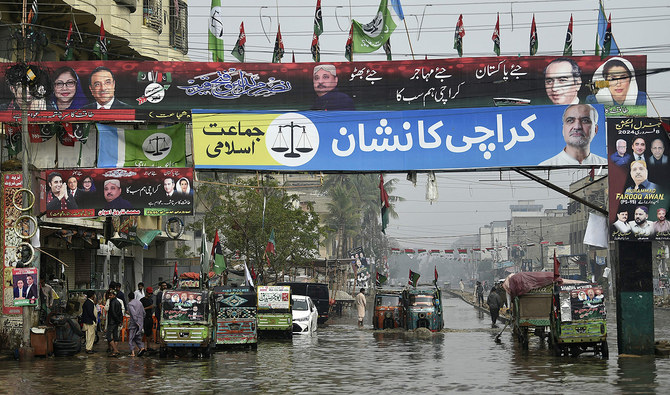
Election posters and banners of the Pakistan Peoples Party (PPP) and Jamaat-e-Islami party are seen across a flooded street in Karachi on February 4, 2024, ahead of the upcoming general elections. (AFP)
2 / 3
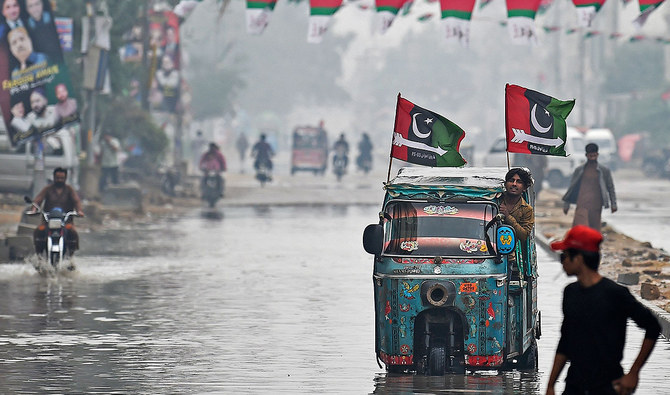
An auto rickshaw with Pakistan Peoples Party (PPP) flags make its way through a flooded street in Karachi on February 4, 2024, ahead of the upcoming general elections. (AFP)
3 / 3
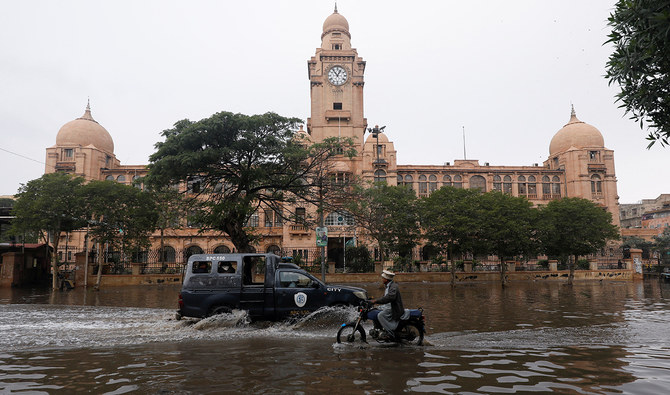
Vehicles drive through a flooded road in front of the colonial-era building of the Karachi Municipal Corporation (KMC), after a thunderstorm in Karachi, Pakistan, February 4, 2024. (REUTERS)
Short Url
Updated 04 February 2024
Follow

Pakistan’s largest city suffers urban flooding, power outages amid heavy rain

  • Scattered rainfall continues in many parts of Karachi, hampering efforts to drain water from flooded arteries
  • Karachi’s clogged drains, poor infrastructure cause its streets to be flooded with water every year during rains

KARACHI: Intermittent rainfall in different parts of the southern port city of Karachi on Sunday made life difficult for thousands of citizens, after heavy rain last night triggered urban flooding and power outages in many parts of Pakistan’s largest city. 

Karachi, the capital of the southern Sindh province, suffers from urban flooding each year, causing people to die from drowning and electrocution. Experts have criticized authorities for failing to unclog the city’s large drains due to which water accumulates on its streets. 

Heavy rainfall on Saturday left many parts of the city submerged with water, including the Shahrah-e-Faisal road, Old City area, Drigh Road, NIPA flyover, Tariq Road and Natha Khan area, among others.

Footage on social media showed cars stranded in floodwater in many parts of the country, especially at the busy Shahrah-e-Faisal thoroughfare, which connects Karachi’s many areas to the airport.

“A light to moderate rain was expected last night but unexpectedly, widespread heavy rainfall triggered massive urban flooding in Karachi,” Sardar Sarfraz, director of the Meteorological Department, told Arab News. 

Sarfraz said many parts of the city received heavy rain, particularly the Faisal base area.

“Seventy-five millimeters of rain has been recorded at Faisal base, which will increase as rainfall continues,” he said, adding that in the 1990s, 96 millimeters of rainfall in the area was recorded.

He warned that if it continued to rain in Karachi, the record could break. 

Weather expert Jawed Memon said that while the rain would stop, a fresh cold wave would grip the city in the days to come. 

“Chances of rain in Karachi will persist till tonight,” Memon told Arab News. “From tomorrow onwards, the weather will clear up, but the current heavy rain spell is triggering urban flooding in many areas of the city, especially major roads.”

In a video posted on social media platform X in the wee hours of Sunday, Karachi Mayor Murtaza Wahab Siddiqui said water stands accumulated in certain areas such as the Old City, Clock Tower, and M.A. Jinnah Road. 

K-Electric, Karachi’s sole power-generating and distributing company, said light was restored in the city in the morning.

Experts have cited the failure of successive governments administrating Karachi to ensure its infrastructure keeps pace with its rapidly rising population as the main reason rainfall triggers urban flooding every year in the metropolis.

The absence of functioning drainage systems, poor infrastructure and encroachments on stormwater drains also contribute to urban flooding in the city.


Pakistan PM calls for faster CPEC implementation, pledges security for Chinese workers

Updated 27 February 2026
Follow

Pakistan PM calls for faster CPEC implementation, pledges security for Chinese workers

  • Shehbaz Sharif pushes expanded cooperation in agriculture, IT and mining under CPEC phase two
  • Chinese envoy reaffirms Beijing’s support for Pakistan’s sovereignty and economic development

ISLAMABAD: Prime Minister Shehbaz Sharif on Friday called for speeding up projects under the China-Pakistan Economic Corridor (CPEC) and pledged stronger security guarantees for Chinese workers and investments, during a meeting with China’s ambassador in Islamabad.

Sharif made the remarks as the two countries strive to launch the second phase of CPEC, a multibillion-dollar infrastructure and energy initiative launched in 2015 as part of China’s Belt and Road Initiative (BRI).

CPEC’s first phase focused largely on power generation and transport infrastructure aimed at easing Pakistan’s chronic energy shortages and improving connectivity. The second phase seeks to expand cooperation into industrial development, with an emphasis on special economic zones and export-oriented growth.

“While highlighting the importance of accelerating ongoing CPEC projects, the Prime Minister stressed on the need to enhance cooperation in agriculture and IT and mining & minerals,” said a statement circulated by the PM Office after the meeting.

“He also underscored Pakistan’s resolve to provide a secure and conducive environment for Chinese personnel, investments, and institutions in Pakistan,” it added.

Chinese nationals and projects in Pakistan have faced security threats in the past, including attacks by militant groups targeting infrastructure sites and convoys. Islamabad has repeatedly vowed to tighten security and has deployed special protection units for Chinese workers.

China is Pakistan’s closest ally in the region and a key economic partner, with CPEC widely regarded by Islamabad as central to long-term economic growth.

During the meeting, the prime minister conveyed greetings to Chinese President Xi Jinping and Premier Li Qiang, particularly on the occasion of the Chinese New Year.

China’s Ambassador to Pakistan, Jiang Zaidong, reiterated Beijing’s support for Pakistan’s sovereignty and socioeconomic development, according to the statement. Both sides also exchanged views on regional and international issues and agreed to maintain close coordination.