

Pakistan PM meets UAE trade minister, calls for enhanced aviation and tourism ties

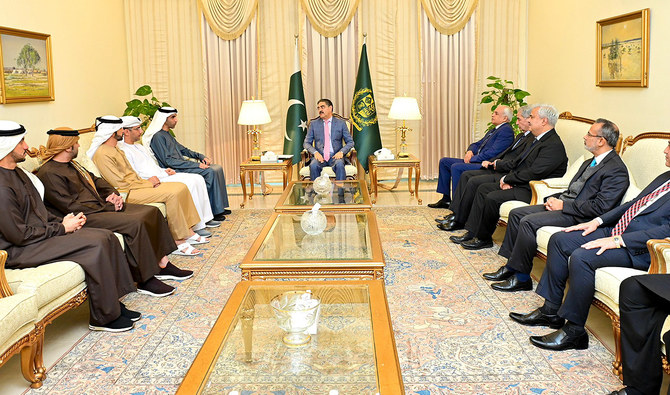
UAE Minister of State for Foreign Trade Dr. Thani bin Ahmed Al Zeyoudi (5th left) speaks during a meeting with Pakistan Prime Minister Anwaar-ul-Haq Kakar (center) at the Prime Minister's Office in Islamabad on February 3, 2024. (Photo courtesy: PMO)
Short Url
Updated 03 February 2024
Follow

Pakistan PM meets UAE trade minister, calls for enhanced aviation and tourism ties

  • Kakar says Pakistan plans to bring together the business community in both countries for greater collaboration
  • Pakistan and the UAE are also considering railway connectivity to increase interactions between their people

ISLAMABAD: Caretaker Prime Minister Anwaar-ul-Haq Kakar said on Saturday Pakistan wanted increased collaboration with the United Arab Emirates (UAE) in the fields of tourism and aviation during a meeting with the visiting trade minister from the Middle Eastern state.
The UAE is home to 1.8 million Pakistanis who make significant contributions to the economy of their home country by sending the second largest sum of remittances after the Pakistani diaspora community in Saudi Arabia.
The UAE has also played a pivotal role in helping the South Asian country deal with its financial crisis in recent years by depositing large chunks of money in Pakistan’s central bank.
Last year, Kakar visited the UAE to strengthen the trade and economic ties between the two countries and highlight the investment opportunities available in various economic sectors of Pakistan.
“During my recent visit to the United Arab Emirates, agreements were signed between the two countries, marking the beginning of a new era of economic partnership between Pakistan and the UAE,” he said during his meeting with the visiting trade minister, Dr. Thani bin Ahmed Al Zeyoudi.
According to a statement issued by the PM Office in Islamabad, Kakar emphasized the need to enhance bilateral cooperation in aviation and tourism industries and work on railway connectivity to increase interactions between the peoples of the two countries.
“The Government of Pakistan will play every possible role in bringing together businessmen and Chambers of Commerce and Industry of both countries,” he assured while praising UAE’s “robust support” for his country with enhanced investment.
The UAE minister expressed determination to further improve trade relations with Pakistan.
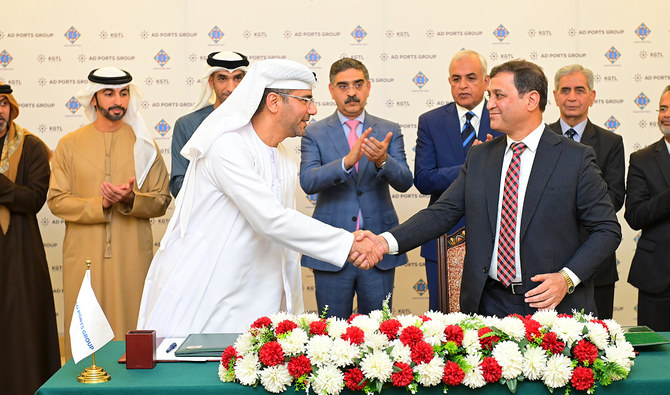


Officials from the Karachi Port Trust, Pakistan (right) and Abu Dhabi Ports Group, UAE (left) shake hands after signing of a Memorandum of Understanding between Pakistan and UAE in Islamabad on February 3, 2024. (Photo courtesy: PMO)

Kakar also witnessed signing of a commercial agreement between the Karachi Port Trust and Abu Dhabi Ports Group that is expected to strengthen bilateral relations in marine and logistic sectors of Pakistan and the UAE.
The prime minister expressed satisfaction over the growth of exchanges, interaction and cooperation between businesses in the two countries.


Pakistan footwear sector flags used imports as barrier to export growth

Updated 5 sec ago
Follow

Pakistan footwear sector flags used imports as barrier to export growth

  • Industry says production capacity far exceeds domestic consumption, signaling export potential
  • Its delegation tells commerce minister up to 40 percent of domestic market met through used shoe imports

KARACHI: Pakistan’s leather and footwear industry has warned that rising imports of used shoes are distorting the domestic market and limiting export growth, according to a commerce ministry statement issued on Thursday after industry representatives met Commerce Minister Jam Kamal Khan.

The meeting focused on export potential, domestic market challenges and regulatory concerns linked to the import of second-hand footwear, which industry leaders say is undermining local manufacturers despite significant production capacity.

“Pakistan’s annual footwear consumption is estimated at around 550 million pairs, while the country has an installed production capacity of nearly 700 million pairs annually, indicating significant potential for both domestic supply and export expansion,” the delegation said, according to the commerce ministry statement.

“A considerable portion of this capacity remains underutilized due to market distortions created by the growing influx of used footwear imports,” it added.

Industry representatives told the minister that around 30-40 percent of Pakistan’s domestic footwear market is currently supplied through imports of used shoes, many of which enter the country under the broader customs category of used clothing and accessories.

They said branded footwear is often imported at very low declared values under this classification, creating what they described as unfair competition for domestic manufacturers.

To address the issue, the delegation proposed introducing a separate Harmonized System (HS) code for used footwear, which would allow regulators to better track imports, improve customs valuation and introduce sector-specific regulatory measures.

The commerce ministry said the proposal has been placed on the agenda of the Tariff Policy Board and could eventually be considered as part of the upcoming federal budget following consultations and approvals.

The commerce minister acknowledged the importance of the leather and footwear sector as a potential export driver and reiterated the government’s support for local manufacturing and export-led growth, the statement said.

He also encouraged industry stakeholders to expand exports while ensuring locally produced footwear remains affordable for domestic consumers.

Both sides agreed to maintain close coordination to help the sector boost employment, increase production and expand Pakistan’s presence in international footwear markets.