
NEW DELHI: Trade unions in India are raising the alarm over a lack of legal protection and rights guarantees for their countrymen working in Israel.
Israel has started a recruitment drive in India as it looks to replace with manpower from South Asia the tens of thousands of Palestinian laborers who have had their work permits revoked since the start of Israel’s attacks on Gaza in October.
In November, the Indian Ministry of Skill Development and Entrepreneurship signed a three-year agreement with Tel Aviv regarding the “temporary employment” of workers in the construction and caregiving sectors.
Authorities in the Indian states of Uttar Pradesh and Haryana have published advertisements offering jobs for 10,000 carpenters, ironworkers, and floor fitters. The advertised salaries were in the range of $1,680 — four times what the workers could earn at home.
While the jobs were advertised by local administrators, workers’ unions have warned that it is unclear who will be taking responsibility for the workers, as they will not be registered in India’s Emigrate system, which is run by the government to ensure that those seeking employment abroad have some protection of their rights. Israel is not one of the 18 countries included in that system.
With concerns growing, the Ministry of External Affairs said in mid-January that labor laws in Israel provide for the protection of migrant rights and labor rights and that it is “committed to safe and legal mobility and migration of our people.”
Unionists, however, say that the workers in Israel have no clarity about who is responsible for their social security and safety in a war zone. They also say that Israel’s treatment of Palestinian laborers casts doubt on how the newly recruited workers will be treated.
“They have driven out the Palestinian workers and they want to recruit Indian workers in their place ... the Indian workers are being made into sacrificial goats,” K. Hemalata, president of the Construction Workers Federation of India, told Arab News. “The labor ministry is not taking responsibility, the state government is not taking responsibility, the National Skill Development Corporation is not taking responsibility, the Ministry of External Affairs is not taking responsibility.”
Sucheta De, secretary of the All-India Central Council of Trade Unions, said the lives of Indians were being put at risk by their own government.
“If you are the government of a sovereign country, the lives and safety of the citizens of that country are your primary responsibility. And, being a sovereign country, if you assess what is going on around the world, you would definitely want your citizens to be safe from a war that is happening somewhere else,” she said. “This is a deliberate attempt to put the lives of the workers at risk.”
Representing some 100 million workers, Indian trade unions have been opposing the mass employment of Indians in Israel since the moment it became public. In early November, they issued a statement saying that Israel’s occupation of Palestine had decimated its economy, making Palestinians dependent on Israel for employment, and that providing the country with manpower would “amount to complicity on India’s part with Israel’s ongoing genocidal war against Palestinians.”
Since the Indian government has proceeded with the plan, the unions are preparing to take action against it.
“Without being transparent, luring our workers like this by sending them to war-torn areas, is a criminal act,” said Amarjeet Kaur, secretary of the All-India Trade Union Congress. “We are totally opposed to it, and we are trying to find out if legal intervention is possible.”
She told Arab News that she also had concerns about India’s complicity in Israel’s war on Gaza.
“Already 30,000 people have been killed and the vast majority of them are women and children. The Israeli government wants Palestinians working in Israel to be replaced by Indian workers. Should the Indian government do it?” Kaur said. “History will not excuse us if India stands with a government which is committing genocide.”
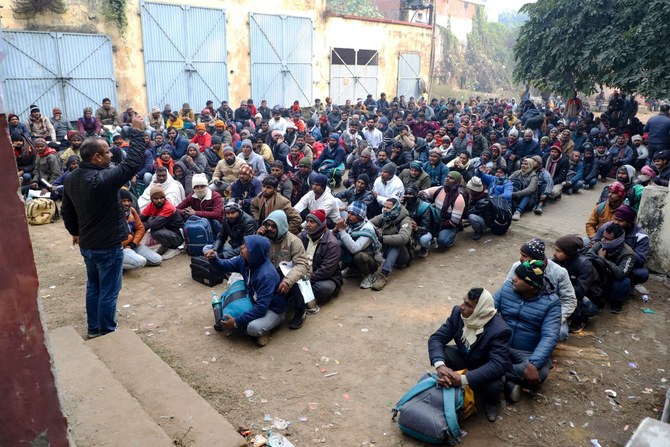
Teams from Israel were conducting job interviews in Rohtak — a city in Haryana — in late January. Thousands of candidates arrived not only from across the state but also from as far afield as Bihar, more than 1,000 km away.
Those who came were desperate for work. Mostly young, they see no prospect of employment in India, where the unemployment rate for those aged 20 to 34 is higher than 20 percent.
Prince Khattar, 25, who came to Rohtak to apply for a carpenter’s job, told Arab News why he wanted to go to Israel. “I heard the salary is very good, somewhere in the range of 140,000 ($1,680). I hope that once I get the job, I will get married,” he said.
Amit Kumar, 30, who applied to work as a mason, was not concerned about his safety.
“I don’t care about the tense situation in Israel. The job is important and it’s a lucrative offer. If death has to come, it will come anyway,” he said. “People die while sleeping too.”
The mostly semi-skilled candidates, not all of whom are literate, had little awareness of Israel’s ongoing war, let alone the social conditions or working conditions in which they would find themselves.
Jagmati Sangwan, an activist in Rohtak, believes the Israeli recruiters are taking advantage of India’s unemployment rates and said the way they had treated the job applicants spoke volumes about the treatment Indian workers could face in Israel.
“In the absence of proper employment opportunities, these young people are being used as fodder,” she told Arab News. “Hundreds of youths came from different states. They were sitting outside the university from 5:30 in the morning, and in the evening the Israelis said they would (only) be conducting interviews for people who were from Haryana.”
Those who arrived from outside the state told Sangwan they had not previously been informed that they would not even be considered for work opportunities.
“It’s a small example of how these young people will be treated in the whole process,” Sangwan said.
“They were all so disappointed. They said: ‘We are returning with heavy hearts. Why did they treat us like this?’”