

Fake news, online hate swell anti-Rohingya sentiment in Indonesia

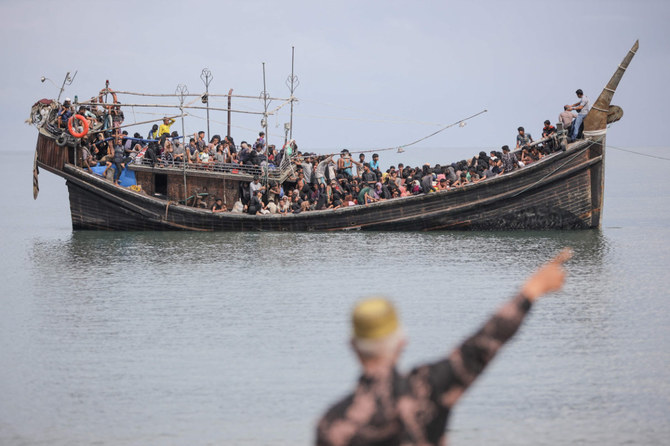
Rohingya refugees are stranded on a boat after the nearby community decided not to allow them to land after giving them water and food in Pineung, Aceh province on November 16, 2023. (AFP/File)
Short Url
Updated 03 February 2024
Follow

Fake news, online hate swell anti-Rohingya sentiment in Indonesia

  • The persecuted Myanmar minority were previously welcomed in the ultra-conservative Aceh province
  • Videos peddling misinformation showed overcrowded vessels claiming to be ships carrying Rohingya to Indonesia has stoked anti-Rohingya feelings

JAKARTA: Arriving on a rickety boat in western Indonesia from squalid Bangladesh camps after weeks at sea late last year, hundreds of Rohingya refugees came to shore only to be turned around and pushed back.
The persecuted Myanmar minority were previously welcomed in the ultra-conservative Aceh province, with many locals sympathetic because of their own long history of war. But a wave of more than 1,500 refugees in recent months has been treated differently.
A spate of online misinformation in the world’s most populous Muslim-majority nation has stoked what experts say is rising anti-Rohingya sentiment culminating in pushback, hate speech and attacks.
In December, hundreds of university students entered a government function hall in Banda Aceh city hosting 137 Rohingya, chanting, kicking refugees’ belongings and demanding they be deported. The refugees were relocated.
“The attack is not an isolated act but the result of a coordinated online campaign of misinformation, disinformation and hate speech,” the United Nations Refugee Agency (UNHCR) said.
On social media, anti-Rohingya videos have been spreading since late last year, racking up more than 90 million views on TikTok alone in November, according to Hokky Situngkir, TikTok analyst at Bandung Fe Institute.
It began after some local media outlets reported the Rohingya’s arrival with sensational headlines, said Situngkir.
The reports have framed the mostly Muslim Rohingya as criminals with bad attitudes and Indonesian community leaders have reinforced this narrative.
Some TikTok users have reshared the sensational articles and videos, which would help generate more views and money.
“Sometimes when the sensation is too big, it turns out to be misinformation,” Situngkir told AFP.

Victims of human traffickers

President Joko Widodo has called for action against human traffickers responsible for smuggling Rohingya and said “temporary humanitarian assistance will be provided” to refugees while prioritizing local communities.
But a few days after the attack on a refugee shelter, the Indonesian navy pushed away a Rohingya boat approaching the Aceh coast.
Jakarta — not a signatory of the UN refugee convention — has appealed to neighboring countries to do more to take in the Rohingya.
On TikTok, dozens of fake UNHCR accounts have flooded Rohingya videos with comments.
“If you don’t want to help, just give them one empty island so they can live there,” one read, presented as if it was written by a real UNHCR account.
A post sharing a report that Indonesia’s Vice President Ma’ruf Amin was considering moving the refugees to an island was viewed three million times.
A verified account wrote underneath: “Big no! It is better to expel them, no use in sheltering them.”
Ismail Fahmi, analyst for social media monitor Drone Emprit, told AFP the narrative “seems coordinated” but presented as if “it was organic.”
The campaign started with posts from anonymous confession accounts, and then several users with large followings replied with anti-Rohingya messages, making the narrative appear to be trending, he said.
Locals say social media is making such anti-Rohingya sentiment appear widespread, but that was not reflected across Aceh day-to-day.
“It seems massive when we observe it on social media,” said Aceh fishermen community secretary-general Azwir Nazar, acknowledging that Rohingya defenders online were treated as a “common enemy.”
But, he said, “In reality, in our daily lives, things seem normal.”

Stoking anti-Rohingya feelings
Some of the most viewed videos peddling misinformation showed overcrowded vessels claiming to be ships carrying Rohingya to Indonesia.
The footage, viewed millions of times on TikTok, actually showed ferry passengers on domestic Bangladesh routes, according to an AFP Fact Check investigation.
Another video claimed Rohingya damaged an East Java refugee center — more than 2,300 kilometers (1,429 miles) from Aceh.
An AFP Fact Check investigation debunked the claim through interviews with authorities who said the perpetrators were not Rohingya.
The videos were uploaded on TikTok and video platform Snack, then reposted on other social media sites like Facebook and by local media outlets with millions of followers, boosting the misinformation’s reach, AFP’s Fact Check team found.
AFP, along with more than 100 fact-checking organizations, is paid by TikTok and Facebook parent Meta to verify videos that potentially contain false information.
Both organizations declined AFP requests for comment.
Some videos and comments were also related to this month’s presidential election.
Some mocked candidate Anies Baswedan, saying he supports the Rohingya because he recommended they be housed “in a separate place” to avoid conflict.
Others praised front-runner and Defense Minister Prabowo Subianto who has said Indonesia should “prioritize our people.”
But in several presidential debates so far, the candidates have not mentioned Rohingya migration.
For some in Aceh, anti-Rohingya feelings have stemmed from frustration at a lack of a government solution.
But the inflated anti-refugee posts have left them wondering if that feeling is genuine.
“Only Allah knows whether (the posts are) all humans,” said Nazar.
“Or perhaps, with the technology now, there might be AI or robots involved.”



House Republicans barely defeat Venezuela war powers resolution to check Trump’s military actions

Updated 23 January 2026
Follow

House Republicans barely defeat Venezuela war powers resolution to check Trump’s military actions

WASHINGTON: The House rejected a Democratic-backed resolution Thursday that would have prevented President Donald Trump from sending US military forces to Venezuela after a tied vote on the legislation fell just short of the majority needed for passage.
The tied vote was the latest sign of Republican House Speaker Mike Johnson’s tenuous hold on the majority, as well as some of the growing pushback in the GOP-controlled Congress to Trump’s aggressions in the Western Hemisphere. A Senate vote on a similar resolution was also tied last week until Vice President JD Vance broke the deadlock.
To defeat the resolution Thursday, Republican leaders had to hold the vote open for more than 20 minutes while Republican Rep. Wesley Hunt, who had been out of Washington all week campaigning for a Senate seat in Texas, rushed back to Capitol Hill to cast the decisive vote.
On the House floor, Democrats responded with shouts that Republican leaders were violating the chamber’s procedural rules. Two Republicans — Reps. Don Bacon of Nebraska and Thomas Massie of Kentucky — voted with all Democrats for the legislation.
The war powers resolution would have directed Trump to remove US troops from Venezuela. The Trump administration told senators last week that there are no US troops on the ground in the South American nation and committed to getting congressional approval before launching major military operations there.
But Democrats argued that the resolution is necessary after the US raid to capture Venezuelan leader Nicolás Maduro and since Trump has stated plans to control the country’s oil industry for years to come.
The response to Trump’s foreign policy
Thursday’s vote was the latest test in Congress of how much leeway Republicans will give a president who campaigned on removing the US from foreign entanglements but has increasingly reached for military options to impose his will in the Western Hemisphere. So far, almost all Republicans have declined to put checks on Trump through the war powers votes.
Rep. Brian Mast, the Republican chair of the House Armed Services Committee, accused Democrats of bringing the war powers resolution to a vote out of “spite” for Trump.
“It’s about the fact that you don’t want President Trump to arrest Maduro, and you will condemn him no matter what he does, even though he brought Maduro to justice with possibly the most successful law enforcement operation in history,” Mast added.
Still, Democrats stridently argued that Congress needs to assert its role in determining when the president can use wartime powers. They have been able to force a series of votes in both the House and Senate as Trump, in recent months, ramped up his campaign against Maduro and set his sights on other conflicts overseas.
“Donald Trump is reducing the United States to a regional bully with fewer allies and more enemies,” Rep. Gregory Meeks, the top Democrat on the House Foreign Affairs Committee, said during a floor debate. “This isn’t making America great again. It’s making us isolated and weak.”
Last week, Senate Republicans were only able to narrowly dismiss the Venezuela war powers resolution after the Trump administration persuaded two Republicans to back away from their earlier support. As part of that effort, Secretary of State Marco Rubio committed to a briefing next week before the Senate Foreign Relations Committee.
Yet Trump’s insistence that the US will possess Greenland over the objections of Denmark, a NATO ally, has alarmed some Republicans on Capitol Hill. They have mounted some of the most outspoken objections to almost anything the president has done since taking office.
Trump this week backed away from military and tariff threats against European allies as he announced that his administration was working with NATO on a “framework of a future deal” on Arctic security.
But Bacon still expressed frustration with Trump’s aggressive foreign policy and voted for the war powers resolution even though it only applies to Venezuela.
“I’m tired of all the threats,” he said.
Trump’s recent military actions — and threats to do more — have reignited a decades-old debate in Congress over the War Powers Act, a law passed in the early 1970s by lawmakers looking to claw back their authority over military actions.
The war powers debate
The War Powers Resolution was passed in the Vietnam War era as the US sent troops to conflicts throughout Asia. It attempted to force presidents to work with Congress to deploy troops if there hasn’t already been a formal declaration of war.
Under the legislation, lawmakers can also force votes on legislation that directs the president to remove US forces from hostilities.
Presidents have long tested the limits of those parameters, and Democrats argue that Trump in his second term has pushed those limits farther than ever.
The Trump administration left Congress in the dark ahead of the surprise raid to capture Maduro. It has also used an evolving set of legal justifications to blow up alleged drug boats and seize sanctioned oil tankers near Venezuela.
Democrats question who gets to benefit from Venezuelan oil licenses
As the Trump administration oversees the sale of Venezuela’s petroleum worldwide, Senate Democrats are also questioning who is benefiting from the contracts.
In one of the first transactions, the US granted Vitol, the world’s largest independent oil broker, a license worth roughly $250 million. A senior partner at Vitol, John Addison, gave roughly $6 million to Trump-aligned political action committees during the presidential election, according to donation records compiled by OpenSecrets.
“Congress and the American people deserve full transparency regarding any financial commitments, promises, deals, or other arrangements related to Venezuela that could favor donors to the President’s campaign and political operation,” 13 Democratic senators wrote to White House Chief of Staff Susie Wiles Thursday in a letter led by Democratic Sen. Adam Schiff of California.
The White House has said it is safeguarding the South American country’s oil for the benefit of both the people of Venezuela and the US