Pakistan’s top business body calls for enhancing Halal food exports to GCC countries 

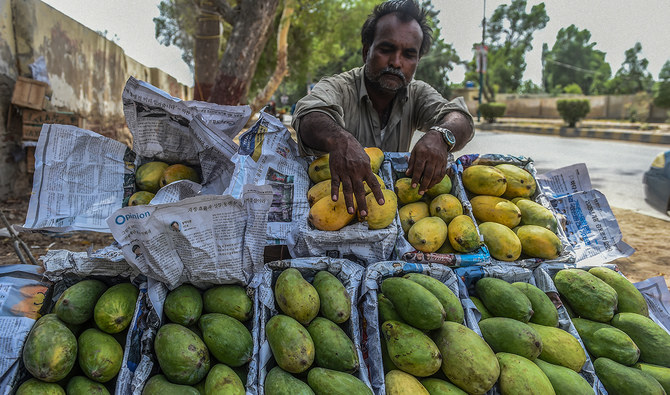
In this picture taken on June 15, 2022, a street vendor waits for customers while selling mangos in Mirpur Khas city in Pakistan's southern Sindh province. (AFP/File)
Short Url
Updated 01 February 2024
Follow

Pakistan’s top business body calls for enhancing Halal food exports to GCC countries 

  • Pakistan’s top business body participated in Makkah Halal Forum 2024 last week, inked agreeement to enhance Halal food exports to kingdom
  • President of Pakistan’s chamber of commerce says country should aim to attain at least 1 percent of global market share of Halal foods

ISLAMABAD: Pakistan’s top business body said on Thursday that the South Asian country should aim to enhance its Halal food exports to Saudi Arabia and other Gulf Cooperation Council (GCC) countries, saying that GCC nations hold the key to enhancing the cash-strapped nation’s food exports. 

A delegation of the Federation of Pakistan Chamber of Commerce and Industry (FPCCI), headed by its president Atif Ikram Sheikh, represented the country’s private sector at the Makkah Halal Forum 2024. The forum, held from Jan. 23-25 in Makkah, offered a platform for exhibitors worldwide to showcase the finest Halal services and products. 

During the visit, the FPCCI delegation and the MANAFEA Agreement— a partnership of various Saudi chambers of commerce and the Islamic Chamber of Commerce— signed an agreement to enhance Pakistan’s exports to Saudi Arabia in particular and Organization of Islamic Countries, the Pakistani business body said. 
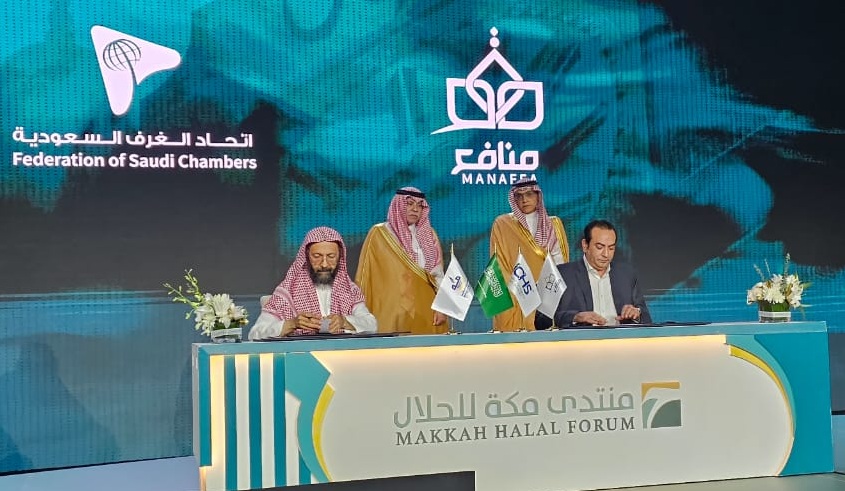


Atif Ikram Sheikh (R), President Federation of Pakistan Chamber of Commerce and Industry and Yousef Khalawi, Secretary General ICCIA, sign agreement at the Makkah Halal Forum 2024 in Saudi Arabia on February 1, 2024. (Photo courtesy: FPCCI)

Sheikh said the market for halal foods is growing in countries around the world, adding that Pakistan should take advantage of it. 

“He said Pakistan should aim to attain at least 1 percent of the market share over the next 3 – 5 years; and, that alone can mean exports of $25 billion as per the current market size,” the FPCCI said. 

Sheikh noted that the global market size for Halal foods has reached a whopping $2.5 trillion, and that it would continue to grow at 13.5 percent per year for the next 10 years. He said as a result, the expected market size for Halal foods can see an over two-fold increase and reach to $5.8 trillion by the year 2033. 

Sheikh said Pakistan has the capability to “swiftly” claim its share in the global Halal foods market as all food products produced in the country are Halal. 

“President FPCCI highlighted that tapping into GCC countries holds the key to multiplying Pakistani Halal foods exports; i.e. Saudi Arabia, UAE, Qatar, Kuwait, Bahrain and Oman,” the statement said.

The South Asian country enjoys fraternal ties with Saudi Arabia, the UAE and other GCC nations. Over 2.5 million Pakistanis reside in the kingdom, making it the country’s top source for remittances while the UAE is a key trading partner for Pakistan in the Middle East. 


Pakistan seeks cooperation with US on regulating digital assets, ambassador says

Updated 11 sec ago
Follow

Pakistan seeks cooperation with US on regulating digital assets, ambassador says

  • Islamabad signals push to align crypto regulation with global frameworks
  • Move follows creation of crypto council, regulator, recent private-sector deals

ISLAMABAD: Pakistan is seeking closer cooperation with the United States on the regulation and governance of digital assets as it builds a formal policy and regulatory framework for cryptocurrencies and related technologies, Pakistan’s ambassador to Washington said on Tuesday, according to state broadcaster Radio Pakistan.

The outreach comes as Pakistan moves to bring digital assets into a regulated space after years of informal use and legal ambiguity. Earlier this year, the government set up a Pakistan Crypto Council to advise on policy, followed by the passage of a Virtual Assets Ordinance and the creation of a dedicated Pakistan Virtual Assets Regulatory Authority to oversee licensing, compliance and market supervision. Officials have described the steps as part of a broader effort to align with international standards while managing financial and regulatory risks.

The policy push has accelerated in recent weeks, with Pakistan announcing partnerships with global crypto firms, including Binance, and signing agreements with domestic exchange HSX aimed at improving compliance, investor protection and market infrastructure. Authorities say millions of Pakistanis already use digital assets, largely outside the formal financial system, prompting concerns over consumer risk, capital flows and regulatory oversight.

“Sheikh highlighted Pakistan’s massive strides in adoption and regulation of digital assets and cryptocurrencies,” Radio Pakistan reported, referring to comments by Pakistan’s Ambassador to Pakistan, Rizwan Saeed Sheikh, during a meeting with Patrick Witt, Executive Director at the US President’s Council of Advisers for Digital Assets.

“He said the establishment of Pakistan Crypto Council (PCC), Promulgation of Virtual Assets Ordinance/Act 2025, Creation of Pakistan Virtual Assets Regulatory Authority (PVARA) and a landmark shift in central Bank’s perspective are reflective of our conscious effort to put in place an institutional framework and comprehensive ecosystem to facilitate millions of our users of digital assets.”

According to Radio Pakistan, Sheikh told his US counterpart that Pakistan viewed cooperation, coordination and collaboration as central to building what he described as a “new economy,” and expressed interest in learning from international regulatory experiences. The broadcaster said the ambassador also welcomed what he described as US leadership in shaping global approaches to digital finance and blockchain regulation.

Pakistan’s move to formalize digital asset regulation comes amid broader economic reforms under an International Monetary Fund program, with authorities under pressure to strengthen financial controls, improve transparency and manage risks linked to emerging technologies. While officials have framed the crypto framework as regulation-first rather than promotion-led, analysts say its implementation, particularly enforcement and coordination with the central bank, will be closely watched by international lenders and investors.

The US meeting did not announce any agreements or joint initiatives, but Pakistani officials have indicated that further engagement with international partners is planned as the country develops detailed rules for licensing, taxation and compliance in the digital assets sector.