Houthis claim attack on US Navy ship in Gulf of Aden

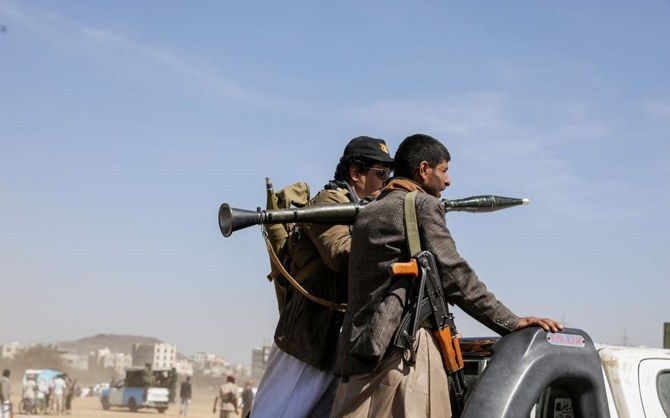
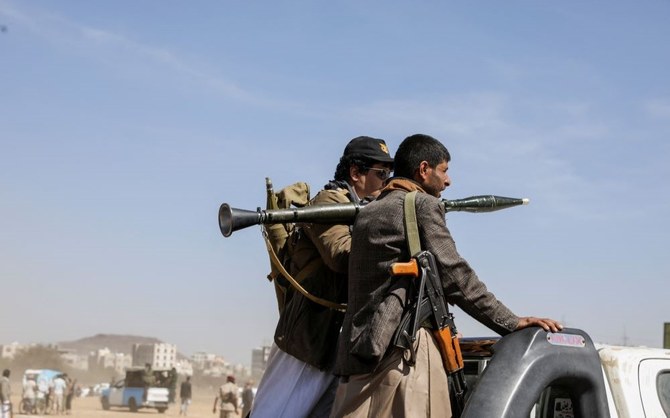
Houthi fighters on the back of a pick-up truck during a parade in support of strikes on ships in the Red Sea and the Gulf of Aden, Sanaa, Yemen, Jan. 29, 2024. (Reuters)
Short Url
Updated 29 January 2024
Follow

Houthis claim attack on US Navy ship in Gulf of Aden

  • Houthi naval troops fired an anti-ship missile at the USS Lewis B. Puller as it traveled in the Gulf of Aden
  • Yemeni leader Rashad Al-Alimi urges EU to declare Houthis as terrorists during talks with envoy

AL-MUKALLA: Yemen’s Houthi militia on Monday said they fired a missile at a US Navy ship in the Gulf of Aden, vowing to continue their attacks on ships in the Red Sea, Bab Al-Mandab, and the Gulf.

Houthi military spokesperson Yahiya Sarae said that Houthi naval troops fired an anti-ship missile at the USS Lewis B. Puller as it traveled in the Gulf of Aden. Sarae said the attack was retribution for US and UK bombings in Yemen and in solidarity with the “oppressed” Palestinians.

“The targeting procedure is part of the Yemeni armed forces’ military actions in defense of Yemen and evidence of their determination to help the oppressed Palestinian people,” Sarae said.

Despite the Houthi’s claims, neither the US Central Command nor the UK’s Maritime Trade Operations agency, which monitors Houthi assaults on ships, reported any fresh strikes in the waters off Yemen over the past 24 hours.

Since November, the Houthis have seized a commercial ship known as Galaxy Leader and fired dozens of drones and missiles against commercial ships in the region, which they say is to push Israel to cease operations in Gaza.

The attacks have pushed the US to lead a coalition to protect international trade lines off Yemen, carrying out dozens of attacks on Houthi-controlled regions and reclassifying the group as terrorists.

The Houthis have said that neither the coalition attacks nor the new designation will stop them from preventing all Israel-bound ships passing through the Red Sea.

“Neither America nor anybody else will be able to prevent Yemen from meeting its humanitarian and moral obligations towards the tortured people of Gaza,” chief Houthi negotiator Mohammed Abdulsalam said on social media platform X on Sunday.

Experts believe the Houthis continue to attack ships to remain in the spotlight and keep the US involved in the region, as they are aware that the administration of President Joe Biden will not deploy troops to Yemen during an election year.

Elisabeth Kendall, a Middle East expert and head of Girton College at the University of Cambridge, told Arab News that the current exchange of strikes between the Houthis and the US may escalate into an aggressive US bombardment of Yemen and may also see the Houthis intensify their own attacks.

“As long as there is no ceasefire in Gaza, the Houthis can position themselves as having rightson their side,” she said.

“The more the US bombs them, the more they can justify their own expansion of operations — as long as they still retain capability, which looks to be the case. We may already be in a spiral.”

Meanwhile, the chairman of Yemen’s Presidential Leadership Council, Rashad Al-Alimi, urged the EU on Monday to declare the Houthis terrorists.

The official news agency SABA reported that Al-Alimi discussed the UN-brokered peace efforts with the EU Ambassador to Yemen Gabriel Munuera Vinals in Riyadh, as well as the impact of the Houthi attacks on Yemen’s oil terminals and the EU’s economic support for the Yemeni government.


Jailed Turkish Kurd leader calls on government to broker deal for Syrian Kurds

Updated 58 min 47 sec ago
Follow

Jailed Turkish Kurd leader calls on government to broker deal for Syrian Kurds

  • Clashes between Syrian forces and the SDF have cast doubt over a deal to integrate the group’s fighters into the army

ANKARA: Jailed Turkish Kurd leader Abdullah Ocalan said Tuesday that it was “crucial” for Turkiye’s government to broker a peace deal between the Kurdish-led Syrian Democratic Forces (SDF) and the Damascus government.
Clashes between Syrian forces and the SDF have cast doubt over a deal to integrate the group’s fighters into the army, which was due to take effect by the end of the year.
Ocalan, founder of the Kurdistan Workers’ Party (PKK) militant group, called on Turkiye to help ensure implementation of the deal announced in March between the SDF and the Syrian government, led by former jihadist Ahmed Al-Sharaa, whose forces ousted longtime ruler Bashar Assad last year.
“It is essential for Turkiye to play a role of facilitator, constructively and aimed at dialogue,” he said in a message released by Turkiye’s pro-Kurdish DEM party.
“This is crucial for both regional peace and to strengthen its own internal peace,” Ocalan, who has been jailed for 26 years, added.
“The fundamental demand made in the agreement signed on March 10 between the SDF and the government in Damascus is for a democratic political model permitting (Syria’s) peoples to govern together,” he added.
“This approach also includes the principle of democratic integration, negotiable with the central authorities. The implementation of the March 10 agreement will facilitate and accelerate that process.”
The backbone of the US-backed SDF is the YPG, a Kurdish militant group seen by Turkiye as an extension of the PKK.
Turkiye and Syria both face long-running unrest in their Kurdish-majority regions, which span their shared border.
In Turkiye, the PKK agreed this year at Ocalan’s urging to end its four-decade armed struggle.
In Syria, Sharaa has agreed to merge the Kurds’ semi-autonomous administration into the central government, but deadly clashes and a series of differences have held up implementation of the deal.
The SDF is calling for a decentralized government, which Sharaa rejects.
Turkish Foreign Minister Hakan Fidan, whose country sees Kurdish fighters across the border as a threat, urged the SDF last week not to be an “obstacle” to stability.
Syrian Kurdish leader Mazloum Abdi said Thursday that “all efforts” were being made to prevent the collapse of talks.