

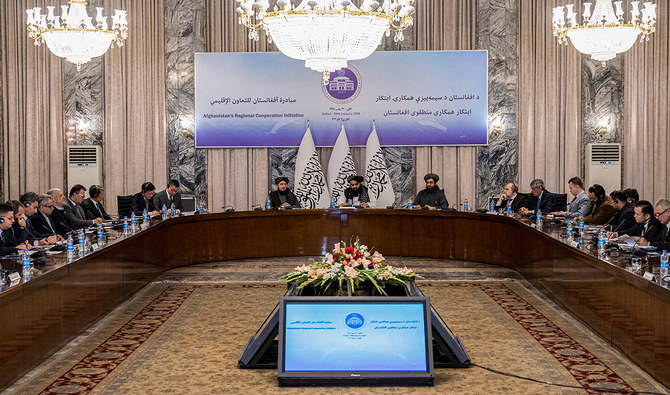

KABUL: Countries should respect the governance and development choices of Afghanistan’s Taliban government, its interim Foreign Minister Mawlawi Amir Khan Muttaqi told foreign representatives at a meeting in Kabul on Monday.
Officials from Russia, China, Iran and Pakistan were present at the meeting, which sought to improve relations between Afghanistan and its regional neighbors.
In his opening speech, Muttaqi said “imposed imported models” were not effective for Afghanistan and that “alien prescriptions,” including plans proposed by the UN, had “led to nothing but war, instability and occupation.”
“The Islamic Emirate of Afghanistan respects others’ interests, choices, government structures and development models and in return expects others to respect Afghanistan’s interests and governance and development choices and models,” he said in a statement issued by the Ministry of Foreign Affairs.
“Afghanistan does not seek confrontation and controversy with any side, rather always stresses positive engagement. Therefore, our choices shall be respected. Instead of proposing governance models and pointing fingers at the system, it is better to engage on mutual interests.”
The Taliban returned to power in August 2021 after two decades of war that killed tens of thousands of Afghans. Their takeover was followed by the withdrawal of US troops and the collapse of the Washington-backed government led by Ashraf Ghani.
The new rulers are not officially recognized by any country, and most nations closed their embassies in Kabul soon after the group’s return to power.
In September, China became the first country to send an ambassador to Afghanistan since the takeover, though Beijing later reiterated its long-standing demands for the Islamic group to pursue “moderate and prudent” policies in order to gain formal recognition, among other things.
An independent assessment commissioned by the UN last year showed that recognition of the Taliban government was linked to compliance with Afghanistan’s international treaty obligations and commitments, which require it to immediately remove sweeping curbs on women’s rights to education and employment opportunities that were introduced by the new rulers.
Muttaqi said on Monday that regional cooperation should include “respecting one another’s choices of indigenous and traditional development models.”
He also called for the removal of sanctions on Afghanistan, which were imposed after the Taliban’s return and led to a worsening economic and humanitarian crisis in the war-torn country.
“We believe Afghanistan and the region’s economic progress and development share a consistent relation. This economic dependency requires further enhancement of joint work in the region,” he said.
Faiz Mohammad Zaland, an assistant professor of public administration and policy at Kabul University, said the Taliban’s engagement with foreign nations was helpful to “directly connect” Afghanistan with the world.
“It will also help us to gain international trust,” he told Arab News.
Abdul Waheed Waheed, an international relations expert based in the Afghan capital, said Monday’s meeting was an opportunity for Afghanistan to seek “support and assistance” to be formally recognized by the international community.
“The main goal of Afghanistan in this regional meeting would be to promote peace, stability and development in the region. It will also aim to strengthen its relationships with neighboring and regional countries and seek their support in addressing common challenges,” he said.


