- Tentative sign of progress on potential agreement could see Israel pause military operations against Hamas
- US announced first military deaths in region since the war began and blamed Iran-backed militants
RAFAH: Israel said “significant gaps” remain after ceasefire talks Sunday with the United States, Qatar and Egypt but called them constructive and said they would continue in the week ahead, a tentative sign of progress on a potential agreement that could see Israel pause military operations against Hamas in exchange for the release of remaining hostages.
The US announced its first military deaths in the region since the war began and blamed Iran-backed militants for the drone strike in Jordan that killed three American service members amid concerns about a wider conflict.
The statement from Israeli Prime Minister Benjamin Netanyahu’s office on the ceasefire talks did not say what the “significant gaps” were. There was no immediate statement from the other parties.
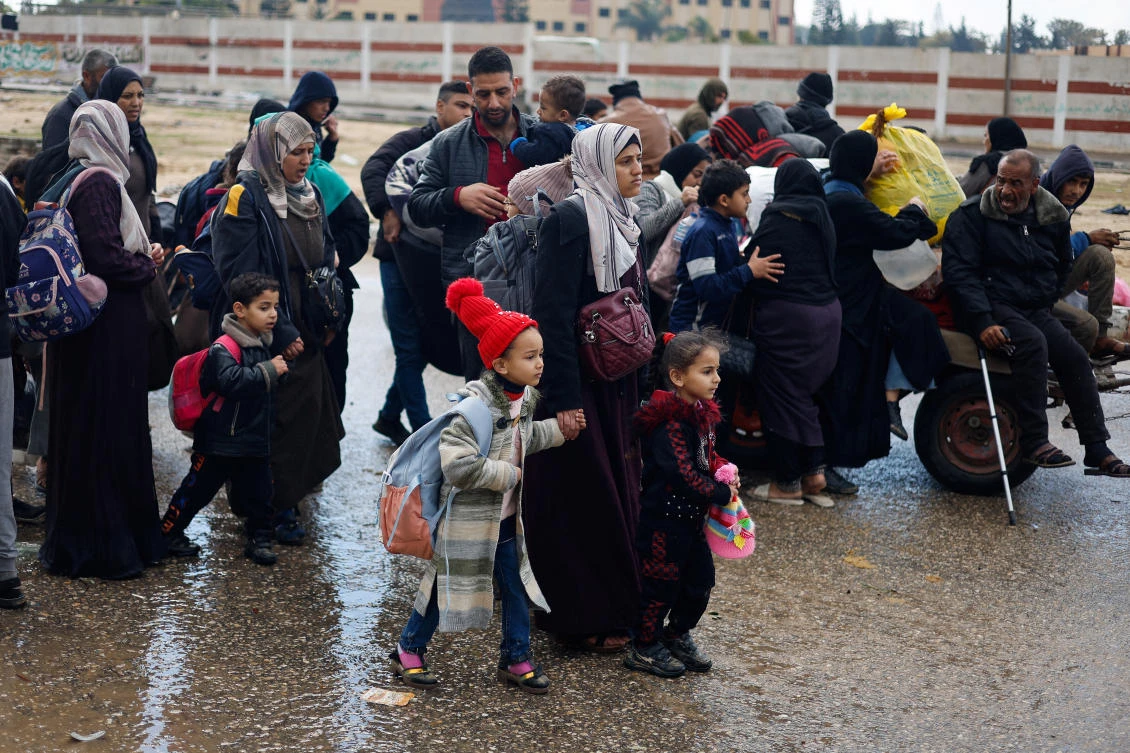
The war has killed more than 26,000 Palestinians, according to local health officials, destroyed vast swaths of Gaza and displaced nearly 85 percent of the territory’s people. Israel says its air and ground offensive has killed more than 9,000 militants, without providing evidence. The Oct. 7 Hamas attack in southern Israel killed about 1,200 people, mostly civilians, and militants took about 250 hostages.
With Gaza’s 2.3 million people in a deepening humanitarian crisis, the United Nations secretary-general called on the United States and others to resume funding the main agency providing aid to the besieged territory, after Israel accused a dozen employees of taking part in the Hamas attack that ignited the war.
Communications Director Juliette Touma warned that the agency for Palestinian refugees, known as UNRWA, would be forced to stop its support in Gaza by the end of February.
Ceasefire talks to continue
Sunday’s intelligence meeting included CIA Director Bill Burns, the head of Israel’s Mossad intelligence agency, David Barnea, Qatari Prime Minister Mohammed bin Abdulrahman Al Thani, and Egyptian intelligence chief Abbas Kamel.
Ahead of the meeting, two senior Biden administration officials said US negotiators were making progress on a potential agreement that would play out over two phases, with the remaining women, elderly and wounded hostages to be released in a first 30-day phase. It also would call for Israel to allow more humanitarian aid into Gaza. The officials requested anonymity to discuss the ongoing negotiations.
More than 100 hostages, mainly women and children, were released in November in exchange for a weeklong ceasefire and the release of 240 Palestinians imprisoned by Israel.
Israeli Defense Minister Yoav Gallant, speaking to troops, said that “these days we are conducting a negotiation process for the release of hostages” but vowed that as long as hostages remain in Gaza, “we will intensify the (military) pressure and continue our efforts — it’s already happening now.”
At least 17 Palestinians were killed in two Israeli airstrikes that hit apartment buildings in central Gaza, according to an Associated Press journalist who saw the bodies at a local hospital. One hit a building in Zawaida, killing 13 people, and the other an apartment block in the Nuseirat refugee camp, killing four.
Also Sunday, 10 Palestinians were killed in a strike that hit a residential building in the Shati refugee camp in Gaza City, said Dr. Moataz Harara, a physician at Shifa Hospital, where the dead were taken.
Israel’s military said troops were engaging in close combat with Hamas in neighborhoods of the southern city of Khan Younis, Gaza’s second-largest.
US deaths highlight regional tensions
The three deaths announced by Biden were the first US fatalities in months of strikes against American forces across the Middle East by Iranian-backed militias amid the war in Gaza. US Central Command said 25 service members were injured.
US officials were working to conclusively identify the group responsible for the attack, but assessed that one of several Iranian-backed groups was responsible. Jordanian state television quoted a government spokesperson as contending the attack happened across the border in Syria. US officials insisted it took place in Jordan, which US troops have long used as a basing point.
The US in recent months has struck targets in Iraq, Syria and Yemen to respond to attacks on American forces and to deter Iranian-backed Houthi rebels from continuing to threaten commercial shipping in the Red Sea.
The war in Gaza has sparked concerns about a regional conflict. The United States, Israel’s closest ally, has increasingly called for restraint in Gaza and for more humanitarian aid to be allowed into the territory while supporting the offensive.
A Gaza lifeline at risk of ‘collapse’
UN Secretary-General Antonio Guterres said “the abhorrent alleged acts” of staff members accused in the Oct. 7 attack “must have consequences,” but added the agency should not be penalized by the withholding of funding, and “the dire needs of the desperate populations they serve must be met.”
The United States, the agency’s largest donor, cut funding over the weekend, followed by eight other countries including Britain and Germany. Together, they provided nearly 60 percent of UNRWA’s budget in 2022.
Guterres said that of the 12 employees accused, nine were immediately terminated, one was confirmed dead and two were still being identified. He said they would be held accountable, including through criminal prosecution.
UNRWA provides basic services for Palestinian families who fled or were driven out of what is now Israel during the 1948 war surrounding the country’s creation. The refugees and their descendants are the majority of Gaza’s population.
Since the war began, most of the territory’s 2.3 million people depend on the agency’s programs for “sheer survival,” including food and shelter, UNRWA Commissioner-General Philippe Lazzarini said.
A quarter of Gaza’s population is facing starvation as fighting and Israeli restrictions hinder the delivery of aid, which has been well below the daily average of 500 trucks before the war
In the past week, hostages’ family members and supporters have blocked aid trucks from entering at the Kerem Shalom crossing. Dozens again blocked the entry on Sunday, chanting “No aid will cross until the last hostages return.”
The military later declared the area around the crossing a closed military zone, which would prohibit protests there.
With Gaza’s future being debated, thousands, including far-right lawmakers in Netanyahu’s coalition and senior Cabinet ministers, gathered in Jerusalem to call for renewing Jewish settlement in Gaza. Settlements there were evacuated in 2005, ending a 38-year-occupation, during a unilateral withdrawal of troops that bitterly divided Israel.
Crowds chanted “death to terrorists” as far-right National Security Minister Itamar Ben-Gvir took the stage and declared it was “time to encourage immigration” of Palestinians from Gaza.
The international community, including the US, has said it will oppose any attempts to expel Palestinians from Gaza. It also overwhelmingly considers settlements on occupied territory illegal.
Netanyahu has said such views do not reflect official policy and he has no plans to resettle Gaza, but he has released few details of a postwar vision for the territory.