

North Korea tests submarine-launched cruise missiles, KCNA says

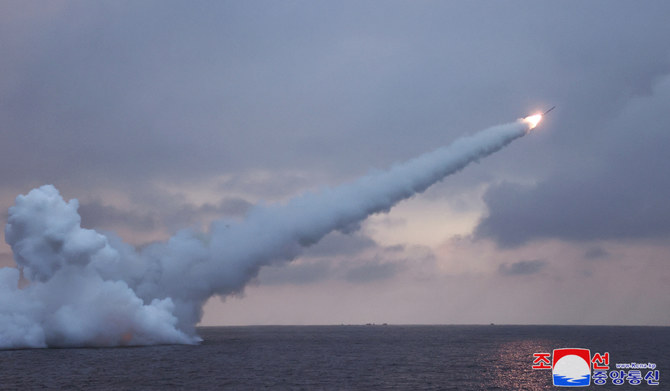
View of what appears to be a submarine-launched cruise missile test at an undisclosed location in North Korea in this picture released by the Korean Central News Agency on January 28, 2024. (REUTERS)
Short Url
Updated 29 January 2024
Follow

North Korea tests submarine-launched cruise missiles, KCNA says

  • North Korea’s cruise missiles are typically less controversial and are not explicitly banned under UN Security Council resolutions

SEOUL: North Korea tested its new strategic cruise missiles for the second time in a week on Sunday, calling it a newly developed submarine-launched cruise missile (SLCM), accelerating its navy’s nuclear armament, state media reported on Monday.
Leader Kim Jong Un supervised the test of the missile, called “Pulhwasal-3-31,” which is identical to the strategic cruise missiles that the North said last week were under development.
State news agency KCNA and official Rodong Sinmun newspaper said the missiles flew above the sea off the country’s east coast for 7,421 seconds and 7,445 seconds and hit an unspecified island target, indicating the flight time exceeded two hours.
Kim called the test a success, KCNA said, “which is of strategic significance in carrying out the plan...for modernizing the army which aims at building a powerful naval force.”
South Korea’s military said on Sunday that the North fired multiple cruise missiles off its coast but did not provide details.
Last week, the North said it had tested a new strategic cruise missile, indicating it was designed to carry a nuclear warhead, but at the time did not mention it was being developed for submarine launch.
State media photographs published on Monday showed a missile launching into a cloudy sky from the water trailed by a plume of smoke which obscures the type of platform it was being fired from.
North Korea’s cruise missiles are typically less controversial and are not explicitly banned under UN Security Council resolutions. But analysts have said intermediate-range cruise missiles were no less a threat than ballistic missiles and are a serious capability for North Korea.
In recent months, the North has tested an array of weapons that include ballistic missile systems that are under development and an underwater drone.
Kim separately inspected the construction of a nuclear submarine and discussed issues related to the manufacturing of other types of new warships, KCNA said but gave no details.
North Korea last year launched what it called its first operational nuclear attack submarine, which analysts said appeared to be a modified from an existing submarine and likely designed to carry ballistic and cruise missiles.
There was skepticism over the real-world utility of such a vessel, especially compared to the more advanced land-based missile systems, because its diesel propulsion generates noise and is limited in range, according to weapons experts.
Kim said at the time the country would accelerate the program to build nuclear-powered submarines.


Trump says he doesn’t know if aliens are real but directs government to release files on UFOs

Updated 2 sec ago
Follow

Trump says he doesn’t know if aliens are real but directs government to release files on UFOs

  • Former President Obama recently suggested in a podcast interview that aliens were real
  • Trump’s daughter-in-law Lara Trump suggested this week that the president was ready to speak about it
WASHINGTON: President Donald Trump said Thursday that he’s directing the Pentagon and other government agencies to identify and release files related to extraterrestrials and UFOs because of “tremendous interest.”
Trump made the announcement in a social media post hours after he accused former President Barack Obama of disclosing “classified information” when Obama recently suggested in a podcast interview that aliens were real.
Trump told reporters aboard Air Force One, “I don’t know if they’re real or not,” and said of Obama, “I may get him out of trouble by declassifying.”
In a post on his social media platform Thursday night, Trump said he was directing government agencies to release files related “to alien and extraterrestrial life, unidentified aerial phenomena (UAP), and unidentified flying objects (UFOs), and any and all other information connected to these highly complex, but extremely interesting and important, matters.”
Obama, who made his comments in a podcast appearance over the weekend, later clarified that he had not seen evidence that aliens “have made contact with us,” but said, “statistically, the universe is so vast that the odds are good there’s life out there.”
Trump told reporters Thursday that when it came to the prospect of extraterrestrial visitors: “I don’t have an opinion on it. I never talk about it. A lot of people do. A lot of people believe it.”
Trump’s daughter-in-law Lara Trump suggested this week that he was ready to speak about it, however, when she said on a podcast that the president had a speech prepared to deliver on aliens that he would give at the “right time.”
That was news to the White House. Press secretary Karoline Leavitt responded with a laugh when she was asked about it Wednesday and told reporters, “A speech on aliens would be news to me.”
Public interest in unidentified flying objects and the possibility of the government hiding secrets of extraterrestrial life re-emerged in the public consciousness after a group of former Pentagon and government officials leaked Navy videos of unknown objects to The New York Times and Politico in 2017. The renewed scrutiny prompted Congress to hold the first hearings on UFOs in 50 years in May 2022, though officials said that the objects, which appeared to be green triangles floating above a Navy ship, were likely drones.
Since then the Pentagon has promised more transparency on the topic. In July 2022 it created the All-Domain Anomaly Resolution Office, or AARO, which was intended to be a central place to collect reports of all military UFO encounters, taking over from a department task force.
In 2023, Dr. Sean Kirkpatrick, the head of AARO at the time, told reporters he didn’t have any evidence “of any program having ever existed as a to do any sort of reverse engineering of any sort of extraterrestrial (unidentified aerial phenomena).”
The information that has been made public shows that the vast majority of UFO reports made by the military go unsolved but the ones that are identified are largely benign in nature.
An 18-page unclassified report submitted to Congress in June 2024 said service members had made 485 reports of unidentified phenomena in the past year but 118 cases were found to be “prosaic objects such as various types of balloons, birds, and unmanned aerial systems.”
“It is important to underscore that, to date, AARO has discovered no evidence of extraterrestrial beings, activity, or technology,” the report stressed.