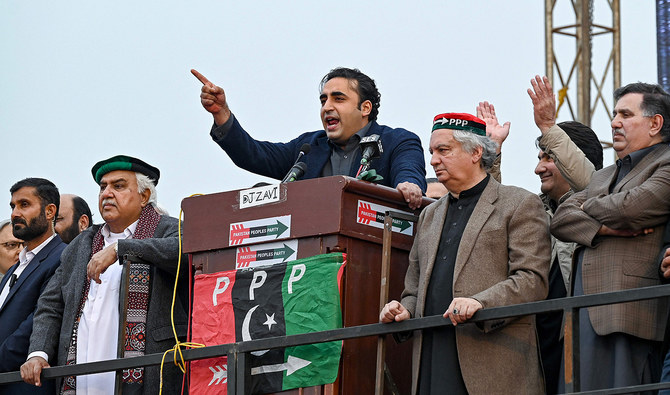
ISLAMABAD: Prime ministerial hopeful Bilawal Bhutto-Zardari’s Pakistan People’s Party (PPP) on Saturday launched its manifesto ahead of the upcoming general elections, promising to bring a “transformational change” by addressing water and food insecurity, lack of employment and other challenges facing the country.
Political parties in Pakistan having been running their election campaigns in full swing as Pakistan, a nation of 241 million, heads to national elections scheduled for February 8.
The PPP, which has been voted to power on five occasions, has outlined a comprehensive plan for inclusive development and a transformative change in its latest manifesto, which is centered on economic gains anchored in social justice, according to Sherry Rehman, the party vice president.
It has a clear message for inclusion and transformational change based on prioritizing economic gains premised on social justice, the creation of employment opportunities, and a strong focus on providing both growth and relief to the most vulnerable sections.
While launching the manifesto, Rehman said business as usual was no longer an option and neither could the country wait for trickle-down, supply-side economic policies for any transformative change, given the present circumstances.
“We cannot wait for the rich to get far, far richer before they allow their wealth to filter down to the landless, the poor, the unemployed, and the unempowered,” she said.
“While we will incentivize entrepreneurs and encourage public-private partnerships for creating and governing substantive health and education initiatives for quality services that reach all, we will seek to share burden with those who can afford it. It’s time for strategic re-sets, and we are ready to harness the clean energy of local solar parks, divert wasteful spending, and create a Pakistan that grows and adds value to change the lives of our citizens.”
In discussing the imperative of inclusive economic growth, the PPP leader emphasized that investments must be encouraged and enabled to ensure the benefits of growth reach every stratum of society.
“Resources have to be mobilized to give way for distribution that is fair, for the labor and women and farmers that turn the wheels of our country to earn a decent, living wage and not just become destitute or victims of health traumas and climate disasters overnight to eke out a subsistence living that leaves children malnourished, with a high percentage still prey to disease and stunting,” she said.
“The focus on young people, women, and the socially disadvantaged, with incentives, support, and an enabling environment for change, has been a core theme for creating prosperity in Pakistan by flattening social pyramids and empowering the growing numbers of the vulnerable and the poor in the country.”
Rehman, a former federal minister for climate change, said her party was seeking to address the growing food and water insecurity challenges in the country, the lack of jobs and vertical growth opportunities for the young, underemployed workforce, while seeking viable solutions for chronic and systemic issues that hamper public social services.
She said the PPP aimed to roll out a diverse range of programs addressing issues such as food insecurity, health care accessibility and social safety net, along with comprehensive offerings to support farmers and laborers.
“By giving them resilient homes and ownership of those homes, as has already begun in Sindh post-flood areas, we will change them into home and small land owners, with women as the actual title holders of these new assets,” she said.
“We will provide social protections under the BISP, expand the existent projects, and empower young people by providing financial support and training, as well as creating youth centers in every district.”
Rehman stressed the party’s ten-point economic agenda, launched in the early part of the campaign by PPP Chairman Bhutto-Zardari, had formed the heart of its “new thinking” on creating a social contract with the people, who had been struggling with soaring inflation and climate and social distress on the ground.
“None of the points have been just thrown together to create a manifesto without a plan to implement the cross-cutting themes, but instead bolstered by thought leadership on how the economic space to fund the people’s agenda for strategic re-sets of our human capital and resources to grow and add value to change the lives of our citizens,” she said.
Rehman said it would need political will and public consensus to reboot Pakistan’s growth and governance.
“There is a clear vision for addressing the challenges the future will hold both at home and abroad,” she said. “With the approaching date of February 8, it is hoped that the masses will rally behind the Pakistan Peoples Party’s young leadership for a transformative change.”


![]()

Pakistan PM hopeful Bhutto-Zardari’s party promises ‘transformational change’ in election manifesto
Short Url
https://arab.news/r97ne
Pakistan PM hopeful Bhutto-Zardari’s party promises ‘transformational change’ in election manifesto
- The manifesto outlines comprehensive plan for inclusive development and is anchored in social justice, party says
- It promises to address food, water insecurity and provide jobs and growth opportunities to most vulnerable sections
Latest updates


© 2026 SAUDI RESEARCH & PUBLISHING COMPANY, All Rights Reserved And subject to Terms of Use Agreement.