


GAZA: Intense fighting raged Saturday in the Gaza city of Khan Yunis, the main theater of conflict where the Israeli army is targeting the Palestinian Islamist militant group Hamas.
The unabated hostilities came a day after the UN’s International Court of Justice in The Hague ruled Israel must prevent possible acts of genocide in the conflict but stopped short of calling for a ceasefire.
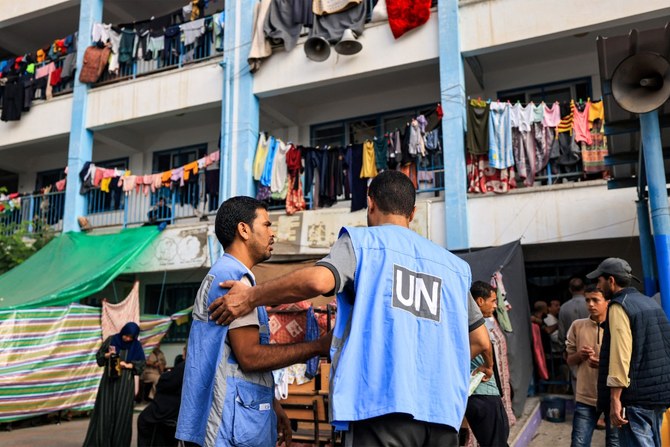
Tensions rose between Israel and the UN agency for Palestinian refugees after Israel alleged several UNRWA staff were involved in the Hamas attack of October 7, leading some key donor countries to suspend funding.
Foreign Minister Israel Katz said Saturday that Israel wants to ensure the UN agency, with tens of thousands of staff in the territory, “will not be a part of the day after” the bloodiest ever Gaza war.
The US, Australia and Canada had already paused funding to the aid agency after the allegations. The agency has opened an investigation into several employees severed ties with them.
Britain, Italy and Finland on Saturday became the latest countries to pause funding for the agency.
Alarm has grown over the plight of civilians in Khan Yunis, the southern hometown of Hamas’s Gaza chief Yahya Sinwar, the suspected mastermind of the October 7 attack.
AFPTV images showed thousands of civilians, among them women and children, fleeing the city on foot as an Israeli tank loomed behind them.
“They besieged us, so we fled,” said Tahani Al-Najjar, who left Khan Yunis with her daughter. “We call on the UN to intervene, to stop the war. Enough of fear and terror!“
Gaza civil defense spokesman Mahmud Bassal said the displaced endured incessant cold rain and warned of the “spread of contagious diseases.”
The Israeli army said its “troops continued to kill numerous armed terrorists from close range” and raided a weapons storage facility in Khan Yunis.
The health ministry in Hamas-run Gaza said at least 135 people were killed in Khan Yunis overnight.
The Hamas government said “massive tank bombardment” targeted a refugee camp in the city and its Nasser hospital.
Issuing a highly anticipated ruling on Friday, the UN’s top court said Israel must prevent genocidal acts in Gaza and allow humanitarian aid into the narrow strip of land which has been under relentless bombardment and siege for almost four months.
Israeli Prime Minister Benjamin Netanyahu rejected the case as “outrageous” while Gaza’s Hamas rulers hailed the ruling, saying it “contributes to isolating Israel and exposing its crimes in Gaza.”
The decision was based on an urgent application brought by South Africa, long a supporter of the Palestinian cause, but a broader judgment on whether genocide has been committed could take years.
“This is the first time the world has told Israel that it is out of line,” said Maha Yasin, a 42-year-old displaced Gaza woman.
“What Israel did to us in Gaza for four months has never happened in history.”
Israel’s military campaign began soon after Hamas’s October 7 attack that resulted in about 1,140 deaths in Israel, mostly civilians, according to an AFP tally of official Israeli figures.
Militants also seized about 250 hostages and Israel says around 132 of them remain in Gaza, including the bodies of at least 28 dead captives.
Israel has vowed to crush Hamas, and Gaza’s health ministry says the Israeli military offensive has killed at least 26,257 people, about 70 percent of them women and children.
The army says at least 220 soldiers have been killed since Israel launched its Gaza ground operations.
With Gaza’s humanitarian crisis growing, the UN says most of the estimated 1.7 million Palestinians displaced by the war are crowded into Rafah on the southern border with Egypt.
At Khan Yunis’s Nasser Hospital, the largest in the besieged city, Doctors Without Borders (MSF) said surgical capacity was “virtually non-existent.”
The charity said the hospital’s services had “collapsed” and the few staff who remained “must contend with very low supplies that are insufficient to handle mass casualty events.”
World Health Organization chief Tedros Adhanom Ghebreyesus said 350 patients and 5,000 displaced people remained at the hospital as fighting continued nearby.
The Palestinian Red Crescent Society said Israeli tanks targeted the Al-Amal hospital, another of the city’s few remaining medical facilities, and that it was “under siege with heavy gunfire.”
“There is no longer a health care system in Gaza,” MSF said.
There were 300 to 500 patients trapped at the Nasser hospital with “war-related injuries such as open wounds, lacerations from explosions, fractures and burns.”
The Israeli military accuses Hamas of operating from tunnels under Gaza hospitals and of using the medical facilities as command centers.
Meirav Eilon Shahar, Israel’s ambassador to the UN in Geneva, accused the WHO this week of collusion with Hamas by ignoring Israeli evidence of Hamas’s “military use” of Gaza hospitals.
Tedros rejected the accusation, saying it could “endanger our staff who are risking their lives to serve the vulnerable.”
Relations between Israel and UNRWA soured further after the UN body said tanks had shelled one of its shelters in Khan Yunis on Wednesday, killing 13 people.
UNRWA said on Friday it had sacked several employees accused by Israel of involvement in the October 7 attack.
The allegations have prompted the United States, Canada, Australia and Italy to suspend funding to the agency.
Israel said it would seek to stop UNRWA from operating in Gaza after the war. Hamas urged the international community to ignore Israel’s “threats,” while the Palestinian Authority said the agency needed “maximum support” from donors.
Diplomatic efforts have sought scaled-up aid deliveries for Gaza and a truce, after a week-long cessation of hostilities in November saw Hamas release dozens of hostages in exchange for Palestinian prisoners held by Israel.
CIA chief William Burns is to meet with his Israeli and Egyptian counterparts, as well as Qatar’s prime minister, in the coming days in Paris to seek a ceasefire, a security source told AFP.
The UN Security Council will meet to discuss the ICJ’s ruling on Wednesday.
* With AFP and Reuters


