Argentina’s Milei to visit Israel, denounces Hamas
Argentina’s Milei to visit Israel, denounces Hamas/node/2448876/world
Argentina’s Milei to visit Israel, denounces Hamas
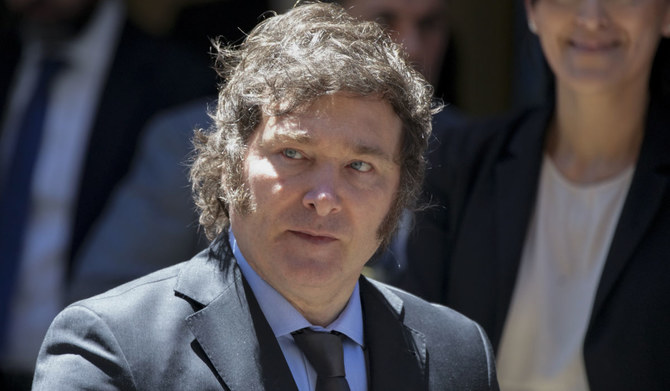
Argentine President Javier Milei leaves the Holocaust museum after attending and event marking the International Day in Memory of the Victims of the Holocaust in Buenos Aires, Argentina, Friday, Jan. 26, 2024. (AP)
Argentina’s Milei to visit Israel, denounces Hamas
Milei has presented himself politically as an ally to Israel, open to moving Argentina’s embassy from Tel Aviv to Jerusalem
Updated 27 January 2024
AFP
BUENOS AIRES: Argentina’s new President Javier Milei, who has recently embraced Orthodox Judaism, said Friday he would visit Israel as he condemned Hamas’ actions in an address to the Jewish community in Buenos Aires.
“In the coming weeks, I will be traveling to the Holy Land,” Milei said in a speech at the Holocaust Museum in Argentina’s capital, evoking a “new chapter in the brotherhood of our two nations.”
He condemned as “atrocious and unforgivable,” the October 7 attack by Islamist group Hamas on Israel which resulted in the deaths of some 1,140 people, most of them civilians according to an AFP tally based on official figures.
Israel has vowed to crush the militant group and launched a military offensive that the health ministry in Hamas-run Gaza says has killed at least 26,083 people, about 70 percent of them women and children.
Milei was speaking on the eve of International Holocaust Memorial Day, and on the same day the International Court of Justice in The Hague ruled that Israel must prevent genocide in its retaliatory war with Hamas and allow aid into Gaza.
He urged the liberation of 11 Argentines among the more than 100 hostages still held in Gaza after being captured during the Hamas attack.
Self-described anarcho-capitalist Milei was raised in a Catholic family but has spoken of his more recent study of the Torah, the book of Jewish scripture.
Right after his November election, he visited the tomb of a revered rabbi in New York, a popular spiritual pilgrimage destination for some Jews.
Argentina’s Jewish community, at 250,000, is one of the largest in Latin America.
Milei has presented himself politically as an ally to Israel, open to moving Argentina’s embassy from Tel Aviv to Jerusalem.
Prior to his election, Milei had referred to Argentine-born Pope Francis as “the evil one,” “nefarious,” and an “imbecile” who “promotes communism.”
The two seemed to reconcile when Francis called to congratulate Milei on his win and the new president invited the pope on a visit.
His Israel visit could coincide with a trip to Rome, where he is to attend a ceremony to canonize an Argentine nun. The Clarin newspaper has said the pope would receive Milei on February 12.
Zelensky hails ‘real progress’ in Berlin talks with Trump envoys
Updated 7 sec ago
BERLIN: Ukrainian President Volodymyr Zelensky said Monday that talks in Berlin with US President Donald Trump’s envoys on ending the war with Russia were “not easy” but brought “real progress” on the question of security guarantees. Zelensky met for a second day with Trump’s special envoy Steve Witkoff and the president’s son-in-law Jared Kushner for talks aimed at ending the war that started with Russia’s 2022 full-scale invasion, building on a proposal initially put forward by Trump. He hailed new security guarantees offered by Washington but also said differences remained on the question of what territories Ukraine would have to cede to battlefield enemy Russia. “There has been sufficient dialogue on the territory, and I think that, frankly speaking, we still have different positions,” Zelensky told reporters. An upbeat German Chancellor Friedrich Merz said the talks had created the “chance for a real peace process” and praised the US for offering “substantial” security guarantees. From Washington, Trump said he would hold a phone call later Monday with Zelensky and a group of European leaders set to meet in Berlin, among them UK Prime Minister Keir Starmer and French President Emmanuel Macron. Also expected were Italian Prime Minister Giorgia Meloni, Polish premier Donald Tusk and Finland’s President Alexander Stubb and other leaders, as well as NATO chief Mark Rutte and European Commission head Ursula von der Leyen. The United States said it had offered strong, NATO-like security guarantees to Ukraine and voiced confidence that Russia would accept, in what Washington said would be a breakthrough in ending the war.
- ‘Very strong deterrence’ -
US officials described the hours of talks in Berlin as positive and said Trump in his call would seek to push forward the deal. The US officials warned Ukraine must accept the deal, which they said would provide security guarantees in line with NATO’s Article Five — which calls an attack on one ally an attack on all. “The basis of that agreement is basically to have really, really strong guarantees — Article Five-like — also a very, very strong deterrence” in the size of Ukraine’s military, a US official said on condition of anonymity. “Those guarantees will not be on the table forever. Those guarantees are on the table right now if there’s a conclusion that’s reached in a good way,” he said. Trump has previously ruled out a formal entry of Ukraine into NATO and sided with Russia in calling Kyiv’s aspirations to the alliance a reason for the full-scale invasion by Moscow. Merz said any ceasefire must be “secured by substantial legal and material security guarantees from the United States and Europe, which the United States has put on the table here in Berlin in terms of legal and material guarantees.” “This is truly remarkable. This is a very important step forward, which I very much welcome,” he said.
- ‘Criminal attack’ -
Zelensky said about the talks with the US side that “these conversations are always not easy” but that it had been “a productive conversation.” An official briefed on the US-Ukrainian talks earlier told AFP that US negotiators still want Ukraine to cede control of the eastern Donbas — made up of the Donetsk and Lugansk regions. Moscow controls almost all of Lugansk and about 80 percent of the Donetsk region, according to the US-based Institute for the Study of War. Russian President Vladimir Putin “wants territory,” said the official, adding that the United States was demanding that Ukraine “withdraw” from the regions and that Kyiv was refusing. One of the US officials acknowledged that there was no agreement on territory. Trump has called it inevitable that Ukraine would need to surrender territory to Russia, an outcome anathematic to Zelensky after his country’s defense of nearly four years. Russia, meanwhile, has signalled it will insist on its core demands, including on territory and on Ukraine never joining NATO. Kremlin spokesman Dmitry Peskov said on Monday that Russia was expecting the United States to “provide us with the concept that is being discussed in Berlin today.” Merz vowed sustained support for Ukraine as it fights back against what he labelled “Putin’s criminal attack.” “We will only be able to achieve lasting peace in Europe together, with a free and sovereign Ukraine, a strong Ukraine that can defend itself against Russian attacks now and in the future,” he said. “The fate of Ukraine is the fate of all Europe.”