

Baloch activists call for unity against ‘rights abuses,’ announce rally upon return from Pakistani capital

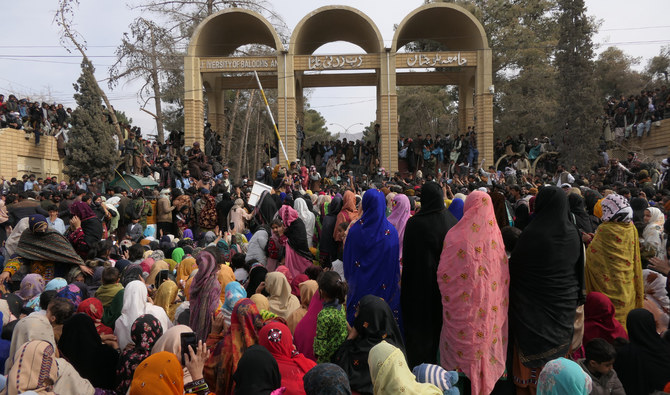
Ethnic Baloch protesters gather to welcome activists in Quetta, Pakistan, on January 25, 2024, as they returned home to the southwestern province after staging a month-long protest sit-in in the Pakistani capital of Islamabad. (AN photo)
Short Url
Updated 25 January 2024
Follow

Baloch activists call for unity against ‘rights abuses,’ announce rally upon return from Pakistani capital

  • Ethnic Baloch protesters on Tuesday ended their month-long sit-in in Islamabad against what they say are rights abuses in Balochistan 
  • The march was ignited by November killing of 24-year-old man, Balach Baloch, in custody of provincial Counter-Terrorism Department 

QUETTA: Baloch activists, who recently staged a month-long protest sit-in in the Pakistani capital of Islamabad, on Thursday called for unity against alleged rights abuses in Balochistan as they returned home to the southwestern province to a warm welcome. 

Led by 30-year-old Dr. Mahrang Baloch, ethnic Baloch protesters marched 1,600 kilometers from the southwestern Turbat district and arrived in Islamabad on December 22. The march was ignited by the November killing of a 24-year-old man, Balach Baloch, in the custody of the provincial Counter-Terrorism Department (CTD). 

The CTD had said Balach Baloch had links with militants and was involved in attacks in the region. His family and protesters say he was killed in a staged shootout by police, who deny the charge. 

On Thursday, these protesters arrived in Balochistan’s provincial capital of Quetta, where they were warmly welcomed and hailed by hundreds of people, mostly women, for highlighting the issues faced by the people of the province. 

Speaking to supporters in Quetta, Dr. Baloch regretted the attitude of the authorities during their stay in Islamabad and announced holding a public rally at the Shahwani Stadium in Quetta on Saturday. 

“We marched toward Islamabad and sat there for 32 days in bitter cold, but they called us ‘terrorists’,” she told supporters gathered on Quetta’s Sariab Road. “We have to be united against the oppression on the Baloch nation, because we have not received justice from Islamabad for the last seven decades.” 



A 30-year-old Baloch activist, Dr. Mahrang Baloch, is addressing protestors in Quetta, Pakistan, on January 25, 2024. (AN photo)

Balochistan has for decades been the site of a low-level insurgency by separatists fighting for a more equitable share of the resources of the mineral-rich province or outright independence from Pakistan. The remote province is Pakistan’s largest by land mass but most impoverished by almost all social and economic indicators. 

Political leaders, human rights activists, and families of victims have for decades spoken against killings in Balochistan by security agencies in staged encounters, a practice where officials claim the victim was killed in a gunfight though they were summarily executed. Authorities deny involvement in such incidents. 

Seema Baloch, a 37-year-old protester who was present at the Islamabad demonstration, said they did not receive any “sympathy” from the central government, but they did succeed in conveying “our message globally.” 

“We have announced a public rally on 27 Jan, 2024 where we will announce our future plan,” she told Arab News. 

However, Caretaker Balochistan Information Minister Jan Achakzai told Arab News that any public meeting in Quetta was subject to the administration’s approval. 


Pakistan Army’s logistics firm to run national shipping corporation, confirm officials

Updated 4 sec ago
Follow

Pakistan Army’s logistics firm to run national shipping corporation, confirm officials

  • Government to transfer 30 percent shares in Pakistan National Shipping Corporation, management control to NLC firm, say officials
  • Officials say the move will increase PNSC’s shipping fleet from 10 to 54, save $6 billion Islamabad pays in foreign freight annually

KARACHI: The government has decided to transfer the state-run Pakistan National Shipping Corporation’s (PNSC) management to the military-run National Logistics Corporation (NLC), officials confirmed on Thursday, saying the move is expected to save $6 billion that Islamabad currently pays in foreign freight annually. 

A week earlier, Prime Minister Shehbaz Sharif’s government sold 75 percent of its shareholding in the national flag carrier Pakistan International Airlines (PIA) to a business consortium led by Arif Habib Group for Rs135 billion ($482 million).

The government’s current drive to privatize state-owned enterprises (SOEs) is a key requirement of the International Monetary Fund’s (IMF) $7 billion loan program. The global lender wants Islamabad to privatize its loss-making state assets to save valuable revenue. 

PNSC reported a 34 percent decline in its profit, which reduced to Rs3.71 billion ($13.2 million) in the July-September quarter this year. Its revenues from shipping business fell by 2 percent to Rs9.32 billion ($33 million) in the same period, according to the company’s filing to the Pakistan Stock Exchange (PSX) seen by Arab News. The PNSC’s profits remained almost stagnant at Rs20 billion ($73 million) in FY25 while its shipping income shrank 18 percent to Rs33.7 billion ($120.3 million).

“We received a letter about one month ago in which the government asked us to sort out things before Dec. 30,” a PNSC official told Arab News on condition of anonymity as he was not authorized to speak to media. “The management control will go to the NLC.”

An NLC official confirmed the same. 

“Yes, this is happening,” an NLC official told Arab News on condition of anonymity. He said details will be shared in due course.

Muhammad Arshad, a spokesman at Pakistan’s Maritime Affairs Ministry, and PNSC Spokesperson Muhammad Farooq Nizami both declined to comment on the matter.

“We can’t say anything about this development until we get an official notification,” Nizami told Arab News. 

Officials said that as per the PNSC Revitalization and Improvement Plan, the government would sell about 30 percent of its PNSC shareholding to NLC, which would then have a controlling share in the corporation’s management.

As of Jun. 30, the government holds 87.56 percent shares in PNSC, whose 198.1 million shares are listed on the PSX with a market capital of Rs109 billion ($389 million). 

The NLC will be required to increase the PNSC’s shipping fleet, which currently comprises only 10 ships, to 54 over the next five years, the shipping company’s official said.

This would help Pakistan’s government save about $6 billion in freight costs as the PNSC’s current 10 ships are only able to handle 11 percent of the country’s commercial cargo, he added.

“As a result, Pakistan has to pay approximately $6 billion annually in foreign exchange to foreign shipping companies as freight charges,” he said. 

Among other objectives, the military-led company is also expected to rid PNSC of its aging fleet, as many vessels are nearing the end of their operational life and won’t be able to sail profitably beyond 2030.

“This initiative will ensure 100 percent replacement of all old PNSC vessels along with the induction of new ships,” the PNSC official said. 

News reports of the transfer of management have led to a rise in the PNSC’s shares at the PSX, which gained by around 21 percent in the last two trading sessions. The stocks traded at Rs548.89 ($1.9) per share on Thursday morning, taking its year-to-date gains to 17 percent.

Pakistan’s government has been cautious in spending its $16 billion foreign exchange reserves as it aims to keep its current account balance in check. 

Pakistan’s current account reported a $812 million deficit in the July-November period from a $503 million surplus last year, according to data shared by the central bank. 

The PNSC official said the increase in the company’s shipping fleet will enhance its share in global maritime freight from $162 million to $1.79 billion. 

“Despite significant growth potential in the shipping industry, the absence of private operators is hindering market dynamism and efficiency,” he said. 

“World-class financial and legal advisers will be appointed for institutional restructuring, transforming PNSC into a modern, agile, and professionally managed organization.”
