

Nearly all US Senate Democrats back two-state solution for Israel and Palestinians

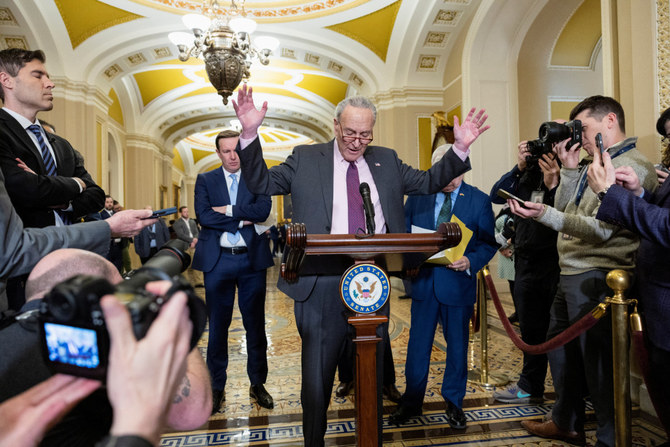
US Senate Majority Leader Chuck Schumer speaks during the weekly Democratic Caucus lunch press conference at the US Capitol building in Washington on January 23, 2024. (REUTERS)
Short Url
Updated 25 January 2024
Follow

Nearly all US Senate Democrats back two-state solution for Israel and Palestinians

  • Forty-nine of the 51 members of the Senate Democratic caucus backed an amendment supporting a negotiated solution to the conflict that results in Israeli and Palestinian states living side by side

WASHINGTON: An overwhelming majority of President Joe Biden’s fellow Democrats in the Senate on Wednesday backed a statement reiterating US support of a two-state solution to the Israeli-Palestinian conflict.

Forty-nine of the 51 members of the Senate Democratic caucus backed an amendment supporting a negotiated solution to the conflict that results in Israeli and Palestinian states living side by side, ensuring Israel’s survival as a secure, democratic, Jewish state and fulfilling the Palestinians’ “legitimate aspirations” for a state of their own.
Senator Brian Schatz introduced the measure as an amendment to an upcoming bill that would provide national security aid to Ukraine, Israel and Taiwan.
“What will determine the future of Israel and Palestine is whether or not there’s hope. And the two-state solution has to be that hope,” Schatz told a news conference.
With war raging in Gaza between Israel and Hamas, Israeli Prime Minister Benjamin Netanyahu said at a press conference this month that he objected to any Palestinian statehood that did not guarantee Israel’s security.
The statement provoked international concern, including from Israel’s biggest backer the United States. Washington maintains that the two-state solution is the only feasible way to bring lasting peace to the region.
The only two Democratic senators who did not sign onto the amendment were John Fetterman and Joe Manchin.
Fetterman has long supported a two-state solution, but he believed the measure should include language stipulating the destruction of Hamas as a precondition to peace, an aide said.
Manchin issued a statement, in which he said: “Once a Palestinian government with its peoples’ best interests at heart agrees that Israel should be a state, I will be the first one to sign on to a bipartisan amendment supporting that Israel recognize a Palestinian state.”
Many of Biden’s fellow Democrats in Congress have been pushing the administration to do more to address the steep toll on Palestinian civilians of Israel’s campaign against Hamas since the militant group’s deadly assault on Oct. 7.


Rubio meets Caribbean leaders as US raises pressure on Cuba

Updated 3 sec ago
Follow

Rubio meets Caribbean leaders as US raises pressure on Cuba

Basseterre: US Secretary of State Marco Rubio will seek to address Caribbean leaders' concerns about Cuba at a summit on Wednesday, as Washington ramps up pressure on the communist island fresh after removing Venezuela's president.
Rubio, a Cuban-American who has spent his political career hoping to topple Havana's government, is also looking for sustained cooperation on Venezuela and troubled Haiti as he takes part in the summit of the Caribbean Community, or CARICOM, which does not include Cuba.
After attending President Donald Trump's State of the Union address to Congress, Rubio flew overnight to join the summit in Saint Kitts and Nevis, a sun-kissed former British colony of fewer than 50,000 people.
Rubio became the highest-ranking US official ever to visit the tiny country, the birthplace of one of the United States' founding fathers, Alexander Hamilton.
Trump has reoriented foreign policy toward the Western Hemisphere through his "Donroe Doctrine" in which he has vowed unrepentant intervention to advance US interests.
After US forces snatched Venezuela's leftist leader Nicolas Maduro in a January 3 raid, the Latin American country has been forced to cut off its crucial oil shipments to Cuba.
This has plunged Cuba into a further economic morass with fuel shortages and rolling blackouts.
Speaking at the opening of the CARICOM summit on Tuesday, Jamaican Prime Minister Andrew Holness warned that a further deterioration in Cuba will impact stability across the Caribbean and trigger migration -- the top political concern for Trump.
"Humanitarian suffering serves no one," Holness said. "A prolonged crisis in Cuba will not remain confined to Cuba."
Plea for 'stability' 
Holness said that Jamaica believed in democracy and free markets -- a rebuke to the communist system in Havana -- but called for "humanitarian relief" for Cubans.
"Jamaica supports constructive dialogue between Cuba and the United States aimed at de-escalation, reform and stability," he said.
"We believe there is space, perhaps more space now than in years past, for pragmatic engagement."
The summit's host, Saint Kitts and Nevis Prime Minister Terrance Drew, also called for humanitarian backing to Cuba, saying: "A destabilized Cuba will destabilize all of us."
A medical doctor, Drew studied for seven years in Cuba and said friends there have told him of food scarcity, power outages and garbage strewn in the streets.
"I can only feel the pain of those who treated me so well when I was a student," he said.
The United States has imposed sanctions on Cuba almost continuously since Fidel Castro's 1959 revolution.
Since becoming the top US diplomat, Rubio has publicly toned down calls for regime change, and Washington has quietly held discussions with Havana.
Trump and Rubio have threatened sanctions against countries that sell oil to Cuba but stopped short of enacting some measures pushed by Cuban-American hardline critics of Havana, such as prohibiting the transfer of remittances.

'Elephant in the room' 
Kamla Persad-Bissessar, the prime minister of Trinidad and Tobago, said she empathized with the Cuban people but took issue with her Jamaican counterpart's remarks.
"We cannot advocate for others to live under communism and dictatorship," she said.
She also criticized CARICOM countries for their reticence, at least publicly, to back what she called the "elephant in the room" -- US intervention in Venezuela.
Trinidad and Tobago, whose coast is visible from Venezuela, gave access to the US military in the run-up to the operation that removed Maduro.
The deposed Venezuelan leader faces US charges of narco-trafficking, which he denies.
Persad-Bissessar thanked Trump, Rubio "and the US military... for standing firm against narco-trafficking, human and arms smuggling."
The Trump administration has been carrying out deadly strikes against alleged drug boats in the Caribbean, drawing criticism by those who say the attacks are legally and ethically dubious.
The Trinidadian prime minister praised the US approach and credited it with bringing down her country's homicide rate by helping cut the flow of firearms from Venezuela.
