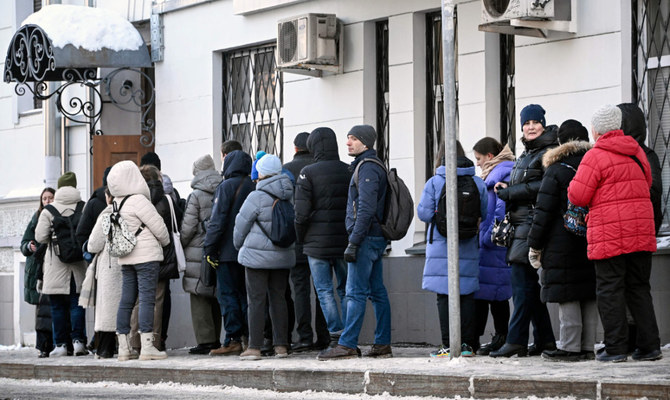
MOSCOW: Queing on a cold winter day in Moscow, Siberian nurse Natalia Avdeyeva said she wanted to make sure at least one opponent to Moscow’s dragging Ukraine offensive was registered for the upcoming presidential election.
A former liberal lawmaker who then moved into political circles accepted by the Kremlin, Boris Nadezhdin has emerged as an unlikely candidate for “peace” ahead of the vote.
Thousands of Russians across the country and abroad have been lining up to register his name to challenge President Vladimir Putin at the ballot box in March.
“I came here to put my signature for Nadezhdin... because he is the candidate who opposes the special military operation,” 53-year-old Avdeyeva said.
“And I want there to be some kind of alternative. All the others (candidates) have the same agenda,” she added.
Nadezhdin — whose name has the Russian word for “hope” in it — has called Putin’s decision to send troops to Ukraine a “fatal mistake” in increasingly vocal and surprising criticism of the Kremlin’s military campaign.
Under Russian electoral law, Nadezhdin needs 100,000 signatures by the end of January to be allowed to run. His website said he had garnered almost 85,000 on Monday evening.
“The main thing that is happening in our country right now is the conflict with Ukraine,” said 37-year-old music teacher Konstantin Filin.
“Nadezhdin is apparently the person that wants to stop it. I am at least pleased that a this many people are ready to get out of their comfort zones and do something,” he said.
Many in the Moscow queue were surprised to see such a turnout, considering that — even with enough signatures to be registered — there is virtually no chance that Nadezhdin could become Russian leader.
Putin, who is 71 years old and has held power since 2000, is running for a fifth Kremlin term that will extend his rule until at least 2030.
The vote will take place more than two years into Russia’s seismic offensive, which has been accompanied at home with a huge crackdown on dissent.
“Putin has made a fatal mistake to start the special military operation,” 60-year-old Nadezhdin has said.
He even went as far as saying: “Putin sees the world in the past and is dragging Russia into the past.”
The statements are exceptional in Russia, which has handed jail terms for similar publicly expressed views and banned criticism of the offensive.
Since the weekend, thousands of Russians have queued in a bid to meet the criteria for Nadezhdin to run.
The door of his Moscow headquarters had the slogan: “Push the door into the future.”
All the other candidates that will face Putin have declared their support for the Ukraine campaign.
Those who did not — like city councillor and pro-peace politician Yekaterina Duntsova — were barred from the vote.
Duntsova called on her supporters to back Nadezhdin after authorities refused to register her.
Maria Feldman, a 20-year-old artist in the Moscow line, had followed Duntsova’s call.
“I trust her a lot and I think that now, he (Nadezhdin) is the best choice of all,” she told AFP.
“He is for freedom of speech and a peaceful sky over our heads,” she added.
Nadezhdin once had a seat in Russia’s lower house of parliament, the Duma.
He used to be close to Boris Nemtsov, the Russian liberal opposition assassinated in 2015, before moving into political circles more closely aligned to the Kremlin.
Despite knowing that Nadezhdin has virtually no chance to become Russian leader, those who queued saw a rare chance to publicly show that they do not support the course Russia has taken.
“It is a possibility to show the state and those who count our votes our position,” said 42-year-old lawyer Pavel, who refused to give his last name.
“In any case, our signatures will be noticed.. I think that’s important.”


![]()

Russians queue to register candidate opposed to Ukraine offensive
Short Url
https://arab.news/zzv5v
Russians queue to register candidate opposed to Ukraine offensive
- The vote will take place more than two years into Russia’s seismic offensive, which has been accompanied at home with a huge crackdown on dissent


Latest updates




© 2026 SAUDI RESEARCH & PUBLISHING COMPANY, All Rights Reserved And subject to Terms of Use Agreement.