

China says supports Iran, Pakistan in continuing to ‘bridge differences through dialogue’

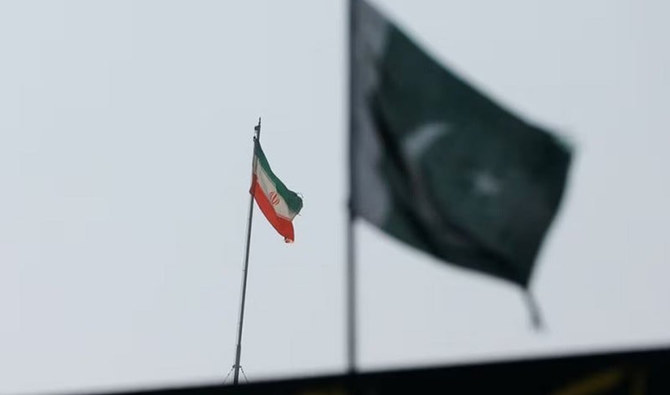
The flag of Iran is seen over its consulate building, with Pakistan's flag in the foreground, in Karachi, Pakistan on January 18, 2024. (REUTERS/File)
Short Url
Updated 22 January 2024
Follow

China says supports Iran, Pakistan in continuing to ‘bridge differences through dialogue’

  • South Asian nations are moving to mend ties after exchanging military strikes last week
  • China, close to both countries, had from the beginning of standoff said it could mediate

ISLAMABAD: China said on Monday it supported Pakistan and Iran in “bridging differences through dialogue and consultations,” as the two South Asian nations move to mend ties after exchanging military strikes last week.

Last week Islamabad said it had hit bases of the anti-Pakistan, separatist Balochistan Liberation Front and Balochistan Liberation Army, after Tehran said its missiles struck militants from the ‘Iranian terrorist group,’ Jaish al Adl (JAA). The tit-for-tat strikes by the two countries were the highest-profile cross-border intrusions in recent years and raised alarm about wider instability in the region since the war between Israel and Hamas erupted on Oct. 7. The two Muslim nations have had a history of frosty ties but the intrusions amounted to the highest level of attacks in decades.

China, close to both countries, from the beginning of the standoff said it was ready to mediate.

“I want to stress that Pakistan and Iran are friendly neighbors, and both are good friends of China. China is committed to upholding regional and international peace and stability and supports Iran and Pakistan in continuing to bridge differences through dialogue and consultation,”

“We would like to continue to play a positive and constructive role in improving the relations between Iran and Pakistan based on the needs of the two countries.”

After Iran’s attack, Pakistan had recalled its ambassador to Tehran and had not allowed his counterpart to return to Islamabad, as well as canceling all high-level diplomatic and trade engagements.

On Monday, Pakistan and Iran announced in a joint statement ambassadors of both countries had been asked to return to their posts by Jan. 26 while the Iranian foreign minister would visit Pakistan on Jan. 29.


Separated twice: An Afghan man’s life in Pakistan and the fear of losing home again

Updated 27 January 2026
Follow

Separated twice: An Afghan man’s life in Pakistan and the fear of losing home again

  • Lost as a child in Peshawar, Mohammad Rahim Khan built a life in Pakistan but remains undocumented
  • Deportation drive of ‘illegal’ foreigners exposes legal gaps around adoption, marriage, refugee status

ISLAMABAD: Mohammad Rahim Khan was five years old when he last saw his mother.

It was at the Hajji Camp bus stop in Pakistan’s northwestern city of Peshawar, more than four decades ago. His mother, an Afghan refugee fleeing war, had brought him across the Tari Mangal border in Kurram district and into Pakistan. While waiting at the crowded terminal, Khan wandered to a nearby toy shop. When he returned, she was gone.

He searched for her for two days. She never came back.

A local shopkeeper, Ali Muhammad, took pity on the child and brought him home, promising to help find his family. The temporary shelter became permanent. Khan grew up in Pakistan, adopted informally into the household, and never returned to Afghanistan.

Now 45, he lives on the outskirts of Islamabad in a modest two-room house, working as a daily wage laborer. But a nationwide deportation drive launched by Pakistan in 2023 has placed his entire life under threat.

Since November 2023, authorities have deported nearly 2 million Afghan nationals, targeting those without legal documentation. Khan, who has remained undocumented throughout his adult life, fears he may soon be among them.

“I spoke to my lawyer that I am very worried,” Khan told Arab News. “I love Pakistan.”

A FAMILY WITHOUT PAPERS

Ali Muhammad later married Khan to his daughter, Gul Mina. Together, they have six children, four daughters and two sons. Yet despite decades in Pakistan, Khan’s Afghan nationality continues to shadow the family.

Khan never held an Afghan refugee card, Afghan Citizen Card (ACC), Proof of Registration (POR), or any other formal documentation. His family assumed for decades that his informal adoption, marriage to a Pakistani citizen, and long residence would provide sufficient legal standing. They only sought legal advice when the deportation drive began threatening separation.

Without a Pakistani national identity card, his children cannot obtain Form-B, the birth registration document required for school enrolment.

“They [children] are told to get a Form-B,” Gul Mina told Arab News. “Otherwise, they will not go to school.”

Three of their daughters were forced to leave school after eighth grade.

Healthcare has also been affected. When Khan’s 13-year-old son, Ehsanullah, fractured his arm, a public hospital refused to issue a registration card without identity documents.

“Then I went to a [private clinic] in Chak Shahzad and got my treatment there,” Khan said.

The family has petitioned the Islamabad High Court to block his deportation. Lawyers say the case highlights how thousands of long-term residents fall through legal cracks created by Pakistan’s citizenship, refugee and documentation framework.

LEGAL GREY ZONE

Pakistan does not legally recognize Western-style adoption. Instead, it uses a guardianship system under the 1890 Guardians and Wards Act, aligning with Islamic principles that preserve lineage, so adopted children don’t inherit or change their family name but receive care, education and welfare through court-appointed guardianship.

“Because we don’t have a legal pathway for adoption per se, the adopted child does not get citizenship of the adopting parents automatically,” said Advocate Umer Ijaz Gillani, a legal expert on citizenship.

Years earlier, Khan’s father-in-law had offered to register him as his biological son to obtain identity documents, but Khan refused, calling the move fraudulent. Because Khan later married his father-in-law’s daughter, both he and his wife cannot legally list the same person as their father on official records, leaving them without a lawful workaround.

Marriage offers no certainty either. Pakistan’s Citizenship Act of 1951 grants citizenship to foreign women married to Pakistani men, but is silent on foreign husbands married to Pakistani women.

While higher courts have, at times, ruled in favor of such men, implementation has been inconsistent. In October 2025, the Supreme Court struck down a high court order that had directed authorities to grant citizenship to an Afghan man married to a Pakistani woman.

Even the Pakistan Origin Card (POC), a long-term residency document, remains difficult to secure.

“We have experienced that in the case of especially Afghan men who marry Pakistani women, the government authorities are often reluctant to recognize this right,” Gillani said.

According to submissions made by government officials in court, authorities have received at least 117 applications for nationality from Afghan men married to Pakistani women following directives issued by the Peshawar High Court, reflecting a broader pattern rather than isolated cases.

‘NO RELAXATION’

Officials say the deportation policy allows no exceptions.

“No relaxation has been granted by the government, including for those who’ve married to Pakistani citizens,” said Asmatullah Shah, the chief commissionerate for Afghan refugees.

“If they want to live here, they should go back and apply for a visa and then they can come here with valid documentation.”

Legal experts note that deportation would send Khan to Afghanistan despite having no known relatives there, and that returning legally would require obtaining an Afghan passport and a Pakistani visa, costs far beyond the means of a daily wage laborer.

For Khan’s mother-in-law, Husn Pari, who raised him for decades as her own son, the prospect is devastating.

“When I am not able to meet [Khan] for one day, my day does not pass,” she said. “His own mother, how much pain must she be in?”

For Khan, the fear of deportation echoes the trauma of his childhood.

“Before I was separated from my first mother,” he said. “The second time I will be separated from my second mother. This is very difficult for me.”