

Hundreds of thousands protest against far right in Germany

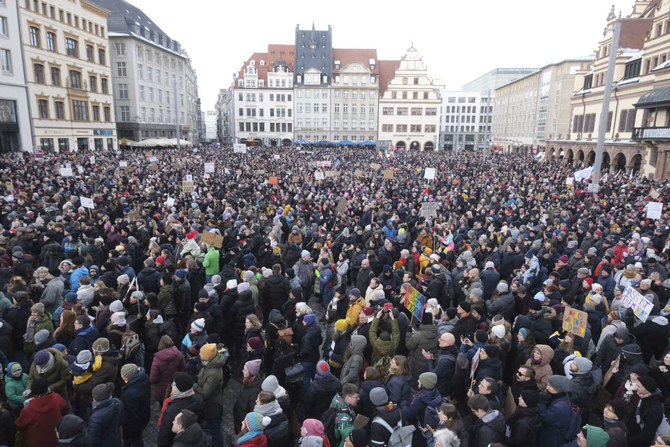
Thousands gather to demonstrate against right-wing extremism, in the market square in Leipzig, Germany, Sunday Jan. 21, 2024. Thousands of people are expected to protest the far right in cities across Germany. (AP)
Short Url
Updated 22 January 2024
Follow

Hundreds of thousands protest against far right in Germany

  • Around 100,000 had turned up for the protest, according to local police, four times as many as were registered for the event

MUNICH, Germany: Hundreds of thousands joined rallies against the far-right AfD party in Germany on Sunday, capping a week-long wave of protest that has seen demonstrators turn out in unusually large numbers across the country.
Between Friday and Sunday alone, protests were organized in some 100 locations, with organizers Campact and Fridays for Future estimating that over 1.4 million people had gone out into the streets to send a “signal against the AfD and the rightwards drift in German society.”
The influx of demonstrators was so large in Munich on Sunday that organizers were forced to cancel a planned march and ask people to disperse for safety reasons.
Around 100,000 had turned up for the protest, according to local police, four times as many as were registered for the event.
Another 100,000 people gathered to protest in Berlin on Sunday evening, according to police figures cited by regional broadcaster RBB.
The wave of mobilization against the far-right party was sparked by a January 10 report by investigative outlet Correctiv, which revealed that AfD members had discussed the expulsion of immigrants and “non-assimilated citizens” at a meeting with extremists.
Among the participants at the talks was Martin Sellner, a leader of Austria’s Identitarian Movement, which subscribes to the “great replacement” conspiracy theory that claims there is a plot by non-white migrants to replace Europe’s “native” white population.

News of the gathering sent shockwaves across Germany at a time when the AfD is soaring in opinion polls, just months ahead of three major regional elections in eastern Germany where their support is strongest.
The anti-immigration party confirmed the presence of its members at the meeting, but has denied taking on the “remigration” project championed by Sellner.
Protests against the AfD and the far-right thinking behind the deportation plan first came together last weekend in Berlin and Potsdam, where the extremist meeting was held, and have gathered pace since.
On Sunday, demonstrators in the capital carried signs with slogans such as “no place for Nazis,” and waved their phone lights together in front of the German parliament.
“It’s good that something finally happened, that the silent majority isn’t so silent anymore,” IT worker Lydia Steffenhagen told AFP at the protest in Berlin.
In Dresden, the capital of the eastern region of Saxony, where the far-right party is leading in the polls, authorities had to alter the course of a protest march.
The procession was lengthened to make space for an “enormous number of participants,” police said on X, formerly Twitter.
Organizers estimated 70,000 people had joined a protest in Cologne, while in Bremen, local police said 45,000 people had turned out in the center to demonstrate.

Katrin Delrieux, 53, said she hoped the protests against the far right would “make a lot of people rethink” their positions.
“Some might not be sure whether they will vote for the AfD or not, but after this protest they simply cannot,” she told AFP in Munich.
Politicians, as well as church leaders and Bundesliga football managers have called on people to take a stand against the far right.
Chancellor Olaf Scholz, who joined a demonstration last weekend, said any plan to expel immigrants or citizens alike amounted to “an attack against our democracy, and in turn, on all of us.”
He urged “all to take a stand — for cohesion, for tolerance, for our democratic Germany.”
Interior Minister Nancy Faeser went so far as to say in the newspapers of the Funke press group that the far-right meeting was reminiscent of “the horrible Wannsee conference,” where the Nazis planned the extermination of European Jews in 1942.
The protests against the far right could “restore trust in democratic conduct,” Josef Schuster, the head of the Central Council of Jews in Germany, told broadcaster Welt TV.
Jews in the country had felt “huge uncertainty” added to by a wave of anti-Semitic incidents following the start of the Israel-Hamas war, Schuster said.


Guinea’s tough new migration route for desperate young west Africans

Updated 1 sec ago
Follow

Guinea’s tough new migration route for desperate young west Africans

CONAKRY: With a determined look on her weathered face, Safiatou Bah has made up her mind: she will leave her young children behind and migrate to Europe on a new and perilous ocean route from Guinea.
Thousands of young Guineans have attempted to migrate via the Atlantic in recent years, a flow so severe that authorities in the junta-led country have dubbed it a “haemorrhage.”
Lacking both economic opportunity and any hope of change, the migrants are leaving from their own shores after neighboring Senegal and Mauritania and Morocco further north, beefed up controls.
However the longer voyage which begins farther south only increases the number of dangers they will face.
Most west Africans traveling the Atlantic route embark in pirogue canoes toward Spain’s Canary Islands off northwest Africa, the jumping off point for their continued journey to the European continent.
At least eight boats have left Guinea since the spring, each carrying more than a hundred people, according to migration NGOs.
Bah, 33, initially left her village for the capital Conakry where she tried to do NGO work that didn’t pan out. In the end, she started a fruit stand to make money to migrate.
Her husband, whom she was married off to at age 18, is now 75 and can no longer provide for the family.
“I’m the one raising my children alone,” Bah told AFP.
Her decision to leave her three children, age 11 to six months, with her mother is firm: “I’m suffering here. You struggle and there’s no one to support you,” she said.

- New route -

Due to increasingly restrictive visa policies in Europe, migrants say their only option is illegal migration.
The Spanish NGO Caminando Fronteras, which monitors migration, confirmed the existence of the new Guinean route to AFP as well as the significant number of people taking it.
Guineans are now the leading African nationality — and the third largest group after Afghans and Ukrainians — to apply for asylum in France, the country’s former colonial ruler.
In 2024 a total of 11,336 asylum applications were made, according to France’s refugee agency OFPRA.
Mamadou Saitiou Barry, managing director of the Directorate General for Guineans Living Abroad, confirmed that “several thousand” Guineans embark on the journey each year.
“We are aware of this, because it is us who lose our sons and these young people,” he said.
Meanwhile Guinea has increased policing measures in an attempt to staunch the outward flow.
Elhadj Mohamed Diallo, director of the Guinean Organization for the Fight Against Irregular Migration (OGLMI), deals with these young people on a daily basis.
“When you tell them that the route is dangerous, most reply: ‘Where we are, we are actually already dead,’” he said, adding that they believe it is better to try.
Even among those with an education, finding a job can be an impossible task.

- Scarring journey -

Abdourahim Diallo, a young father of two, cannot find work and has lost all hope in his country, much like Bah.
AFP met him at a gathering of dozens of young people in Conakry’s Yattaya T6 suburb, in an unelectrified shack being used as a cafe.
“Here we have more than 150 young people and none of them has a job,” Ibrahima Balde, head of a neighborhood young people’s association, told AFP.
Diallo, who said he has “a lot of family who are counting on me,” is preparing to migrate for the fourth time.
His shocking prior attempts, which left him with physical — and no doubt psychological — scars, span 2011 to 2024, leading him through Mali, Algeria and Morocco.
He spent five years surviving in Morocco’s Gourougou forest, which overlooks the Spanish enclave of Melilla.
Thousands of migrants from sub-Saharan Africa seeking to enter the enclave eke out a living in the surrounding woods.
To reach the area and escape authorities, one must jump from a moving train, according to Diallo, who said “some break their feet while others die.”
In December 2011 he injured his head after attempting, along with hundreds of others, to scale the Melilla fence.
Another time he nearly died when his pirogue capsized off Morocco.
Overall, he said, he has lost count of the arrests in Morocco, extortion by various police, and robberies along the way.
Next door to the cafe, 30-year-old Mamadou Yero Diallo is bent under the hood of a car in his garage.
“We manage, we earn a little for food, nothing more,” he said, insisting he too will attempt the Atlantic route later this year.
As for Bah, she became less confident in her upcoming journey when speaking about conversations she has had with those who returned.
“There are so many risks,” she said, adding that she has heard of migrant women being raped.
“But I’m still going,” she said. “I ask God to protect me.”