Russia-bound aircraft from India crashes in Afghanistan

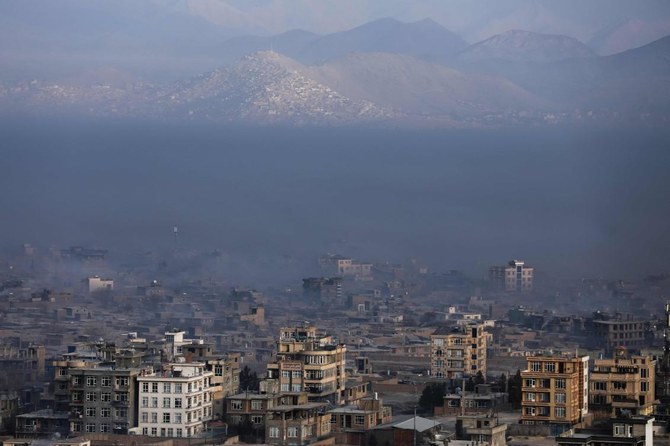
A general view of fog laden west Kabul on January 19, 2024. (Photo by Omer ABRAR / AFP)
Short Url
Updated 21 January 2024
Follow

Russia-bound aircraft from India crashes in Afghanistan

  • Plane went missing in Badakhshan province, which borders China, Tajikistan, Pakistan
  • Private jet was charter ambulance flight traveling from India via Uzbekistan to Moscow

KABUL: A Russian-registered private plane carrying six people is believed to have crashed in a remote area of Afghanistan, the Ministry of Transport and Civil Aviation said on Sunday.

The crash took place on Saturday night in a mountainous area near Zebak district in the northeastern Badakhshan province, which borders China, Tajikistan, and Pakistan.

“According to initial information, a Falcon 10 Russian private jet plane carrying six crew and passengers was heading to Tashkent (the capital of Uzbekistan) from India yesterday at 7 p.m.

“Due to some technical problem, the plane lost its signal. Possibly when it was over the outskirts of Zebak and Kuran wa Munjan districts of northeastern Badakhshan province, it got lost and crashed,” Imamuddin Ahmadi, civil aviation ministry spokesman, told Arab News.

Ahmadi said the ministry had dispatched a team to investigate the incident and that more details would follow.

The mighty Hindu Kush mountain range cuts through the rural Afghan province, which is home to the nation’s highest mountain, Mount Noshaq, at 7,492 meters high.

Russian aviation authorities said in a statement that the plane was a charter ambulance flight traveling from the Indian city of Gaya, via Uzbekistan, to Moscow on a French-made Dassault Aviation Falcon 10 manufactured in 1978.

“On the evening of Saturday, Jan. 20, while in the airspace of Afghanistan (near the border of Tajikistan), the Falcon 10 aircraft, registered in the state register of civil aircraft of the Russian Federation, stopped communicating and disappeared from radar screens,” the statement added.

“There were six people on board the plane – four crew members and two passengers.”

Russian authorities also said they were in contact with their Afghan and Tajikistan counterparts.

“The search for the aircraft is underway.”


Report highlights role of British Muslim charitable giving in supporting UK public services

Updated 05 December 2025
Follow

Report highlights role of British Muslim charitable giving in supporting UK public services

  • The study, “Building Britain: British Muslims Giving Back,” finds that donations from British Muslims are helping to bolster overstretched service

LONDON: British Muslim charitable giving is playing an increasingly significant role in supporting frontline public services across the UK, according to a new report by policy and research organization Equi.

The study, “Building Britain: British Muslims Giving Back,” finds that donations from British Muslims are helping to bolster overstretched services, including local councils, the NHS and welfare systems, at a time of growing financial pressure.

The report estimates that Muslim donors contribute around £2.2 billion ($2.9 billion) annually, making them the UK’s most generous community.

This figure is around four times the national giving average and rises to almost 10 times the average among higher earners.

According to the findings, Muslim-led charities are providing a wide range of support, including housing assistance, emergency cash grants, food provision and mental health services, easing demand on statutory services.

Equi points to evidence from 2023 showing that housing support delivered by the National Zakat Foundation helped prevent evictions that would have cost councils an estimated £28.8 million, with every £1 of charitable spending generating £73 in public sector savings.

The report also highlights a generational shift, with younger British Muslims increasingly directing their donations toward domestic causes such as homelessness, child poverty and mental health challenges.

Despite their growing impact, Muslim charities face a number of barriers, including de-banking, restrictive funding rules, securitization measures and what the report describes as limited recognition from government. Equi argues that these challenges are constraining the sector’s ability to maximize its contribution.

“British Muslim giving is not just generosity but a lifeline for public services that needs recognizing,” said Equi Managing Director Prof. Javed Khan.

“From preventing evictions to supporting mental health, these donations are saving millions for the taxpayer and strengthening communities across Britain. The evidence is clear that Muslim-led action is delivering frontline support where the state is struggling,” he added.

Equi is calling on policymakers to engage more closely with Muslim-led charities and to move beyond what it describes as symbolic recognition.

The report recommends measures such as UK-based match-funding schemes and greater faith literacy within policymaking, which it says could unlock billions of pounds in additional domestic spending while maintaining the UK’s global humanitarian commitments.

The study concluded that with greater collaboration between government and Muslim charities, charitable giving could play an even more transformative role in strengthening public services and social cohesion across the country.