

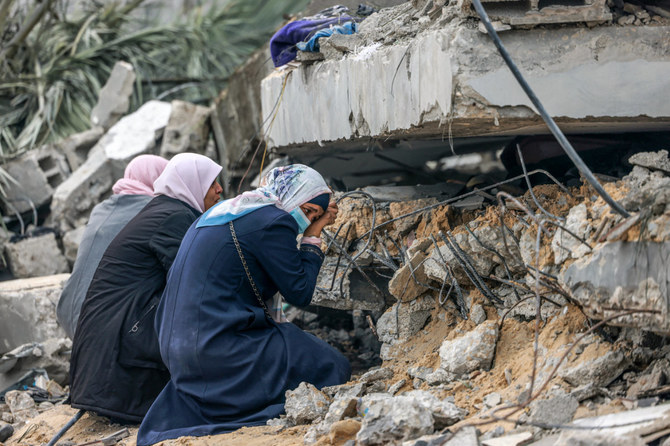

NEW YORK CITY: About 70 per cent of the people killed during the war in Gaza were women and children, and on average two mothers have lost their lives every hour since the conflict began, UN Women said on Friday.
The agency called for an immediate ceasefire and no effort to be spared to ensure women and girls receive proper protection and have safe access to fast, unrestricted and “gender-responsive” humanitarian assistance.
“At least 24,620 Palestinians have been killed in Gaza, about 16,000 of whom were women or children,” said Sima Bahous, the executive director of UN Women. This is three times the number of people killed in the territory in the previous 15 years combined, she added.
“It is now more than 100 days since the horrors of the Hamas attacks on Israel of Oct. 7 and the horrors that have followed, especially in Gaza,” and evidence continues to emerge that women and children are the “first victims of conflict,” she said.
“We are failing them. That failure, and the generational trauma inflicted on the Palestinian people over these 100 days and counting, will haunt all of us for generations to come. Without change, these last 100 days, (which) have seen unparalleled destruction rained on the people of Gaza, will be mere prelude to the next 100.
“However much we mourn the situation of the women and girls of Gaza today, we will mourn further tomorrow, without unrestricted humanitarian assistance and an end to the destruction and killing.”
Bahous said women and girls in Gaza are being deprived of safety, medicine, healthcare and shelter, they face imminent starvation and famine and, most of all, they are deprived of hope and justice.
A “gender alert” issued by UN Women on the effects of the crisis in Gaza on women and girls said that the majority of those killed, wounded or displaced in the territory are female. It found that of the 1.9 million people who have been displaced, nearly 1 million are women and girls. They are forced to seek refuge in precarious shelters at a time when “nowhere and no one is safe in Gaza.”
It added: “The impossible decisions regarding whether to evacuate, how and when to do so, and where to go, are entrenched with gender-differentiated fears and experiences, as gendered risks, including attacks and harassment, emerge along displacement routes.”
UN Women estimates that at least 3,000 women have become widows and the heads of their households during the conflict and are in urgent need of protection and food assistance, and at least 10,000 children have lost their fathers. There are fears that many such families will need to resort to desperate coping mechanisms, including early marriage.
The agency also reiterated its “deep concern at the accounts of unconscionable sexual violence and other gender-based violence during the Oct. 7 attacks.” It repeated its calls for those responsible to be held accountable, for all of those affected to receive justice and support, and for the immediate and unconditional release of all Israeli hostages held by Hamas.
“We unequivocally condemn all acts of sexual and gender-based violence wherever, whenever and against whomever they are perpetrated,” said Bahous. “I call again for accountability for all those affected by the Oct. 7 attacks.
“It is also more than 100 days that the families of those held hostage in Gaza (have) waited in unimaginable pain for those they love to return to them. Their courage in the face of suffering and their commitment to peace is humbling. I call again for all hostages to be released immediately and unconditionally.”
She also repeated a plea for an immediate humanitarian ceasefire and unrestricted humanitarian access to be granted so that aid can reach all the people of Gaza, including vital assistance and services for women and girls.
“This is a time for peace,” said Bahous. “We owe this to all Israeli and Palestinian women and girls. This is not their conflict. They must no longer pay its price.”


